Part 2: The Door Major Wouldn’t Let Anyone Open
Part 2: The Door Major Wouldn’t Let Anyone Open
Eli refused to explain the key until we reached his grandfather’s farmhouse.
The place looked exhausted.
Peeling white paint. Sagging porch. Uncut grass.
Eli knocked three times.
“Grandpa?”
No answer.
Then Major growled.
Not at us.
At the house.
We found Arthur Turner sitting asleep in the kitchen with an untouched bowl of soup beside him. The seventy-six-year-old woke confused and called Eli by his father’s name.
That told me enough.
This kid wasn’t simply feeding nine abandoned dogs.
He was trying to take care of an elderly man whose memory was disappearing.
Eli led us upstairs.
At the end of the hallway stood a locked bedroom.
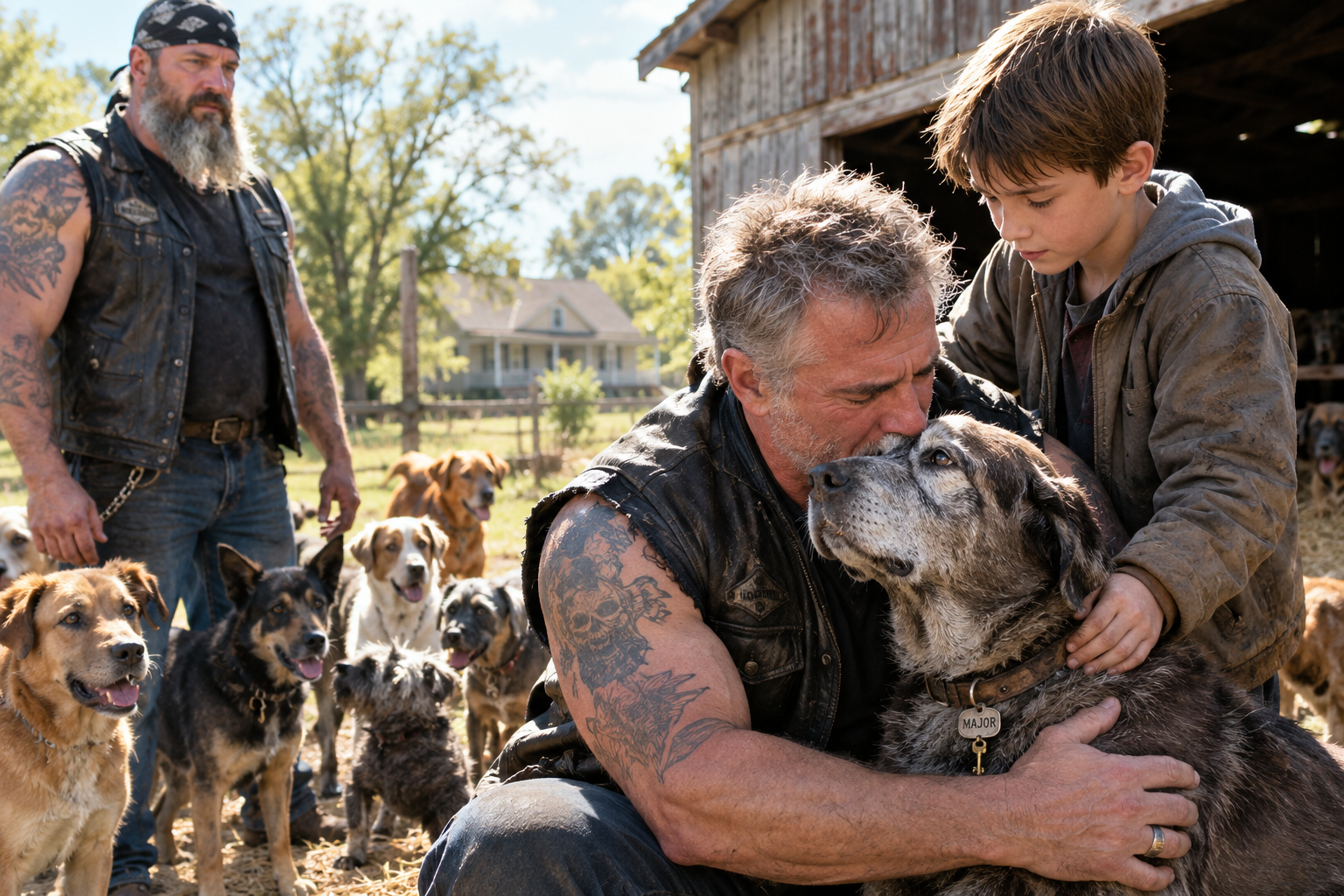
Major planted himself in front of it.
“What’s inside?” I asked.
Eli shook his head.
“Grandpa keeps trying to open it. Major stops him.”
Arthur suddenly appeared behind us.
His face changed when he saw the brass key.
“Tom?”
Cole and I exchanged looks.
“Tom Bennett?” Cole asked.
Arthur nodded.
“The motorcycle man.”
Then pieces began coming back.
During the flood, water had reached Arthur’s property before emergency crews arrived. Arthur had been trapped downstairs after falling.
Tom Bennett found him.
Tom got Arthur outside, then returned because Arthur kept screaming about his grandson.
But Eli wasn’t there.
The boy had already gone searching for abandoned animals.
Before Tom rode away, he left something with Arthur.
“Safe,” Arthur whispered.
We opened the bedroom.
Inside stood an old metal lockbox.
The brass key fit.
Cole’s hands trembled as he lifted the lid.
There was no money.
No weapon.
No mysterious fortune.
Inside were Tom’s wallet, damaged phone, photographs, and a small waterproof notebook.
Arthur had apparently found the items tangled in flood debris near Tom’s overturned motorcycle days after the water receded.
His worsening memory meant he never delivered them.
But Major remembered the room.
That was why he guarded it.
Cole opened the notebook.
Most pages contained phone numbers, motorcycle maintenance notes, and names of families Tom had checked during the flood.
The final readable page stopped us cold.
Nine addresses were written there.
Beside several were short notes:
DOG STILL THERE.
OWNER EVACUATED.
COME BACK.
Eli stared at the page.
Slowly, he began recognizing locations.
The trailer park.
The collapsed porch.
The fence where he’d found Daisy.
The abandoned farmhouse where he’d found Buster.
The dogs Eli had been rescuing for two years were some of the same animals Tom had been trying to reach during his final hours.
Cole sat on the bed.
Major rested his head against Cole’s knee.
For two years, an eleven-year-old boy had unknowingly finished our brother’s last unfinished job.
But that didn’t mean we could simply leave everything as it was.
Eli needed help.
So did Arthur.
And nine dogs living secretly inside a collapsing barn needed proper care.
We contacted the appropriate county services and a local senior-support organization. Arthur received a medical evaluation and in-home assistance while relatives were located. Eli wasn’t treated like a criminal for trying to keep everyone alive; adults finally began addressing responsibilities no child should have been carrying alone.
A veterinarian examined every dog.
The Iron Ravens paid the bills.
Several animals were eventually adopted into carefully screened homes.
Three stayed with Eli and Arthur once their living situation was stabilized.
And Major?
Cole wanted him desperately.
But he looked at Eli and understood.
“Who does he sleep beside?”
“Me.”
“Who feeds him?”
“Me.”
“Who did he choose when nobody else came?”
Eli’s eyes filled.
Cole handed him the collar.
“Then he’s already home.”
Months later, we rebuilt the old tobacco barn into a small foster space operated with a legitimate rescue organization.
Above the entrance hung a simple wooden plaque:
BENNETT’S BARN
No dramatic slogan.
Tom wouldn’t have liked one.
Eli never stole dog food again.
Every month, motorcycles rolled up carrying bags of it.
And Major spent his final years lying beside the barn door, watching Eli work.
When Major eventually died, Cole buried Tom’s old collar beside him.
But he gave the brass key to Eli.
“Why me?” the boy asked.
Cole looked around at the dogs sleeping safely inside.
“Because Tom started opening doors for things nobody else noticed.”
Then he put his enormous hand on Eli’s shoulder.
“You finished the job.”
Eli had entered that supermarket as a thief with seventy-three cents in his pocket.
But he hadn’t stolen because he wanted something.
He stole because nine hungry animals were depending on an eleven-year-old boy who believed nobody else was coming.
He was wrong.
Sometimes help arrives late.
What matters is that when you finally see someone carrying more than they should, you don’t walk past them.