Part 2: The Coordinates Nobody Checked
Part 2: The Coordinates Nobody Checked
Walter Harper stared at the two maps until his hands began shaking.
The official search grid ended nearly four miles from the coordinates in Daniel Ruiz’s letter.
“Are you telling me my son could have been there?”
Daniel didn’t answer immediately.
“I’m telling you that’s where I last saw Ethan.”
The airport seemed to disappear around us.
Walter looked at me.
“Brick.”
I knew what he wanted.
But I wasn’t going to give him another promise.
“We verify it first.”
Over the next several weeks, the Iron Ravens didn’t storm a military office or threaten anyone. We did something Walter had been trying to do for years.
We organized the evidence.
Captain Aaron Mills and Daniel provided sworn statements. We matched dates, evacuation records, coordinates, and the incorrectly cross-filed reports. A veterans’ legal-aid attorney helped Walter submit the material through the proper channels.
Eventually, the discrepancy reached people who could act on it.
The explanation was painfully ordinary.
Ethan’s operation had involved multiple units operating under changing conditions. After the attack, survivors were evacuated through another command. Their statements were cataloged under that unit’s operation number.
Meanwhile, one coordinate in Ethan’s original incident package had been transcribed incorrectly during the chaotic aftermath.
The original search had not been careless.
It had simply been based on incomplete information.
But incomplete information had left a father standing inside an airport every Friday for six years.
A new recovery review began.
Months passed.
Walter kept waiting.
Every Friday.
Same brown coat.
Same cardboard sign.
The Iron Ravens started joining him.
At first there were three motorcycles outside the terminal.
Then eight.
Then twenty.
Nobody carried banners.
Nobody demanded attention.
We just made sure Walter wasn’t waiting alone.
Eleven months after Daniel handed him that letter, my phone rang at 6:12 on a Tuesday morning.
I rode to Walter’s house.
He opened the door before I knocked.
One look at my face was enough.
“They found him?”
I nodded.
A recovery team examining the corrected area had located remains and equipment associated with the missing operation. Identification took additional time.
Dental records and DNA eventually provided the answer Walter had waited years to receive.
Ethan was coming home.
Walter sat down on his porch.
He didn’t cry immediately.
He simply whispered:
“Evelyn should be here.”
I sat beside him.
For several minutes, neither of us spoke.
Then Walter reached inside his shirt and removed his wedding ring from a chain.
“She knew he’d come home.”
The day Ethan returned, the airport was different.
Military personnel stood along the route.
Aaron and Daniel came back.
So did dozens of Iron Ravens.
Our motorcycles remained silent.
This wasn’t our moment.
It belonged to Walter.
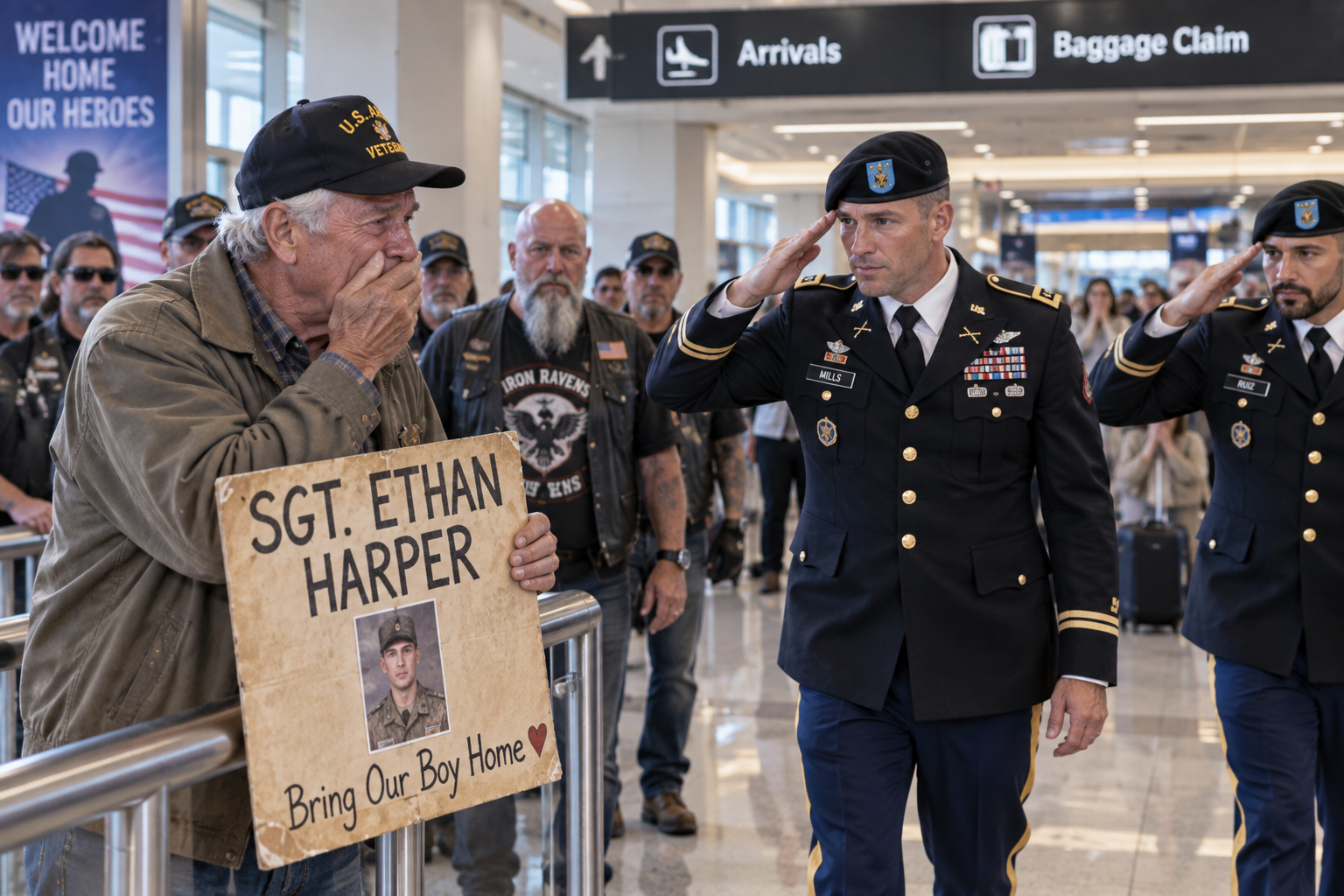
When Ethan’s flag-covered casket appeared, Walter stood exactly where I’d first seen him.
But there was no cardboard sign in his hands.
He didn’t need one anymore.
His boy had finally arrived.
Daniel stepped beside him.
“There was something else you deserved to know.”
Walter looked at him.
Daniel had spent six years remembering Ethan’s final words.
After pulling Aaron and Daniel from the damaged vehicle, Ethan realized another soldier might still be trapped.
Daniel had grabbed his vest.
“Harper, don’t go back!”
Ethan pulled free.
Then he said:
“My dad taught me you don’t count yourself until everybody’s accounted for.”
And he ran back.
Walter closed his eyes.
“That sounds like him.”
“No, sir,” Daniel replied. “He said it sounded like you.”
Walter finally broke.
Not loudly.
He pressed one hand against Ethan’s casket and cried like a father who had spent six years refusing to accept an empty grave.
Before the burial, Walter asked for a private minute.
He placed three things inside with Ethan.
A photograph of Evelyn wearing Ethan’s baseball cap.
A copy of Daniel’s six-year-old letter.
And the yellowed airport sign.
SGT. ETHAN HARPER.
The same cardboard Walter had carried through hundreds of arrivals.
The corners were taped.
The bottom was water-stained.
The letters had been rewritten again and again.
Walter ran his fingers across his son’s name one last time.
“Your mother and I kept our side,” he whispered.
“We waited.”
After the funeral, something unexpected happened.
Walter stopped going to the airport on Fridays.
But the Iron Ravens didn’t stop visiting him.
We repaired his porch.
Aaron called every month.
Daniel brought his wife and the little boy he’d named Ethan to meet him.
Walter eventually hung one photograph in his living room.
It wasn’t Ethan in uniform.
It was Ethan at seventeen, standing beside his father with grease on both hands while they repaired an old motorcycle.
Walter lived another seven years.
When he died, Daniel attended the funeral.
So did Aaron.
So did thirty-one Iron Ravens.
And beside Walter’s casket stood a photograph of that battered airport sign.
People sometimes tell this story as though we helped Walter find his son.
That’s not how I remember it.
Walter had never stopped looking.
All we did was believe that an old man’s unanswered question still deserved an answer.
Because sometimes hope means believing someone will return.
And sometimes it means refusing to let the truth disappear simply because everyone else has gone home.