Part 2: The Door Thomas Mercer Never Came Back to Open
Part 2: The Door Thomas Mercer Never Came Back to Open
Walter locked the janitor’s closet behind him.
Then he led us down a narrow maintenance corridor beneath the rest stop.
Rook followed silently.
At the end stood an old steel cabinet built into the wall.
Walter inserted the brass key.
It turned.
Inside wasn’t money.
There were no weapons. No treasure.
Just a dented metal toolbox, an envelope, several photographs, and an old ledger wrapped in plastic.
Rook immediately recognized the handwriting on the envelope.
His father’s.
WALTER — IF I DON’T COME BACK, GIVE THIS TO MY BOY WHEN HE’S READY.
Rook sat down on an overturned bucket.
His father had died twenty-nine years earlier.
Rook had been sixteen.
“What was this place?” he asked.
Walter smiled sadly.
“More than a rest stop.”
Thirty-four years earlier, Walter had been living out of his car after losing a factory job.
Thomas Mercer found him sleeping behind the building one winter morning.
Thomas didn’t offer him cash.
He offered breakfast.
Then work.
The rest stop manager needed someone for overnight maintenance, and Thomas vouched for a stranger he’d known less than an hour.
Walter eventually became the full-time janitor.
But Thomas kept returning.
So did other Iron Ravens.
The ledger explained why.
Before smartphones, roadside assistance apps, or social media, Thomas had quietly used the rest stop as an informal help point.
Stranded traveler needed gasoline?
Someone wrote it down.
Family needed a motel room after their car broke down?
Written down.
Veteran needed a ride?
Written down.
Every page contained names, dates, and small expenses.
Five dollars.
Twelve dollars.
Twenty-three.
Beside most entries, Thomas had written the same two words:
PAID FORWARD.
Walter looked at Rook.
“Your father never wanted repayment.”
Rook opened the envelope.
The letter inside was short.
Thomas wrote that he worried Rook was growing up believing strength meant never needing anybody.
He wanted his son to understand something he’d learned on the road:
A strong man isn’t the one everybody fears. He’s the one people aren’t afraid to ask for help.
Rook read that sentence twice.
Then Walter pointed toward the bottom of the letter.
There was one final instruction.
If Rook ever gets this, tell him the broom matters more than the bike. He’ll understand eventually.
Rook stared at Walter.
“The broom?”
Walter laughed.
“Your dad used to help me clean this place.”
That explained it.
Thomas Mercer—the man Rook remembered as enormous, loud, grease-covered and nearly impossible to embarrass—had apparently spent countless nights sweeping floors beside a janitor.
Nobody photographed it.
Nobody applauded.
Thomas simply saw work that needed doing.
So he helped.
Behind us, footsteps entered the corridor.
It was the rest-stop manager.
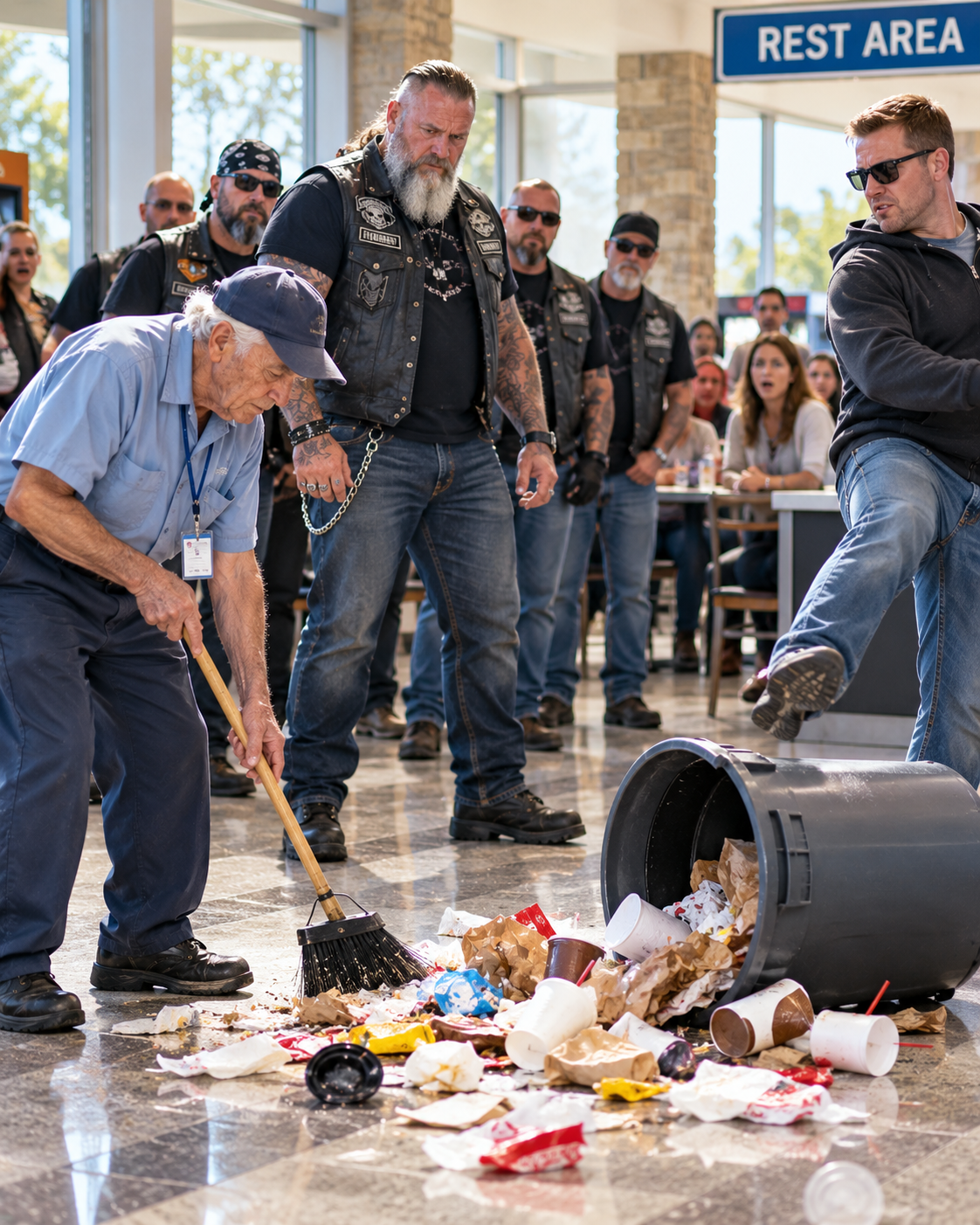
And beside him stood the man who had kicked over Walter’s trash can.
His name was Travis Cole.
The manager had reviewed the lobby security footage after another traveler complained.
Travis suddenly looked far less confident.
Rook stood.
He didn’t threaten him.
Didn’t touch him.
Didn’t even raise his voice.
“Walter spent twenty minutes cleaning that floor.”
Travis shrugged nervously.
“I said it was an accident.”
“No,” the manager said. “The camera says otherwise.”
Travis looked toward Rook, perhaps expecting the biker to do something dramatic.
Rook simply picked up the old broom leaning against the wall.
Then he held it out.
Travis stared at it.
“What?”
Rook didn’t answer for Walter.
He looked at the janitor.
Walter considered the situation.
Then he said, “You made the mess. You can help clean what still needs cleaning.”
Travis’s face reddened.
But with the manager standing there and the incident already documented, the performance was over.
He took the broom.
Nobody cheered.
Nobody humiliated him.
Walter simply showed him where the cleaning supplies were.
That mattered to Rook.
Because his father hadn’t left him instructions about punishing people.
He’d left him instructions about helping them become better.
Rook took the toolbox and letter home.
The ledger stayed with Walter until it could be copied and preserved.
The following month, the Iron Ravens returned.
Not for the hidden cabinet.
They came carrying cleaning supplies.
Coffee.
And a new wooden bench for travelers waiting on rides.
Then they started something Thomas would have recognized immediately.
A small roadside assistance fund.
No giant checks.
No publicity campaign.
Just fuel cards, emergency motel assistance, rides to repair shops, and help connecting stranded travelers with legitimate services.
They called it the Mercer Road Fund.
Walter hated the name.
“He would’ve hated it too,” Walter complained.
“That’s why we picked it,” Rook said.
Walter laughed.
He retired the following year.
At his final shift, seventeen Iron Ravens arrived.
Walter expected speeches.
Instead, Rook handed him his old broom.
Every biker had signed the handle.
Walter looked at it for a long time.
Then he found Rook’s message:
THE BROOM MATTERED MORE. I FINALLY UNDERSTAND.
Walter’s eyes filled.
Years later, people still told the story incorrectly.
They said a huge biker once confronted a man who deliberately kicked trash across a freshly cleaned floor.
That wasn’t what Rook remembered.
He remembered an eighty-year-old janitor bending down without complaint.
He remembered seven bikers choosing to help instead of perform.
And he remembered discovering that his father’s greatest legacy wasn’t hidden inside a steel cabinet.
It had been lying in plain sight.
Sometimes strength isn’t the hand that can throw a punch.
It’s the hand willing to pick up the broom.