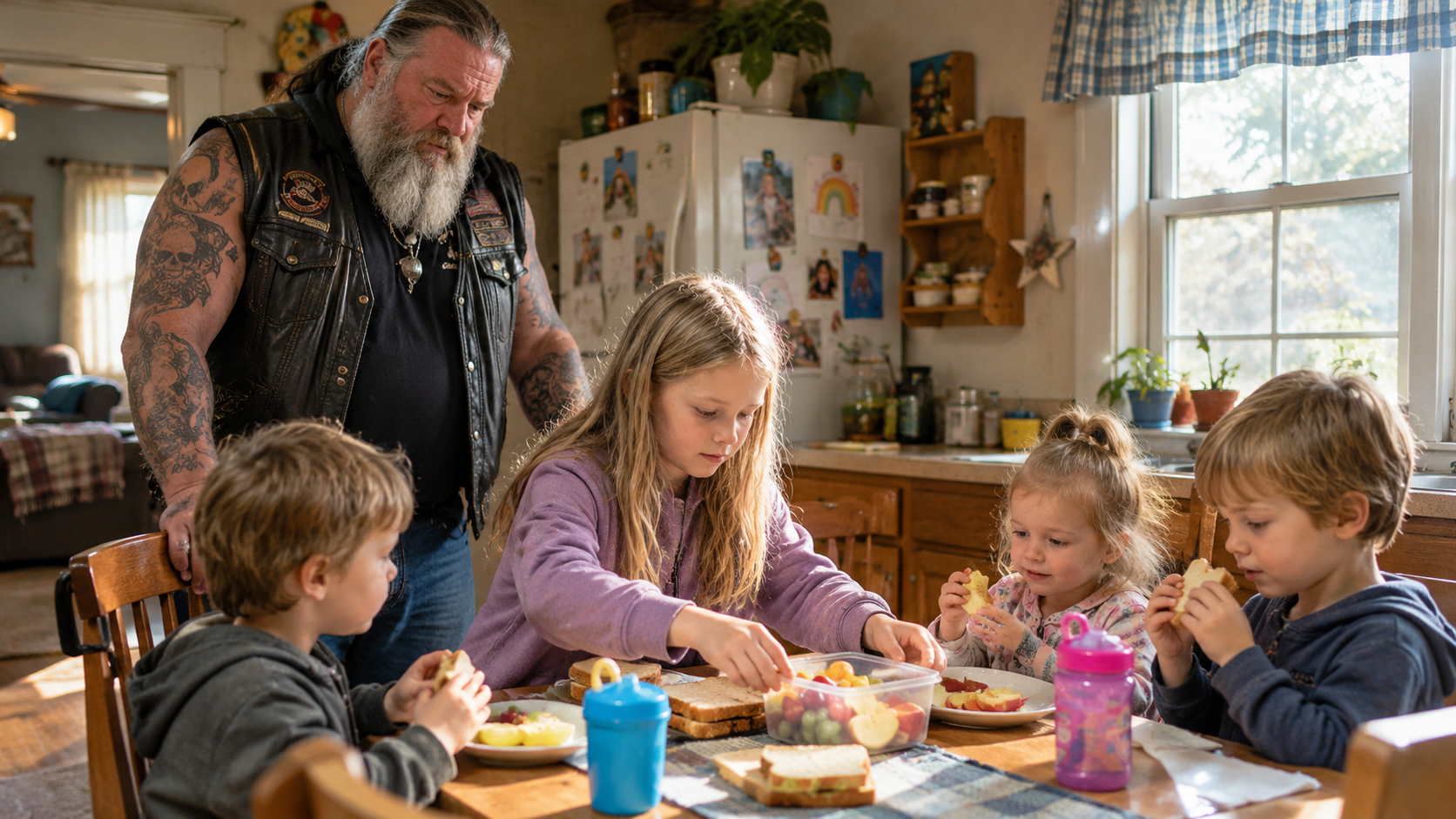
Part 2: The Mother Who Had Been Trying to Get Home
Part 2: The Mother Who Had Been Trying to Get Home
The call came from an old Iron Ravens brother named Cole Maddox.
“Rook, I found Emma’s mother.”
I stepped onto the porch so the children wouldn’t hear.
“Where?”
“West Virginia. Construction camp outside Charleston.”
“Why hasn’t she come home?”
Cole went quiet.
“She hasn’t been paid in almost three months.”
Her name was Rachel Carter.
After their father died, Rachel had taken temporary construction work because it paid better than anything she could find near home. She arranged for a woman she trusted to watch the children and sent money every week.
Then the contractor began delaying wages.
One missed paycheck became two.
Then three.
Rachel’s bank account emptied.
The babysitter apparently took the last household cash and disappeared.
Rachel didn’t know.
She had been calling an old prepaid phone that was no longer working.
When Rachel finally tried to leave the job, she discovered another problem: she had no money for transportation, and the company-provided ride that had brought workers to the remote site wasn’t available for an early return.
She wasn’t physically imprisoned.
But being 250 miles from home with no wages, little cash, and no reliable transportation can become its own kind of trap.
She had spent eleven days asking coworkers for rides and trying to reach home.
That distinction mattered.
So did what happened next.
We didn’t ride onto the construction site and threaten anyone.
We contacted the appropriate authorities and a worker-support attorney. Several employees had kept timesheets, messages about delayed payroll, and photographs of posted work schedules.
Those records mattered more than forty motorcycles ever could.
Meanwhile, the children’s situation had to be handled properly.
The school counselor contacted child-welfare professionals. A maternal aunt was located two counties away and agreed to come immediately. Emergency food and medical evaluations were arranged.
Emma fought every step.
“They’ll separate us.”
I knelt in front of her.
“Look at me.”
Her eyes were swollen from crying.
“You kept them together when there was nobody else.”
She gripped Lily’s hand.
“But now there are adults here.”
“I am an adult.”
That nearly broke me.
“No, kid.”
I shook my head.
“You’re seven.”
For the first time, Emma didn’t argue.
Rachel arrived the following afternoon.
The Iron Ravens didn’t escort her with roaring engines.
Cole drove her home in his pickup.
When the blue door opened, Emma stood perfectly still.
Rachel ran inside.
She dropped her bag before reaching the living room.
“Mommy!”
The younger children rushed her.
Emma didn’t.
She remained beside the kitchen table.
Rachel looked at her oldest daughter.
Then she saw the plastic lunch container.
The same scratched blue box Emma had carried to school every morning.
Rachel understood.
“Oh, baby.”
Emma’s chin trembled.
“I gave Lily the milk.”
Rachel crossed the room.
“I know.”
“And Ben and Tyler got the bread.”
“I know.”
“I wasn’t hungry.”
That was the lie Emma had practiced for nine days.
Her mother pulled her close.
Emma held herself together for perhaps three seconds.
Then she started sobbing.
“I was hungry, Mommy.”
Every adult in that room looked away.
Rachel sank to the floor with her daughter in her arms.
“You never have to hide being hungry from me.”
Over the following weeks, the family’s problems didn’t magically disappear.
But they became adult problems again.
The wage dispute moved through the appropriate legal and labor channels. Rachel and other workers used their payroll records and timesheets to pursue the money they said they were owed.
Locally, Rachel found work that allowed her to remain near the children. Her sister helped with childcare while the family stabilized.
The Iron Ravens contributed groceries through a community food program rather than leaving envelopes of cash on the porch.
And Mrs. Alvarez changed something at school.
She worked with administrators so children experiencing food insecurity could discreetly access additional food without being singled out in front of classmates.
Emma slowly gained weight.
Then one Friday, I visited Lincoln Elementary.
She was sitting in the cafeteria.
There was a turkey sandwich on her tray.
She ate half.
Then carefully wrapped the other half in a napkin.
My chest tightened.
“Emma.”
She grinned.
“Relax, Rook.”
She pointed toward her backpack.
Inside was another sandwich already packed for home.
“This one’s mine.”
Then she took the biggest bite I’d ever seen a seven-year-old take.
I laughed so loudly three teachers turned around.
Months later, Rachel told me Emma still kept emergency crackers in her bedroom.
Some fears don’t disappear just because the refrigerator is full again.
But now, when Emma worried about food, she told someone.
When Rachel needed help, she asked.
And when the Iron Ravens passed that little blue house, we no longer saw a seven-year-old trying to hold a family together.
We saw a child riding her bicycle in the yard while her mother watched from the porch.
That’s what stayed with me.
People called Emma brave.
She was.
But adults should be careful about praising children for surviving responsibilities they never should have carried.
Emma didn’t need to become stronger.
She needed the adults around her to finally become responsible enough that she could be seven years old again.