Part 2: The Designer Behind the Curtain
Part 2: The Designer Behind the Curtain
The entire venue watched the screen.
Vivienne couldn’t move.
On the recording, her assistant entered a private design room and opened a locked cabinet.
Inside were Clara’s sketches.
Dozens of them.
Original designs.
Detailed patterns.
Notes written in Clara’s handwriting.
Vivienne had copied them.
Then she had presented variations of those designs to sponsors as her own.
A stunned fashion editor stood.
“I’ve seen those sketches before.”
Another designer nodded.
“So have I.”
Vivienne turned toward her assistant.
“You told me everything was deleted.”
The assistant lowered his eyes.
“I thought it was.”
Clara remained silent.
She had known this day would come.
For months, she had collected the evidence quietly.
She hadn’t wanted revenge.
She wanted the truth.
After the accident that changed her mobility, Clara had rebuilt her career from nothing.
She learned pattern-making.
Digital fashion design.
Fabric engineering.
She spent countless nights creating clothing that allowed people with different physical needs to feel elegant without being treated like objects of sympathy.
Her wheelchair was never supposed to define her.
Her work was.
Vivienne had understood that.
And that was precisely why she had tried to destroy her.
The runway director approached Clara.
“Why didn’t you tell us?”
Clara looked toward the audience.
“Because nobody listens when they think you’re asking for pity.”
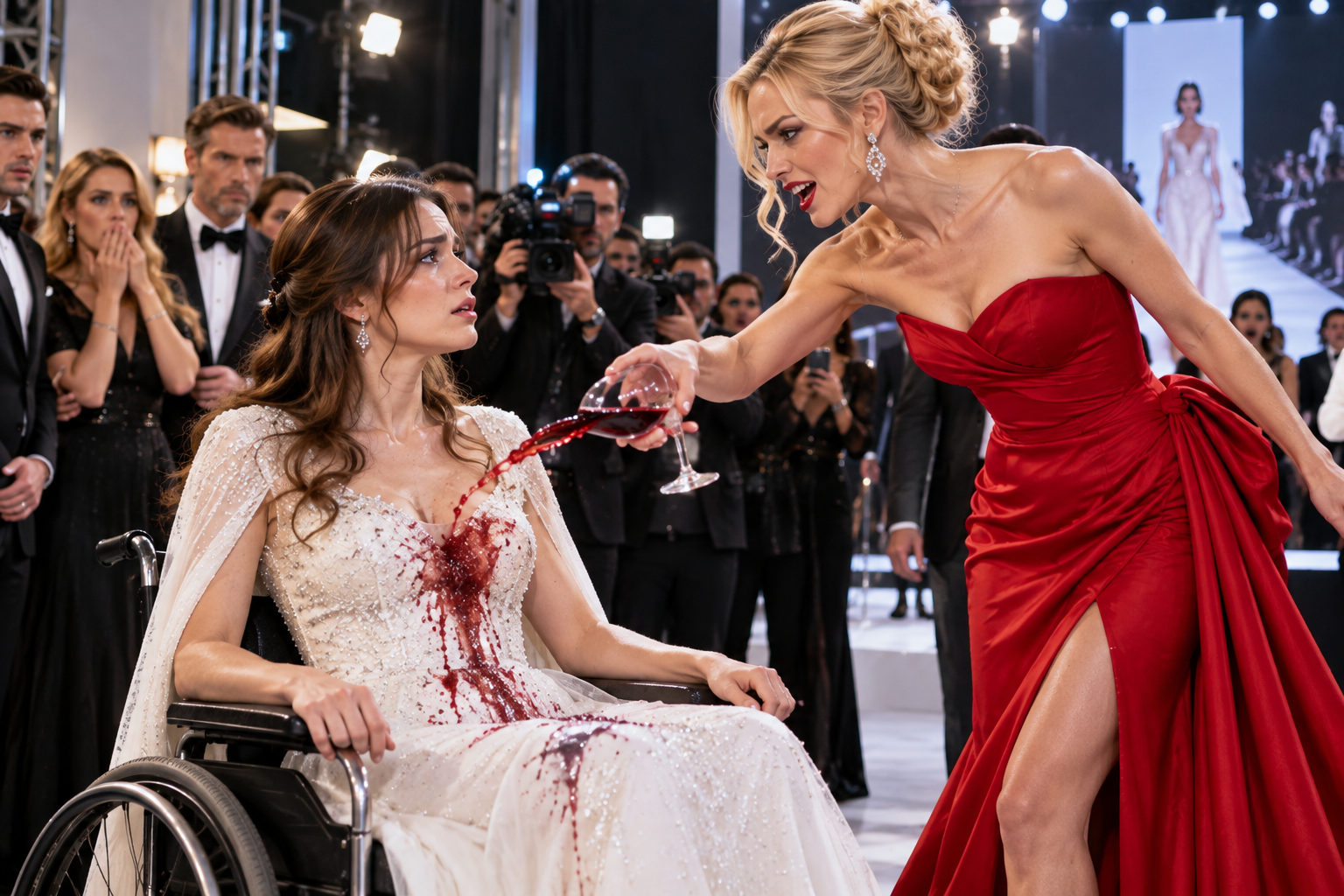
She touched the crimson pattern spreading across her gown.
“So I made sure they couldn’t ignore the evidence.”
The chief executive of the fashion house stepped onto the runway.
He held a contract.
“Vivienne Cross,” he said, “your agreement with this house is terminated effective immediately.”
Vivienne stared at him.
“You can’t do this.”
He turned toward Clara.
“We already did.”
Reporters surged forward.
Sponsors began calling their lawyers.
Designers who had spent years praising Vivienne suddenly refused to meet her eyes.
But Clara didn’t celebrate.
She asked the technicians to replay the runway presentation.
The models appeared beneath the blue lights.
One after another, they walked wearing Clara’s designs.
Each garment carried the same crimson-and-silver pattern.
The pattern created when Vivienne had poured wine across Clara’s gown.
The audience rose to its feet.
The applause grew louder.
Not because anyone felt sorry for Clara.
Because they finally understood what she had created.
Later that night, Clara stood alone backstage.
Vivienne appeared in the doorway.
For once, she wasn’t smiling.
“You planned everything.”
Clara shook her head.
“No.”
“You knew I would attack you.”
“No.”
“You knew the cameras were recording.”
Clara looked at her.
“I knew the truth would eventually surface.”
Vivienne’s eyes filled with anger.
“You took everything from me.”
Clara slowly shook her head.
“You did that yourself.”
Vivienne looked down at the crimson stain still covering Clara’s gown.
“That dress…”
“You thought you ruined it.”
Clara smiled faintly.
“You gave me the final detail.”
Months later, Clara opened her own studio in New York.
Her first independent collection was called Redemption.
She hired young designers who had been ignored by major fashion houses.
She created adaptive couture for people who had spent years believing fashion wasn’t made for them.
At the entrance to her studio, she placed one photograph inside a black frame.
It showed her sitting backstage in her wheelchair.
Wine covered her white gown.
Hundreds of people stared at her.
Beneath the photograph were five simple words:
THEY THOUGHT I WAS FINISHED.
Clara never removed it.
Because she wanted to remember what happened before the applause.
Not the humiliation.
The choice.
Vivienne had believed one glass of wine could destroy Clara’s biggest night.
Instead, it became the defining image of the collection that launched Clara’s career.
And the woman everyone had once treated as someone who needed pity became something far more powerful.
A designer whose name no one could erase.