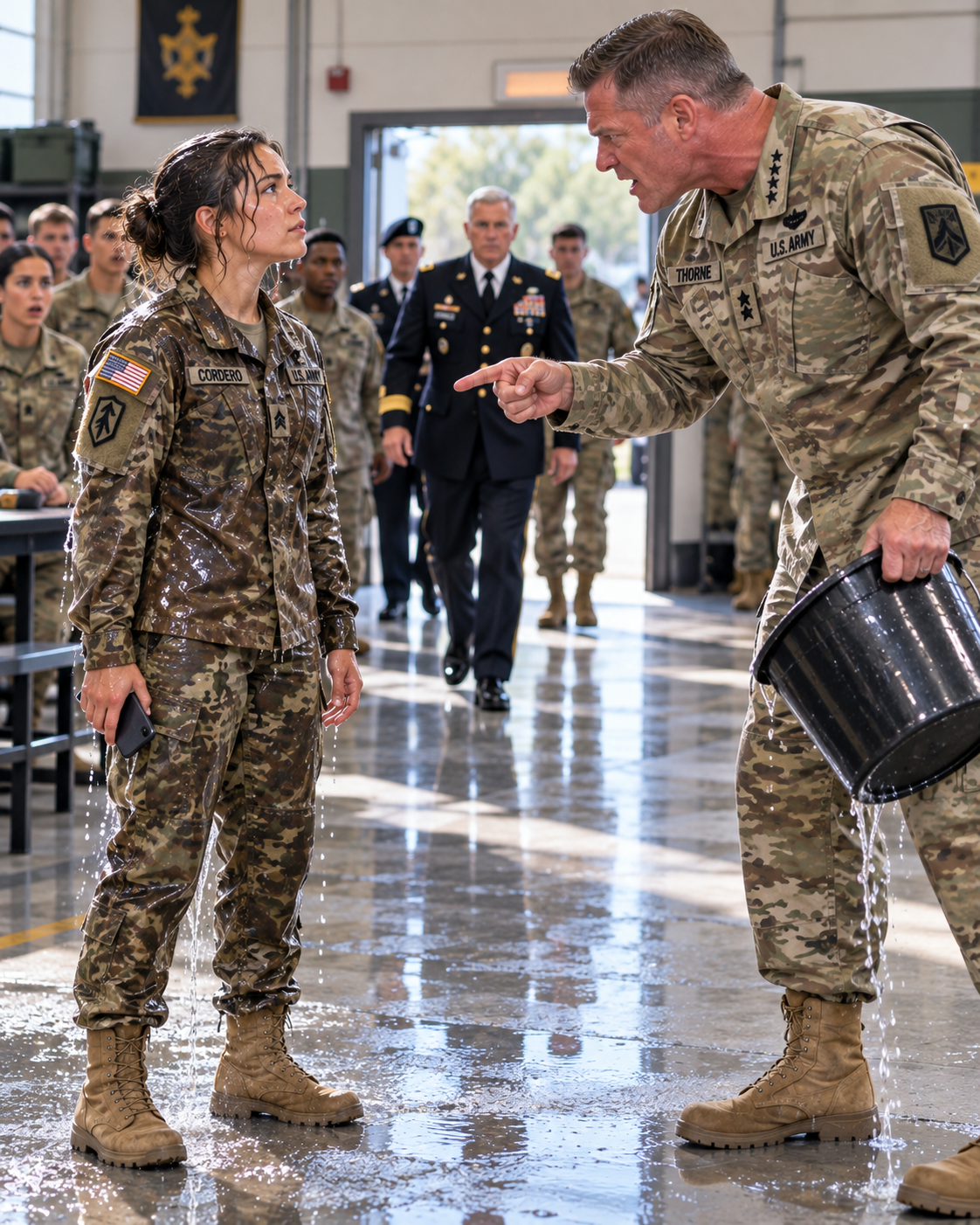
Part 2: The Report He Thought Nobody Had Read
Part 2: The Report He Thought Nobody Had Read
“So now we need to determine whether what happened here was discipline… or retaliation against a soldier who reported a safety hazard.”
Nobody moved.
Major General Harris Thorne looked at the sealed folder in the colonel’s hand.
Then at Specialist Ava Cordero.
“You filed a complaint against me?”
Ava wiped water from her face.
“No, sir. I filed a safety report about the equipment.”
That distinction mattered.
Three days earlier, Ava had been assigned to inspect training equipment before a scheduled exercise. During the inspection, she’d found damage around a load-bearing assembly.
She photographed it.
Recorded the equipment number.
Then submitted the deficiency through the proper channel.
The following morning, however, the equipment appeared back on the training schedule.
No repair record.
No replacement documentation.
No indication that anyone qualified had cleared it.
So when Ava was ordered to use it, she refused.
Not dramatically.
Not disrespectfully.
She simply said:
“Sergeant, this equipment is tagged in my report. I need confirmation it’s been cleared.”
That request traveled upward.
Eventually, Thorne entered the hall.
He didn’t know Ava.
He knew only that a junior specialist had stopped part of an exercise.
And instead of checking why, he’d assumed he was dealing with defiance.
The colonel from the inspector general office placed the folder on a table.
“We received Specialist Cordero’s report before today’s incident.”
Thorne’s jaw tightened.
“I was told the equipment had been inspected.”
“Then we’ll determine who told you that.”
The colonel looked toward the soldiers.
“And nobody in this room is going to speculate.”
Ava appreciated that.
She didn’t want a public execution.
She wanted the equipment checked.
Her father entered moments later.
Retired General Mateo Cordero didn’t storm across the room.
He didn’t threaten Thorne.
He walked directly to Ava.
“You hurt?”
“No.”
“You need medical attention?”
“I don’t think so.”
“We’re still getting you checked.”
Ava almost smiled.
That was her father.
Not the retired general.
Dad.
Only after confirming she was okay did Mateo turn toward Thorne.
For several uncomfortable seconds, the two men looked at each other.
Thorne finally spoke.
“General Cordero.”
“Retired,” Mateo replied.
Then he said something nobody expected.
“This isn’t my investigation.”
Thorne blinked.
Mateo pointed toward his daughter.
“And she doesn’t need my rank to make her report matter.”
Ava looked at him.
That sentence meant more than any threat could have.
The review began immediately.
Witness statements were collected.
Training records were preserved.
The damaged equipment was removed from service pending technical inspection.
Investigators also reviewed how Ava’s original report had been handled.
What they found wasn’t a cinematic conspiracy.
It was something more ordinary—and therefore more believable.
A maintenance concern had moved through several people.
One supervisor believed another section had cleared it.
Someone updated a scheduling spreadsheet without confirming the inspection.
The equipment returned to the training roster.
A chain of assumptions had replaced verification.
The technical inspection later confirmed that Ava had identified a legitimate defect.
Whether it would have caused an accident could not be known with certainty.
But it should not have been returned to use without proper clearance.
Then came the second investigation.
Thorne’s conduct.
Witnesses confirmed that he had publicly berated Ava after she questioned the order.
They confirmed the comments about her family.
They confirmed the bucket.
Video from the training hall supported much of their account.
The issue was referred through the appropriate command process.
Ava wasn’t told every administrative detail.
Nor was she entitled to be.
But she was formally informed that her safety report had been justified and that the training procedure would be corrected.
Several weeks later, Thorne requested to speak with her.
Ava agreed only after confirming the meeting would occur professionally, with another officer present.
Thorne entered without the swagger she’d seen that morning.
“I owe you an apology.”
Ava waited.
“I believed you were challenging my authority.”
“I was challenging the equipment status, sir.”
“I know that now.”
Ava studied him.
Then she asked:
“If my father hadn’t been General Cordero, would we be having this conversation?”
Thorne had no quick answer.
That was answer enough.
Ava continued.
“That is the part you should think about.”
He nodded slowly.
She didn’t forgive him on command.
She didn’t need to.
An apology could acknowledge wrongdoing.
It couldn’t erase it.
Months later, Ava was walking through another training area when she noticed a young private staring nervously at a piece of equipment.
“You okay?” she asked.
The private hesitated.
“Ma’am, this inspection tag doesn’t match the log.”
A nearby sergeant turned.
For half a second, Ava saw the private preparing himself to be dismissed.
Instead, the sergeant walked over.
“Good catch. Nobody uses it until we verify.”
Fourteen words.
No humiliation.
No argument.
No rank contest.
The equipment was pulled aside.
The exercise continued with a replacement.
Ava watched the private walk away.
That was when she realized the most important outcome of what had happened wasn’t what became of Thorne.
It was that somebody had learned to stop and listen.
Later that evening, Ava visited her parents.
Mateo was grilling steaks in the backyard.
“You know,” he said, “your mother thinks I handled the whole thing very professionally.”
Ava laughed.
“Mom told me she confiscated your car keys because you wanted to drive to the base before I finished the phone call.”
Mateo stared at the grill.
“Your mother exaggerates.”
“She said you were wearing slippers.”
“They were tactical slippers.”
Ava laughed harder than she had in weeks.
Then Mateo became serious.
“I meant what I said that day.”
“What?”
“You shouldn’t need me.”
Ava looked at him.
He continued.
“If the Army listens to you only after learning who your father is, then something has gone wrong.”
Ava nodded.
That had bothered her too.
People around the installation eventually learned she was the daughter of a retired general.
Some treated her differently afterward.
She hated that.
So whenever the story came up, Ava corrected it.
“My father didn’t save me.”
The safety report had existed before Mateo arrived.
The photographs existed.
The equipment number existed.
The witnesses existed.
The training-hall recording existed.
Her father’s phone call made people pay attention faster.
The evidence was what mattered.
And that became the lesson Ava carried forward.
Not that humiliating the wrong soldier could bring a powerful parent through the door.
Something far more important:
A private, a specialist, or a general should be able to point at the same unsafe equipment and receive the same answer:
Stop. Check it. Then continue only when it’s safe.