Part 2: The Mark That Couldn’t Be Faked
Part 2: The Mark That Couldn’t Be Faked
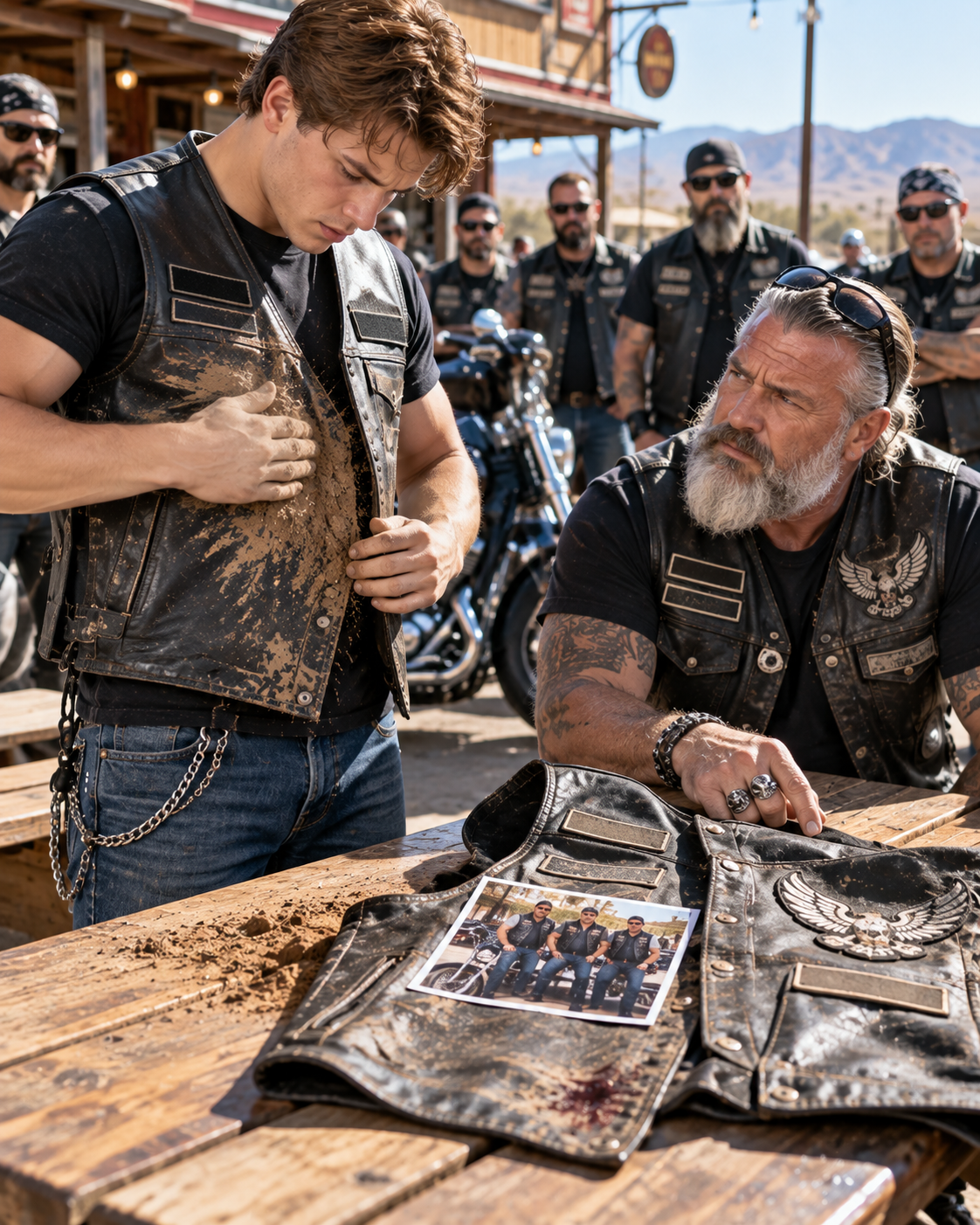
Tyler stared at the photograph.
His father, Michael Boone, looked barely thirty.
Long hair. Black T-shirt. Crooked grin.
Tyler had seen that smile in family albums, but never this photograph.
“You knew him?”
Hammer nodded.
“Before you were born.”
Tyler looked toward the old Harley beneath the cottonwood tree.
“My mother told me Dad quit riding when I was little.”
“He did.”
“Then why is his motorcycle here?”
Hammer pulled out the bench across from him.
“Sit down.”
For once, Tyler didn’t argue.
Hammer explained that Michael had ridden with several of the men long before the club became what it was today.
Back then, they were mostly young mechanics, construction workers and veterans with cheap motorcycles and more confidence than money.
Michael had been different.
He was the one who carried extra water.
The one who stopped when somebody was stranded.
The one who remembered whose kid had a birthday.
Then Michael became a father.
Everything changed.
“He loved riding,” Hammer said. “But he loved being your dad more.”
Michael eventually sold his motorcycle and stepped away from club life.
The Harley under the tree wasn’t actually his.
It belonged to Hammer’s younger brother, Dean.
That explained the photograph.
But not the stain.
Tyler pointed toward Hammer’s vest.
“What happened that night?”
Hammer looked at the mark for several seconds.
“Your father wasn’t riding.”
It happened eighteen years earlier on a desert highway outside Flagstaff.
Hammer and Dean had been returning from a weekend ride when a sudden storm swept across the highway.
Visibility collapsed.
Dean lost control on loose gravel.
Hammer stopped immediately.
Another vehicle nearly struck him as he tried to warn traffic away from the crash site.
Then a pickup appeared through the rain.
Michael Boone was driving home from a construction job.
He recognized Hammer.
Michael positioned his truck farther up the shoulder with its hazard lights flashing, called emergency services, and helped keep approaching traffic away while Hammer stayed with Dean.
During the confusion, Hammer slipped on the wet shoulder and injured his arm.
Michael grabbed his vest and pulled him away from the traffic lane.
The dark stain came from that chaotic night.
Not from anything glamorous.
Not from a fight.
Not from some outlaw legend.
Just rain, road grime and a friend refusing to leave another man alone.
Dean survived.
Hammer never forgot it.
Tyler swallowed.
“Why didn’t Dad tell me?”
“Maybe because he didn’t think helping somebody deserved a legend.”
That sounded exactly like Michael Boone.
He had died six years earlier after a sudden heart attack.
Tyler had been eighteen.
For years afterward, Tyler had tried to collect pieces of the man he’d lost.
His tools.
His photographs.
His old work jacket.
Even the music he’d listened to.
Joining the riding community had become another way of reaching backward.
Hammer finally understood why Tyler had rubbed dirt onto the new vest.
“You’re not trying to look old,” he said.
Tyler looked away.
“You’re trying to look like him.”
That landed harder than any insult could have.
Tyler stared at his new patch.
“I barely remember him riding.”
“Then don’t imitate the photographs.”
Hammer leaned forward.
“Imitate the man.”
The older biker picked up Tyler’s vest.
Most of the loose dirt brushed away easily beneath his hand.
“See that?”
Tyler nodded.
“That’s the problem with fake history. Comes off in thirty seconds.”
A few men laughed softly.
Even Tyler did.
Then Hammer handed the vest back.
“Wear it clean.”
“For how long?”
Hammer shrugged.
“Until life changes that.”
The club rode out that afternoon.
Tyler’s vest looked embarrassingly new beside everyone else’s.
For the first time, he didn’t care.
Months passed.
Then came a cold November afternoon on Interstate 40.
The riders noticed an SUV stopped awkwardly on the shoulder.
A woman stood beside it with two children while smoke drifted from beneath the hood.
Hammer began slowing.
But Tyler was already pulling over.
He parked safely away from traffic, called roadside assistance and helped move the family farther from the highway while another rider placed emergency markers where approaching drivers could see them.
Nothing dramatic happened.
Nobody filmed it.
The SUV was eventually towed.
The family left safely.
When Tyler climbed back onto his motorcycle, Hammer noticed a thin black streak across the bottom of Tyler’s vest.
Probably grease from leaning against the disabled SUV.
Tyler noticed it too.
He reached down as though he might wipe it away.
Then stopped.
Hammer smiled.
“Going to clean that?”
Tyler considered the question.
“Eventually.”
They both laughed.
Years later, Tyler’s vest no longer looked new.
The shoulders had faded.
One seam had been repaired.
There were marks whose stories he’d forgotten and others he could remember down to the mile marker.
But inside one pocket, protected in plastic, he carried a copy of that old photograph.
Michael Boone.
Hammer Dawson.
Dean Dawson.
Three young men beside a motorcycle.
Tyler eventually understood what Hammer had tried to teach him that first morning.
The vest itself wasn’t sacred because leather was sacred.
The patches weren’t meaningful because they made someone look dangerous.
They mattered because they represented responsibility—to the people beside you and to the standards you claimed to live by.
Anybody could throw a vest into the dirt.
Anybody could scratch leather.
Anybody could manufacture the appearance of experience.
But there was no shortcut for becoming the kind of man whose worn vest actually had stories worth telling.
Years later, a newly patched rider once asked Tyler how to make his own brand-new vest look less clean.
Tyler laughed.
He remembered himself at twenty-four.
Then he gave the young man the same answer Hammer had given him.
“Don’t.”
The rider looked confused.
Tyler pointed toward the open highway.
“Put it on. Live right. Ride long enough.”
Then he touched the faded grease mark near the bottom of his own vest.
“The road will write the rest.”