Part 2: The Message on Gregory’s Phone
Part 2: The Message on Gregory’s Phone
“He wasn’t working alone.”
Samantha’s words changed the room.
The deputy immediately stepped into the hallway and contacted investigators back in Oregon.
Ray “Hammer” Dawson remained near the doorway.
He wanted to help.
But this was no longer something twelve bikers could solve by climbing onto motorcycles.
A child might be in danger.
That required police.
The timestamped photograph of Caleb was forwarded to local authorities near Samantha’s home. Her parents were contacted through law enforcement rather than directly from Gregory’s phone.
Within minutes came the first good news.
Caleb was safe.
He was with Samantha’s father.
But the photograph was real.
Someone had been watching them.
Samantha’s relief lasted only seconds.
“Who took it?”
Investigators began working on that question.
Gregory’s phone contained more than photographs. There were messages, location notes and records suggesting another person had supplied information about Samantha’s family’s routines.
Police preserved the device rather than allowing anyone in the diner to search further.
Samantha was taken to a hospital for evaluation and then reunited with her parents through the appropriate authorities.
Before leaving, she asked for one thing.
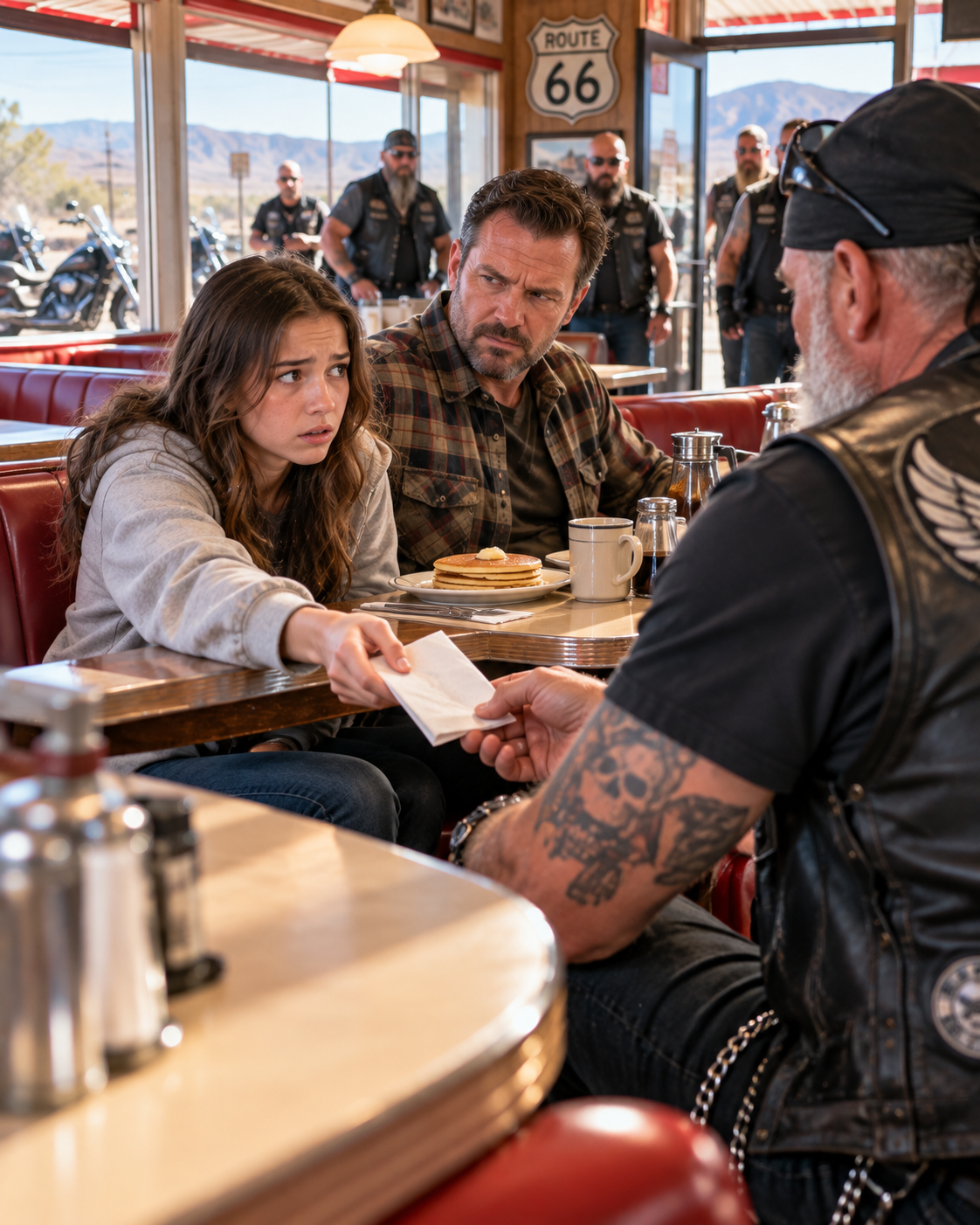
“My napkin.”
Ray handed it to the deputy instead.
“Evidence first.”
Samantha managed a tiny smile.
“Then I want it back.”
“You got it.”
The investigation continued for weeks.
The second person wasn’t some mysterious criminal mastermind.
He was a man Gregory knew who had access to information about Samantha’s family through casual community connections. Investigators alleged that he had helped Gregory track movements and had continued watching the Miller home after Samantha disappeared.
The photographs and electronic records helped authorities identify him.
He was arrested and the allegations were handled through the courts.
For Samantha, however, being physically safe didn’t make everything normal again.
She hated gray sedans.
She couldn’t sit with her back toward restaurant doors.
Sometimes a turn signal clicking beside her at night made her hands shake.
Her parents found professional support for her and stopped expecting recovery to happen on anybody else’s schedule.
Months passed.
Then one Saturday morning, Samantha heard motorcycles.
A lot of them.
She froze beside the living-room window.
Her mother looked outside.
“Samantha…”
Motorcycles were moving slowly along their street.
Dozens.
Then more.
But they weren’t surrounding the house.
They were gathering several blocks away for a charity ride organized with local community groups to support organizations helping missing and exploited children.
Ray had contacted Samantha’s parents beforehand.
Nothing was supposed to happen without their permission.
He hadn’t even told the riders Samantha’s address.
But her father had invited Ray to stop by.
One motorcycle eventually pulled into the driveway.
Ray removed his helmet.
Samantha stepped onto the porch.
“You came all the way from Arizona?”
Ray shrugged.
“You gave me a napkin. Felt rude not to return it.”
He reached into his vest.
Inside a clear evidence-release sleeve was the original diner napkin, returned after authorities no longer needed it.
The handwriting was still there:
HE’S NOT MY DAD.
PLEASE DON’T REACT.
CALL 911.
Samantha stared at it.
“I thought you guys were going to fight him.”
“So did he.”
“Why didn’t you?”
Ray leaned against his motorcycle.
“Because getting you out safely mattered more than proving how tough we were.”
That answer stayed with her.
Then Ray handed her something else.
A small card.
On one side were emergency numbers and simple instructions for discreetly seeking help in a public place.
On the other was one sentence:
ASK FOR HELP. LET PROFESSIONALS HANDLE THE DANGER.
The motorcycle ride raised money for victim-support services.
Ray’s club also worked with participating businesses to encourage employees to recognize situations where someone might be quietly asking for assistance.
The story spread.
Not Samantha’s name.
Not her photograph.
Her parents insisted those remain private.
What spread was the lesson of the napkin.
Pay attention.
Don’t create a confrontation.
Call trained responders.
Give the person asking for help room to get away safely.
A year later, Samantha returned to Arizona with her parents.
She wanted to see the diner.
Ray was already there.
So were several riders from that morning.
Samantha sat in the same booth.
For a moment, she couldn’t touch the menu.
Then Ray sat at the counter where he’d been that day.
He didn’t say anything.
He simply ordered pancakes.
Samantha laughed.
It was the first time that memory had belonged to her instead of Gregory.
Before leaving, the diner owner showed her something mounted discreetly behind the counter.
Not the original napkin.
A replica.
Underneath were four words:
IF SOMEONE ASKS, LISTEN.
Samantha stared at it for a long time.
She had once believed twelve frightening-looking strangers had saved her.
As she grew older, she understood the truth was more complicated.
She had saved herself first.
She noticed an opportunity.
She wrote the message.
She took the risk of asking for help.
Ray simply did the most important thing a stranger could do afterward.
He believed her.
He stayed calm.
And he called the people trained to intervene.
As Samantha walked toward the door, Ray called after her.
“Hey, kid.”
She turned.
He held up a clean diner napkin.
“You forgot something.”
Samantha smiled.
“Keep it.”
“Why?”
She opened the door.
This time there was no gray sedan waiting outside.
No hand beneath a jacket.
Just sunlight, her parents, and an ordinary highway stretching toward home.
She looked back at Ray.
“Because somebody else might need one.”