Part 2: The Soldier Who Was Supposed to Be Number Twenty-Four
Part 2: The Soldier Who Was Supposed to Be Number Twenty-Four
“She was supposed to be number twenty-four.”
Master Sergeant Daniel Reeves’s words left the dining facility silent.
Lieutenant Natalie Carter tightened her grip on the crutch.
“Master Sergeant, that’s enough.”
But Colonel James Whitaker had already understood what happened.
He turned toward Sergeant Briggs.
“Step away from the lieutenant.”
Briggs obeyed.
For the first time, his confidence was gone.
“Sir, I didn’t know—”
Natalie interrupted him.
“That isn’t the problem.”
Everyone looked at her.
“You shouldn’t need to know my history before deciding whether you’re going to respect my medical equipment.”
Briggs said nothing.
That was exactly the point.
Natalie didn’t want sympathy because of what happened at Outpost Mercer.
She certainly didn’t want a dining facility full of soldiers turning her into a legend.
But the photograph on the table had already opened a door she’d spent months trying to keep closed.
Reeves looked at the colonel.
“My brother never told me exactly what happened.”
Natalie closed her eyes.
Then she pulled out a chair.
“Sit down, Master Sergeant.”
Reeves did.
Natalie remained standing.
“Your brother wasn’t supposed to tell you.”
Seven months earlier, Natalie had been attached to a logistics and evacuation element operating near Outpost Mercer in Afghanistan.
When deteriorating conditions forced personnel to leave the position, the evacuation plan began breaking apart.
One vehicle became unusable.
Communications were intermittent.
Several people were injured.
The neat sequence written in the operations plan stopped existing.
Natalie helped reorganize the movement.
Not alone.
Never alone.
Medics stabilized casualties.
Drivers moved vehicles through difficult terrain.
Soldiers carried equipment and one another.
Aircrews coordinated the final extraction.
Twenty-four people were scheduled to leave.
Only twenty-three initially made it onto the last available vehicle.
Natalie was the missing name.
“Why?” Reeves asked.
Natalie hesitated.
“One of the wounded soldiers couldn’t be moved safely in the position he’d been placed.”
So Natalie gave up her space.
She remained behind with another small element until a follow-up extraction could reach them.
During that delay, Natalie suffered the leg injury that eventually put her at Walter Reed.
Reeves swallowed.
“My brother?”
Natalie nodded.
“He was the soldier who took my place.”
Reeves looked down.
Across the room, Briggs seemed unable to move.
But Natalie wasn’t finished.
“Your brother didn’t survive because I’m extraordinary.”
She pointed toward the photograph.
“He survived because dozens of people did their jobs correctly when the plan stopped working.”
That was why portions of Natalie’s involvement had initially been withheld from the public account while operational details and personnel information were reviewed.
It wasn’t a secret designed to create a dramatic reveal.
It was paperwork, security considerations and an unfinished official process.
Colonel Whitaker had come to find Natalie because that process had finally moved forward.
Her rehabilitation assignment was being extended, and brigade leadership wanted to discuss her next duty position.
But now there was another matter to address.
Whitaker looked toward Briggs.
“Sergeant, report to your first sergeant.”
Briggs swallowed.
“Yes, sir.”
Natalie spoke.
“Colonel.”
Whitaker stopped.
“I want what happened here documented accurately.”
“It will be.”
“No exaggerations.”
Whitaker understood.
Natalie continued.
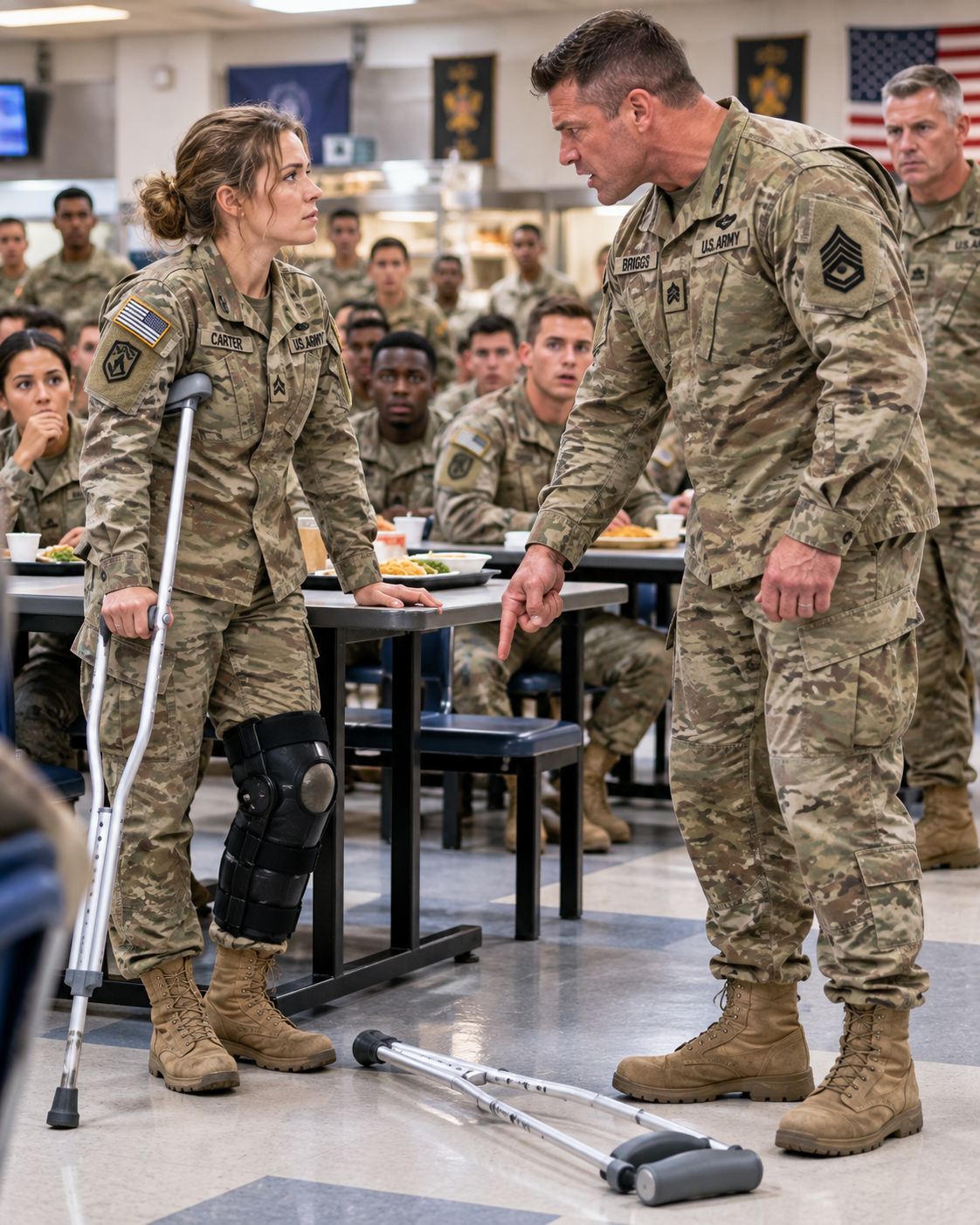
“He moved my crutch and made inappropriate comments. That’s what happened. Whatever action follows should be based on that—not on who I was overseas.”
“Yes, Lieutenant.”
Briggs looked at her.
There was something almost worse than anger in his expression.
Embarrassment.
“I apologize, ma’am.”
Natalie held his gaze.
“Don’t apologize because you found out about Mercer.”
Briggs lowered his eyes.
“I’m apologizing because I shouldn’t have touched the crutch.”
Natalie nodded once.
“That’s the apology.”
The command review later included witness statements and available dining-facility footage. Briggs’s conduct was addressed through his chain of command, including corrective action and additional leadership training.
There was no instant career-ending punishment.
No general stormed into the building.
No medal appeared from nowhere.
There didn’t need to be.
The issue was simpler.
A noncommissioned officer had humiliated another soldier over a visible medical limitation.
The Army already had procedures for addressing that.
Three weeks later, Natalie entered the same dining facility.
Conversation continued.
Nobody went silent.
That pleased her.
She reached the crowded lunch area and paused.
A young private immediately started pulling a chair away.
“Ma’am, I’ll make room.”
Natalie smiled.
“Thank you.”
Then another voice came from behind him.
“Give her enough clearance on the left.”
Natalie recognized it.
Briggs.
He stood several feet away.
No grin.
No sarcasm.
He didn’t rush over to perform some dramatic act of redemption.
He simply noticed the obstacle and corrected it.
Natalie sat.
Briggs started walking away.
“Sergeant.”
He turned.
Natalie pointed toward the coffee station.
“You’re blocking the creamer.”
He looked down.
He actually was.
Several soldiers tried not to laugh.
Briggs stepped aside.
“Yes, ma’am.”
Natalie smiled.
The room relaxed.
Months later, she no longer needed the crutch.
The brace lasted longer.
So did the rehabilitation.
Reeves occasionally sent her updates about his brother, who had returned home and was doing well.
Once, his brother included a short handwritten note:
I KNOW YOU DON’T WANT TO BE CALLED A HERO. SO I’LL JUST SAY THANK YOU FOR MAKING SURE I GOT HOME.
Natalie kept that note.
Not because it reminded her of what she’d sacrificed.
Because it reminded her that she had come home too.
Just differently.
The strangest lesson of the entire incident had nothing to do with Afghanistan.
Briggs had believed the crutch represented weakness.
Reeves had nearly turned it into proof of heroism.
Natalie eventually rejected both ideas.
It was neither.
It was medical equipment.
And she shouldn’t have needed a battlefield story, a photograph, or twenty-three surviving soldiers before people understood something that simple:
Respect shouldn’t begin only after you discover what someone endured to deserve it.