Part 2: The Light Beyond the Tracks
Part 2: The Light Beyond the Tracks
The dog stared toward the abandoned cabin.
Then it barked.
Once.
Sharp and urgent.
I looked at the note again.
THOMAS MERCER DIDN’T DIE TWENTY YEARS AGO.
“Ray,” Cole said behind me. “What’s going on?”
I handed him the paper.
His expression changed.
Twenty years earlier, Thomas Mercer and I had served together before returning to civilian life. He was the man who first called me “Hammer,” after watching me repair a broken field shelter with whatever tools I could find.
Then Thomas disappeared.
His truck was recovered near a flooded river.
His body was never found.
Eventually, everyone accepted that he was dead.
Everyone except me.
The injured dog tried to stand.
“Ranger,” I whispered.
Its ears lifted.
That settled it.
Thomas had once told me that if he ever owned another dog, he’d name it Ranger.
I called emergency services for the animal and reported the suspicious note and cabin rather than charging inside.
The light remained on.
A deputy arrived first. Then another.
Only after they cleared the building did I approach.
Nobody was inside.
But somebody had been there recently.
Coffee was still warm.
A dog bowl sat beside the door.
On the table was an old photograph of Thomas and me standing beside two motorcycles.
Underneath it lay my missing friend’s military identification tags.
And another letter.
This one was longer.
Thomas explained that his disappearance had never been some elaborate secret mission.
The truth was more painful.
After returning home, he had struggled badly with civilian life. He became isolated, ashamed, and convinced that everyone he loved would be better without him.
One night, he abandoned his truck near the river.
Then he walked away from his entire life.
Years passed.
Shame made returning harder.
Eventually, Thomas built a quiet existence several states away.
He adopted Ranger.
And recently, after receiving a serious medical diagnosis, he decided there was one person he needed to face before time made the decision for him.
Me.
At the bottom of the letter was an address.
Not the cabin.
A veterans’ residence forty miles away.
The next morning, I went alone.
No biker convoy.
No roaring engines.
Some reunions didn’t need an audience.
Thomas was sitting beneath a covered porch when I arrived.
Older.
Thinner.
Gray beard.
But I recognized him instantly.
He looked at me.
“Hammer.”
Twenty years of anger rose into my throat.
“You let me bury an empty coffin.”
“I know.”
“I searched for you.”
“I know.”
“I thought you were dead.”
Thomas lowered his eyes.
“I know.”
I wanted to shout.
Instead, I sat beside him.
“Why the dog?”
Thomas explained that Ranger had escaped during a storm while he was temporarily staying near the mountain town. A volunteer had reported seeing the dog near the railroad corridor.
Thomas couldn’t search far because of his health.
So he contacted someone from the local veterans’ network who knew our motorcycle club would be riding through the area.
The note had been attached to Ranger’s collar in case someone found him.
Thomas hadn’t planned the railroad emergency.
That part had been terrible chance.
“Then why my name?”
Thomas looked at me.
“Because I was finally trying to come home.”
Ranger recovered.
The leg required treatment, but the veterinarian expected him to walk normally again.
Thomas and I didn’t repair twenty lost years in one conversation.
There was no magical forgiveness.
He apologized.
I got angry.
He answered questions.
Sometimes I left.
Then I came back.
And so did the other riders.
Three months later, Thomas stood outside our clubhouse.
Ranger sat beside him.
Nobody made speeches.
Cole simply opened the door.
Thomas hesitated.
“You sure?”
I looked at him.
“No.”
He almost smiled.
“But come inside anyway.”
Thomas lived another fourteen months.
During that time, he helped our club establish a small transportation program connecting isolated veterans with appointments and local support services.
After he died, Ranger stayed with me.
I still carry Thomas’s pocket watch.
But the military symbol on it means something different now.
For twenty years, I thought it represented the friend I’d lost.
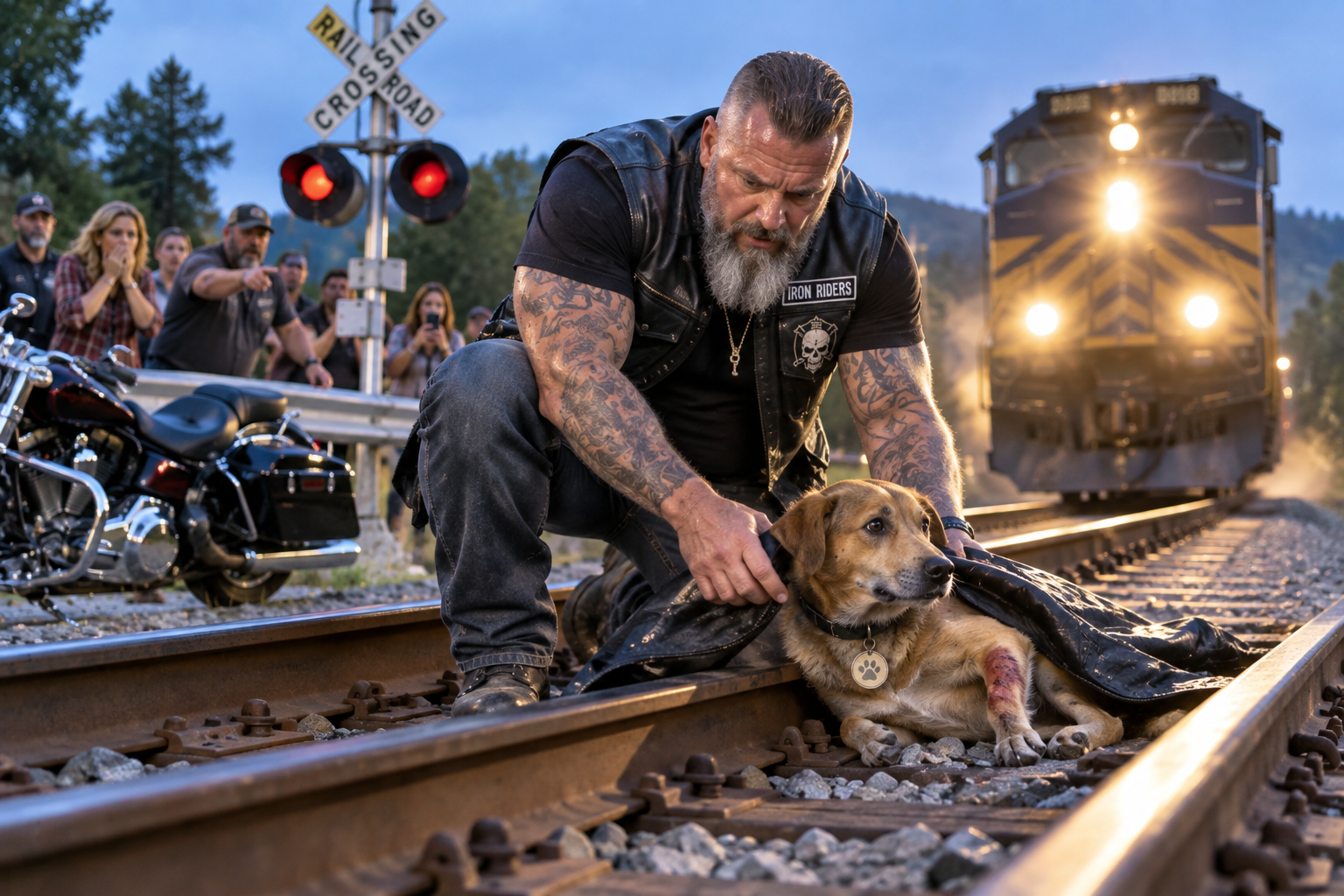
Now it reminds me of the night an injured dog stopped me beside a railroad track and forced two old men to confront everything silence had stolen from them.
People later called me brave for running toward that dog.
They were wrong.
Pulling Ranger from the tracks took seconds.
Sitting beside Thomas after twenty years of anger—and choosing to come back the next day—was the harder rescue.