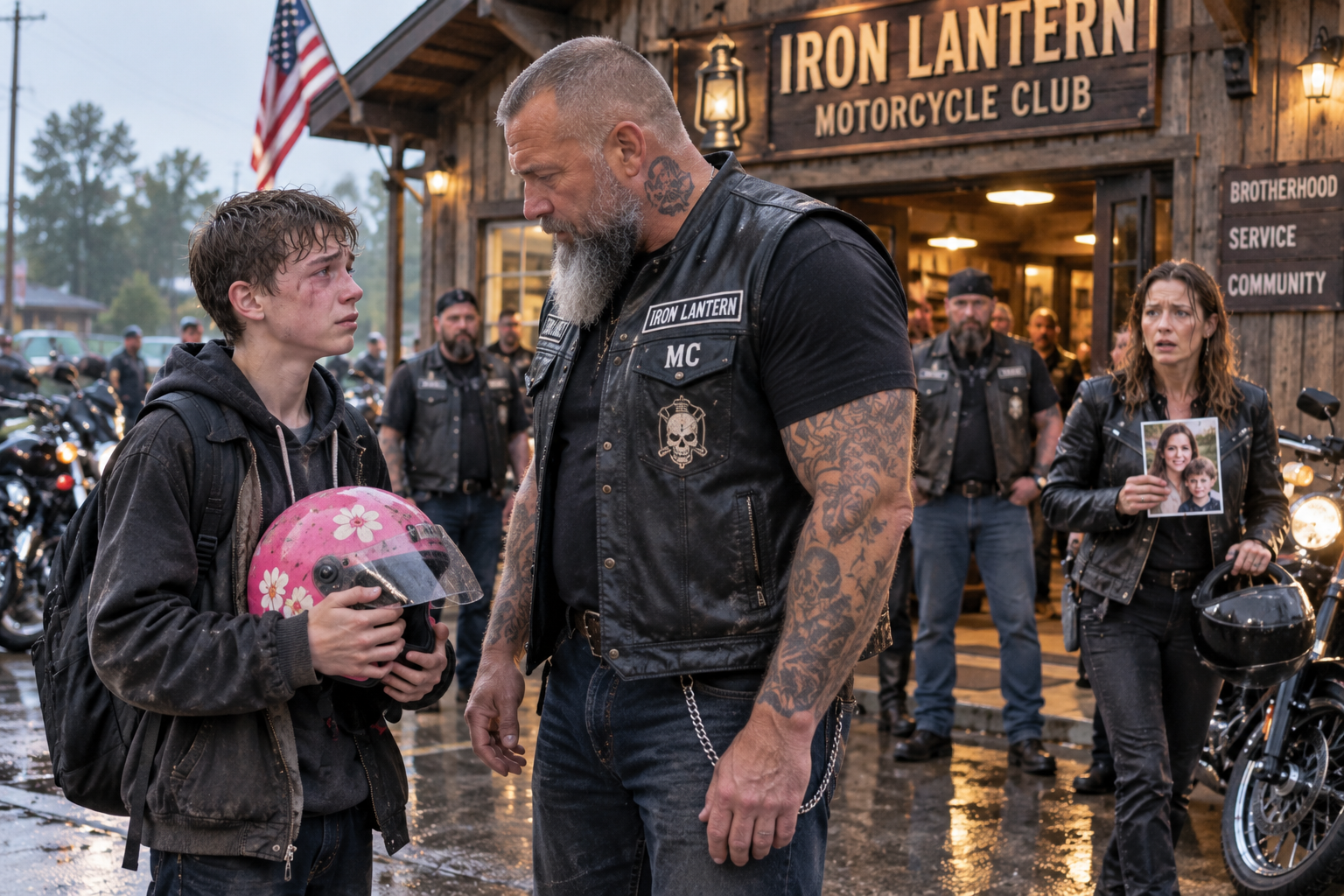
Part 2: The Woman Who Knew His Secret Name
Part 2: The Woman Who Knew His Secret Name
“Bug.”
Noah froze.
The pink helmet slipped slightly in his hands.
Nobody had called him that since he was ten.
The woman beside the motorcycle removed her gloves. She was in her early forties, exhausted-looking, with rain running through her dark hair.
Noah stepped backward.
“Who are you?”
Her eyes filled.
“My name is Claire Bennett.”
Noah’s face hardened.
“My mother’s name was Rebecca.”
“I know.”
Rook immediately stepped between them.
“Then start explaining.”
Claire didn’t object.
She reached into her jacket and produced an old photograph from the Clark County fair.
Rebecca stood beside Noah near the lemonade stand.
Claire stood behind them.
“My sister was your mother.”
Noah stared at her.
An aunt.
A relative nobody had ever told him existed.
Claire explained that she and Rebecca had been estranged before the fair. Rebecca had struggled with instability for years, and after she disappeared, Claire learned about Noah too late.
By then, he had entered foster care.
Claire claimed she tried to locate him, but records, moves, and her own unstable circumstances complicated everything.
Rook didn’t simply accept the story.
Neither did Noah.
They called Noah’s caseworker.
The photograph, names, dates, and family connection would have to be verified through the proper process.
Noah was still sixteen.
A motorcycle club couldn’t simply decide where he would live because forty bikers wanted to help.
That afternoon, Noah sat at the clubhouse table while his caseworker spoke with Rook privately.
The club could potentially become part of Noah’s support network, she explained, but any placement, visitation, employment, or guardianship arrangement required approval.
Rook agreed.
No shortcuts.
No pretending leather vests made them above the rules.
Then he asked the question that mattered.
“Can he keep coming here?”
With appropriate permission and supervision, there were ways to make that possible.
So the Iron Lantern Riders began with something simple.
Saturday mornings.
Noah helped in the workshop.
Not for free.
Rook refused that immediately.
“You work, you get paid.”
“I told you I don’t need money.”
“And I told you this isn’t charity.”
Noah’s first jobs weren’t glamorous.
Sweeping floors.
Organizing tools.
Washing motorcycles.
Learning how to check tire pressure and inspect brake pads.
But every Saturday, the same chair waited for him at breakfast.
Nobody used it.
Nobody moved it.
It was Noah’s.
Claire’s story was eventually confirmed.
She hadn’t come to take Noah away.
She wanted the opportunity to rebuild contact carefully.
Noah didn’t run into her arms.
Real life wasn’t that easy.
He was angry.
He wanted to know why she hadn’t found him sooner.
Some answers satisfied him.
Others didn’t.
But Claire kept showing up.
So did Rook.
Months passed.
Then came Noah’s seventeenth birthday.
When he entered the clubhouse, the pink helmet was sitting on the table.
Cleaned.
The repaired strap remained exactly as Noah had fixed it.
Beside it was a new certified helmet in his size.
Noah looked at Rook.
“I thought I returned this.”
Rook shook his head.
“You returned nothing.”
“It belonged to Hannah.”
“It did.”
Rook smiled.
“Then it belonged to the kid who needed it.”
Noah touched the silver star.
“Why did you keep searching that night?”
Rook looked toward the other bikers.
“Because you were ten.”
“That’s it?”
“That should’ve been enough.”
Noah lowered his head.
For six years, he’d believed the helmet proved somebody once cared about him.
He had been wrong.
The helmet wasn’t the proof.
The people were.
By eighteen, Noah had completed high school and entered a technical training program. The club helped with tools and transportation through legitimate mentoring and community-support channels.
Claire remained part of his life too.
Their relationship grew slowly.
Imperfectly.
Honestly.
Years later, Rook walked into the clubhouse and noticed something hanging inside a glass case.
The battered pink helmet.
Beneath it was a small handwritten card Noah had made himself:
THE NIGHT SOMEBODY LOOKED FOR ME.
Rook stared at it.
Noah, now working in the shop, noticed.
“You remember what I asked you that morning?”
Rook nodded.
A place that won’t disappear.
Noah smiled.
“I don’t need that anymore.”
Rook looked surprised.
Noah pointed around the clubhouse.
“I know where to find you.”
Then he returned to work.
And Rook finally understood why that battered pink helmet had survived five foster homes, garbage bags, and one midnight trip back from the curb.
Noah hadn’t carried it for six years because he owed the bikers something.
He carried it because, during the loneliest night of his childhood, it reminded him that somebody had noticed he was missing—and stayed long enough to search.