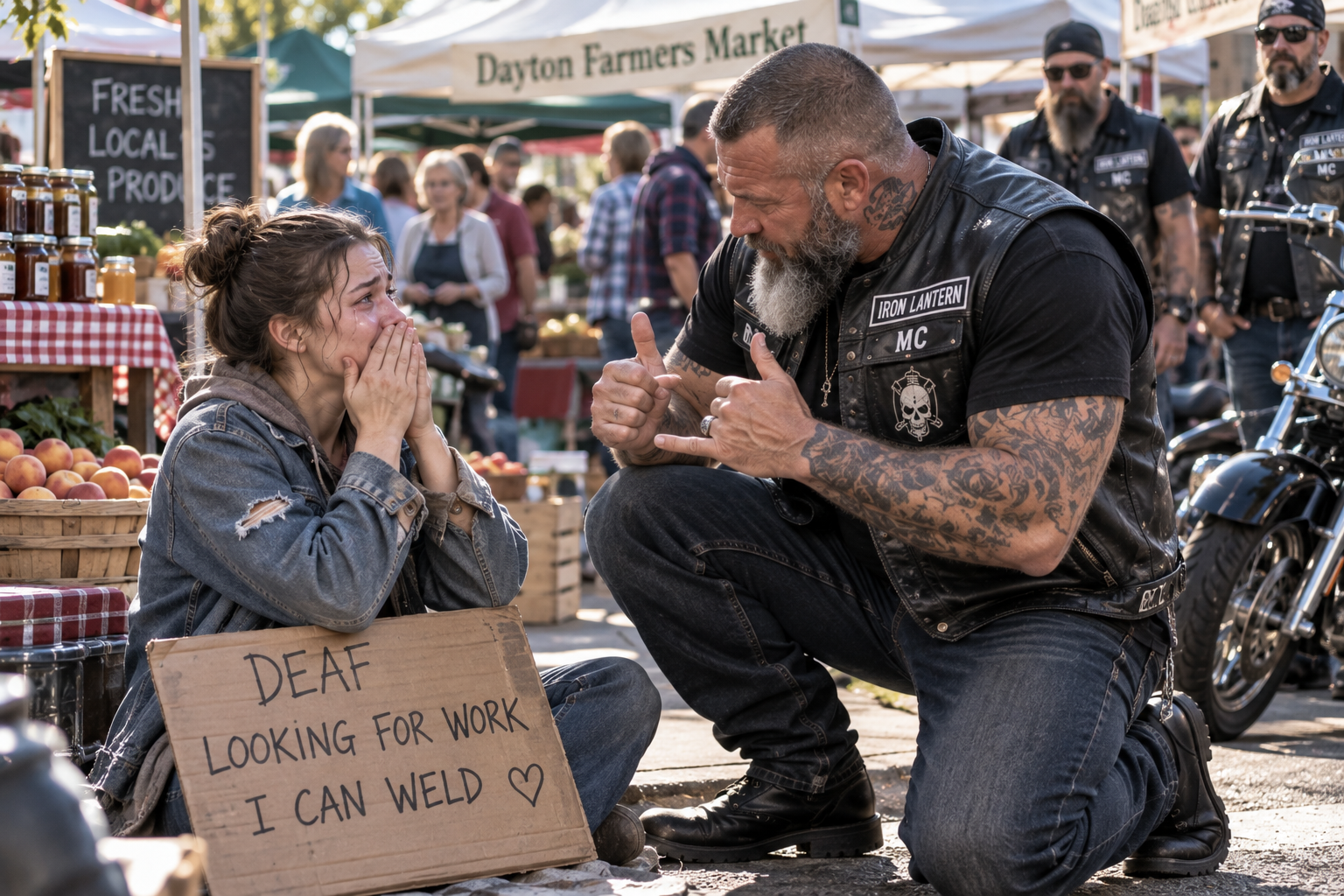
Part 2: The Alarm Nobody Could Hear
Part 2: The Alarm Nobody Could Hear
Earl Boone dropped his welding hood.
“What do you mean it triggered?”
Elena pressed her palm against the steel wall again.
Her eyes narrowed.
Then she signed rapidly to Rook.
Something is running behind this wall.
Earl reached for the alarm panel.
The indicator showed an active fault.
No audible siren.
Rook immediately ordered everyone outside while Earl shut down the equipment.
Minutes later, they discovered an overheated electrical component inside a service compartment.
Nothing catastrophic had happened.
But Elena had identified a safety problem nobody in that garage knew existed.
Rook looked at her.
“You still want the job?”
Elena smiled.
“Was that the interview?”
“No.”
Rook pointed toward her weld.
“That was.”
She started Monday.
But hiring Elena created a bigger question.
The shop had been designed entirely around workers who could hear.
Forklift horns.
Machine alarms.
Someone shouting from across the floor.
Rook refused to treat Elena’s deafness as something she alone had to overcome.
Instead, he brought in a workplace-safety specialist.
Audible alarms were supplemented with bright strobes.
Certain workstations received vibration alerts.
Forklift routes were marked more clearly.
Employees learned basic signs for STOP, DANGER, FIRE, HELP, and CLEAR.
Earl complained initially.
“We’ve worked here eighteen years without all this.”
Rook answered:
“And we’ve been lucky for eighteen years.”
Three months later, nobody complained anymore.
Especially Earl.
It happened on a Thursday afternoon.
Elena was repairing a touring-bike frame when she felt an unusual vibration through the workbench.
She looked up.
A white strobe flashed.
Then another.
Emergency alert.
Smoke was beginning to seep from a storage area.
Elena immediately shut down her equipment and moved toward the designated exit.
Then she noticed two motorcycles still on lifts at the rear.
Earl and Mason were working there.
Neither man was moving.
The shop’s audible alarm had failed again.
Worse, both were wearing hearing protection while using pneumatic tools.
They hadn’t noticed the smoke.
Elena ran to the wall and hit the visual emergency switch.
Every upgraded strobe in the garage exploded with white light.
Earl looked up.
Elena signed one word.
FIRE.
Mason immediately shut down his equipment.
Everyone evacuated.
Firefighters later traced the smoke to an electrical failure near stored shop materials. The suppression and response systems contained the incident before it spread significantly.
Nobody was seriously injured.
Outside, Earl sat on the curb staring at the flashing emergency lights.
Elena approached.
He looked embarrassed.
“I didn’t hear anything.”
Elena raised an eyebrow.
Then signed slowly.
Neither did I.
Earl laughed.
For the first time, he understood.
The changes hadn’t made the shop safer only for Elena.
They had made it safer for everyone.
Months passed.
Elena became one of Mercer Iron & Cycle’s most reliable fabricators.
Her work spoke for itself.
Custom frames arrived from three states.
Riders began requesting her by name.
But Rook’s favorite moment happened almost a year after he’d found her at Webster Street Market.
A young man entered the shop carrying a cardboard sign.
He was looking for work.
His right leg was prosthetic.
Before he could explain what he couldn’t do, Elena walked over.
She looked at his résumé.
Then looked toward Rook.
Rook smiled.
“Test him.”
Elena smiled back.
Because she understood exactly what those words meant.
Not charity.
Not pity.
An opportunity to demonstrate ability.
Later, Rook found Elena’s original cardboard sign hanging inside her locker.
The front still read:
DEAF. LOOKING FOR WORK. I CAN WELD.
But something had been written beneath it.
Rook recognized Elena’s handwriting.
THEY KEPT READING THE FIRST LINE AND NEVER REACHED THE SECOND.
He stood there for a long moment.
Then Elena tapped his shoulder.
Rook turned.
She signed:
“Coffee?”
He answered with the first sign he’d learned specifically for her.
“Always.”
A year earlier, everyone at the market had noticed what Elena couldn’t hear.
Rook had noticed something else.
What she could do.
And the safety system installed because one deaf welder deserved an equal chance eventually proved something much larger:
Sometimes inclusion isn’t about changing one workplace for one person. It’s about discovering how many dangers everyone else had simply learned to accept.