Part 2: The Box Behind the Garage Wall
Part 2: The Box Behind the Garage Wall
Hammer stared into the metal box.
Six folders.
Six elderly homeowners.
Six property transactions.
And the same name appeared repeatedly:
Grant Pike.
Hammer didn’t touch anything else.
“Everybody out of the garage.”
One of the bikers looked confused.
“Why?”
“Because if this matters, we’re not contaminating it.”
The police photographed the box where it had been found. Eleanor gave permission for investigators and her attorney to review its contents.
Grant Pike immediately denied wrongdoing.
He insisted the papers proved nothing.
Maybe he was right.
Hammer wasn’t interested in deciding guilt in a driveway.
He wanted evidence preserved.
Eleanor sat at her kitchen table while attorney Rebecca Collins enlarged the documents on a tablet so she could read them.
Then Eleanor remembered.
Her late husband, Harold, had kept records for several older neighbors. After retiring from accounting, he often helped friends organize tax notices, repair estimates, and property correspondence.
Harold had died four years earlier.
Eleanor had forgotten the box existed.
Rebecca compared those papers with Eleanor’s contract.
The similarities were disturbing.
Several homeowners had apparently entered transactions involving unusually low sale prices or complicated fees. Some documents referenced businesses connected through mailing addresses or representatives that overlapped with Pike’s dealings.
But Rebecca refused to make accusations before checking public records.
“Patterns aren’t proof,” she told Hammer.
“Then find proof.”
She did exactly that.
Over the following days, county property records, notary information, corporate filings, and transaction documents were collected and compared.
Reporters contacted families named in Harold’s files.
Some said their relatives had knowingly sold distressed properties.
Others described circumstances that raised questions about whether the elderly owners had understood the agreements they signed.
That distinction mattered.
Not every bad bargain was necessarily illegal.
But Eleanor’s situation contained a more immediate problem.
The document supposedly waiving her thirty-day possession period was disputed.
Her attorney obtained an emergency court hearing before the movers could return.
Hammer attended.
He wore a clean black shirt instead of his leather vest.
Eleanor sat beside Rebecca with a magnifier in her hand.
Pike arrived with counsel.
The judge didn’t deliver some dramatic speech about bikers and justice.
She reviewed documents.
Asked questions.
Compared dates.
And preserved Eleanor’s occupancy while the validity of the disputed paperwork and underlying transaction could be examined through the proper legal process.
For the first time in days, Eleanor knew nobody was coming that afternoon to empty her house.
Outside the courthouse, she grabbed Hammer’s enormous hand.
“You saved my home.”
“No.”
He shook his head.
“We bought you time.”
That answer mattered.
Because the case wasn’t over.
Investigators later examined the wider pattern uncovered in Harold’s files, while the affected homeowners and families were advised to obtain independent legal review. Some transactions had ordinary explanations. Others required considerably more scrutiny.
Hammer never claimed the Iron Saints had exposed a giant criminal empire.
They had found documents.
Professionals followed them.
That was enough.
Eleanor’s own dispute eventually ended with the contested transaction being unwound through a negotiated legal resolution. She retained her home, while the financial and documentary issues were addressed through attorneys rather than threats in a driveway.
The first thing she did afterward was change the locks.
Then she called Hammer.
He arrived expecting another problem.
Instead, Eleanor led him into the detached garage.
The old cot was gone.
The space heater was gone.
But the wooden shelf Hammer had built thirty years earlier was still attached to the wall.
Eleanor touched it.
“Remember your first morning here?”
Hammer laughed softly.
“You opened the garage door at six.”
“You were furious.”
“It was freezing.”
“You needed daylight.”
Hammer looked away.
At twenty-six, he had believed Eleanor saved him because she gave him somewhere to sleep.
He understood now that wasn’t it.
Every morning she made him open that garage door.
Every morning she made him face another day.
Eleanor removed the old brass key from her pocket.
“I kept this because I always wondered whether you’d come back.”
Hammer reached beneath his shirt and pulled out his matching key.
“I never stopped carrying mine.”
She smiled.
A month later, the Iron Saints repaired Eleanor’s garage roof and installed brighter lighting, with her permission.
But they didn’t turn it into a monument.
They turned it into something useful.
Working with a local nonprofit and legal-aid volunteers, the club began holding occasional community sessions there where older residents could get help finding reputable resources for home repairs, property paperwork, and independent legal advice.
Eleanor sat near the entrance drinking coffee and correcting everyone who called it Hammer’s project.
“This was my garage first.”
Nobody argued.
One evening, Hammer was locking up when Eleanor called his name.
“Raymond.”
He turned.
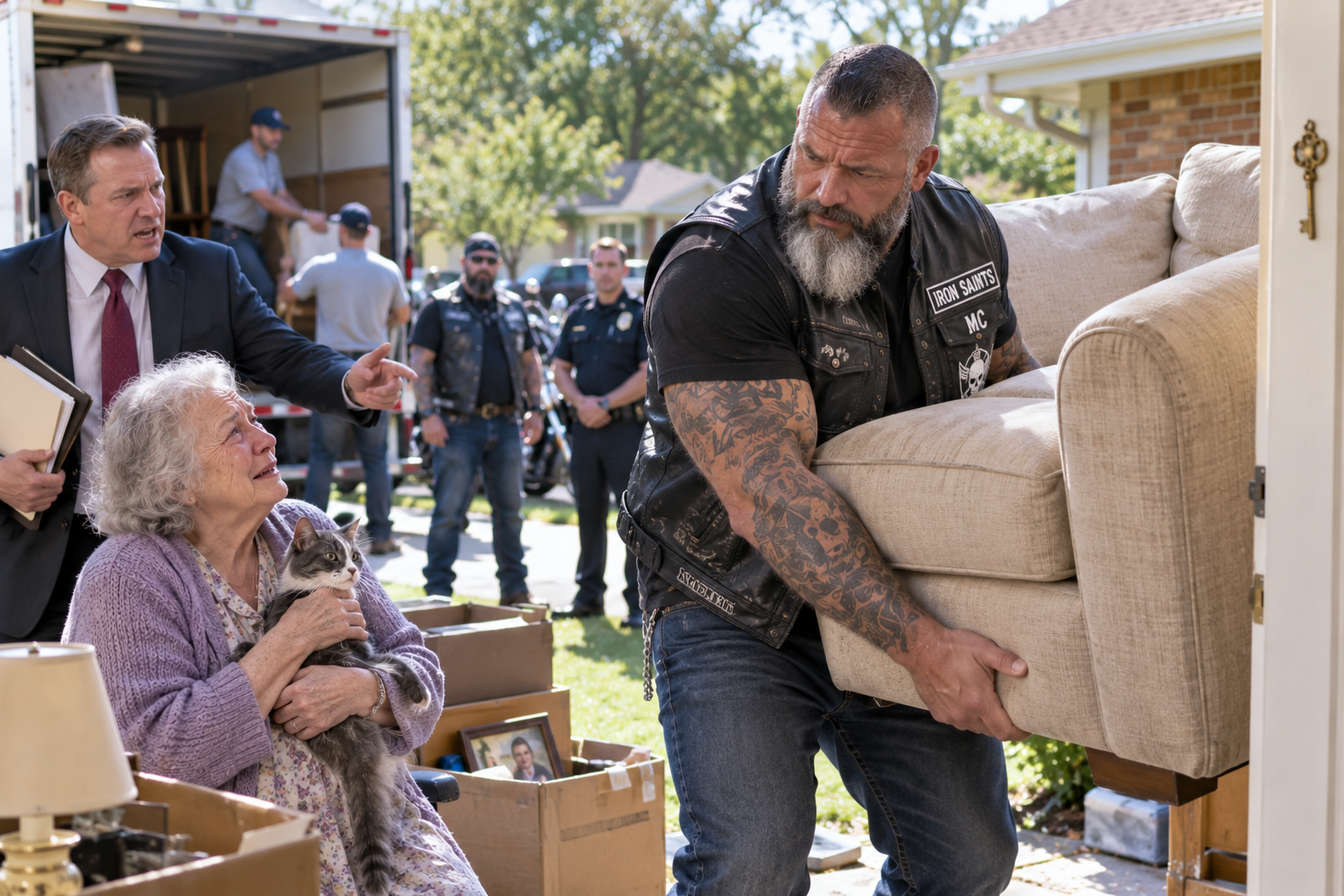
She pointed toward the sofa he’d carried back inside months earlier.
“You know that thing weighs nearly two hundred pounds?”
Hammer smiled.
“You could’ve mentioned that before I picked it up.”
Eleanor laughed.
Then her expression softened.
“Thirty years ago, I gave a boy a key because he needed somewhere safe to sleep.”
She looked toward the bikers helping stack chairs.
“I didn’t know what kind of man would bring it back.”
Hammer closed his fist around the old brass key.
He had spent decades believing he still owed Eleanor for eleven weeks in a cold Memphis garage.
He finally understood the debt differently.
Eleanor hadn’t given him a place to hide from his life.
She had given him a door—and taught him that every morning, he still had to choose to open it.