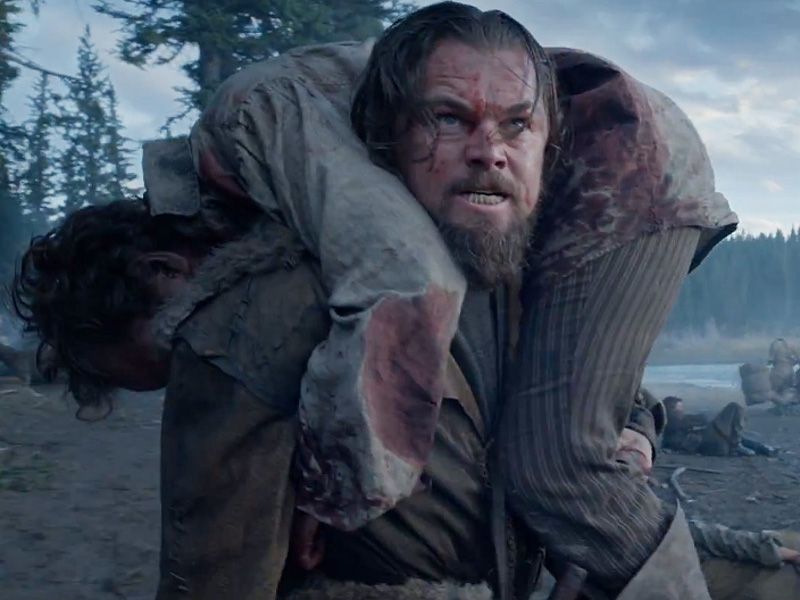
The Revenant: Leonardo DiCaprio’s Brutal Survival Epic That Finally Won Him the Oscar
The Revenant: Leonardo DiCaprio’s Brutal Survival Epic That Finally Won Him the Oscar
Left for dead in a frozen wilderness, betrayed by the men who were supposed to protect him, and separated from civilization by hundreds of miles of unforgiving terrain, one frontiersman refuses to die.
That is the brutal premise at the heart of The Revenant (2015), Alejandro G. Iñárritu’s epic Western survival drama starring Leonardo DiCaprio in the performance that finally earned him the Academy Award for Best Actor.
Set in 1823, the film follows frontiersman Hugh Glass, an experienced tracker guiding a fur-trapping expedition through the dangerous American wilderness.
From its opening moments, the expedition feels vulnerable. The landscape is beautiful but merciless, and danger can appear without warning.
Then Glass experiences an encounter that changes everything.
While scouting alone, he is viciously attacked by a grizzly bear. He survives, but his injuries are catastrophic. Unable to walk and barely able to communicate, Glass becomes a burden to the remaining members of the expedition as they attempt to escape the wilderness.
Their captain initially refuses to abandon him.
Eventually, however, several men are left behind to remain with Glass until his expected death.
One of them is John Fitzgerald, played by Tom Hardy.
And that decision sets the real story in motion.
The Betrayal That Changes Everything
Fitzgerald has little interest in sacrificing his own survival for a man he believes is already dying.
What follows becomes far more disturbing than simply leaving Glass behind.
After a devastating confrontation involving Glass and his son Hawk, Fitzgerald abandons the severely wounded frontiersman and continues toward safety.
Glass should have died there.
Instead, he begins moving.
At first, survival means little more than crawling.
He drags his battered body across the frozen ground. He struggles for food. He faces freezing temperatures, rivers, hostile terrain and injuries that would seemingly make continuing impossible.
Every mile becomes another battle.
Yet something stronger than physical survival is pulling him forward.
Glass remembers what happened.
And he knows who was responsible.
Leonardo DiCaprio at His Most Physically Committed
The Revenant became famous not only for its story but also for the extraordinary physical intensity of Leonardo DiCaprio’s performance.
For long stretches of the movie, Glass communicates less through dialogue than through movement, breathing, pain and sheer determination.
The audience watches him crawl, stumble and fight against an environment that seems determined to erase him.
DiCaprio’s performance earned him the Academy Award for Best Actor, his first competitive acting Oscar after several previous nominations.
But the performance works because the physical suffering serves something deeper.
Glass is not simply trying to stay alive.
Grief and betrayal have transformed survival into a mission.
The men who abandoned him believe the wilderness has finished the job for them.
They have no idea he is coming back.
Tom Hardy Creates a Different Kind of Threat
Opposite DiCaprio is Tom Hardy as John Fitzgerald, a character driven largely by self-preservation.
Fitzgerald is dangerous precisely because his decisions often come from a brutal survival instinct rather than the behavior of a conventional Western villain.
Hardy received an Academy Award nomination for Best Supporting Actor for the performance.
As Glass slowly makes his way through the wilderness, the distance between the two men begins shrinking.
That gives The Revenant its relentless momentum.
The question is no longer simply whether Glass can survive.
It becomes whether he can survive long enough to reach the man who believes he is dead.
A Wilderness That Feels Like Another Character
Director Alejandro G. Iñárritu and cinematographer Emmanuel Lubezki make the landscape essential to the film.
Towering mountains, frozen rivers, enormous forests and vast stretches of snow dwarf the people moving through them.
Much of the production became known for its demanding approach to filming in natural environments and making extensive use of natural light.
The result is a Western that often feels startlingly immediate.
The camera moves through chaotic encounters, follows characters across enormous landscapes and lingers on Glass during moments when simply breathing appears difficult.
There is very little romantic about this version of the frontier.
Cold can kill.
Hunger can kill.
A single injury can become catastrophic.
And help may be days away.
That realism makes Glass’s journey increasingly difficult to watch — and almost impossible to look away from.
More Than a Revenge Story
On the surface, The Revenant appears to be a straightforward tale of survival and vengeance.
But underneath the brutality are questions about grief, justice and what remains of a person after nearly everything has been taken away.
Glass is driven forward by memories of his family, particularly his son.
Those memories blur with dreams and visions as exhaustion pushes him closer to death.
The film gradually asks whether revenge is actually keeping Glass alive or preventing him from escaping the suffering that has consumed him.
That distinction becomes increasingly important as his journey approaches its conclusion.
Because eventually, survival gives Glass what once seemed impossible:
another chance to confront the past.
The Film That Finally Gave DiCaprio His Best Actor Oscar
Released in 2015, The Revenant became one of the most celebrated films of its awards season.
At the 88th Academy Awards, Alejandro G. Iñárritu won Best Director, Emmanuel Lubezki won Best Cinematography, and Leonardo DiCaprio won Best Actor.
The Oscar became especially memorable because audiences had spent years watching DiCaprio deliver acclaimed performances without winning in the category.
Yet reducing The Revenant to “the movie that finally gave DiCaprio an Oscar” misses what makes it so memorable.
This is a film built around endurance.
Its central character loses almost everything, is abandoned in a place where survival appears impossible, and then refuses to disappear.
The people who left Hugh Glass behind believed they were walking away from a dying man.
What they failed to understand was that Glass still had one reason to keep moving.
And across the frozen wilderness of The Revenant, that reason proves powerful enough to bring him back from the edge of death.