Part 2: The Name on the Clubhouse Wall
Part 2: The Name on the Clubhouse Wall
For several seconds, I thought I’d misheard her.
“Thomas Maddox?”
Eleanor nodded.
“My husband.”
I sat down beside her on the bus.
“My father was Thomas Maddox.”
Her face went pale.
Then she whispered, “What was your mother’s name?”
“Carol.”
Eleanor closed her eyes.
That was when I realized this wasn’t going to be the reunion I’d imagined.
Thomas hadn’t been living some secret second life.
Eleanor explained that she’d married him years before he ever met my mother.
They had been young. Thomas had recently left the Army and struggled to settle into civilian life. Their marriage lasted less than three years.
There were no children.
Eventually they divorced.
Thomas moved west.
Eleanor remarried.
They lost contact.
“So why does my motorcycle club have his photograph?”
She looked confused.
I showed her a picture from my phone.
Our clubhouse wall displayed Thomas beside several early Iron Ravens members. Underneath were the words:
THE MAN WHO DISAPPEARED.
Eleanor touched the screen.
“He didn’t disappear.”
Then she told me something my father had never mentioned.
After their divorce, Thomas had volunteered with a roadside assistance group made up largely of veterans and motorcycle riders.
He carried fuel.
Tools.
Blankets.
He stopped for stranded motorists long before cell phones made calling for help easy.
One winter night, Thomas helped a young motorcyclist whose bike had broken down outside Dayton.
That rider was Raymond “Hawk” Lawson.
The future founder of the Iron Ravens.
Thomas stayed with Hawk for nearly six hours in freezing weather until a tow truck arrived.
Years later, Hawk founded the club and tried finding Thomas.
He never could.
So he hung Thomas’s photograph in the clubhouse.
Not as a missing person.
As the man whose roadside kindness inspired one of the club’s earliest rules:
Nobody gets left beside the road.
I had misunderstood that wall for twenty years.
But there was another question.
“How do you know all this?”
Eleanor smiled.
“Because Hawk found me.”
After Thomas died, Hawk eventually located Eleanor while trying to learn more about the stranger who had helped him.
She gave Hawk the photograph.
She just never knew where it ended up.
Then she asked the question I’d been avoiding.
“When did your father die?”
“Twelve years ago.”
Her expression softened.
“Was he happy?”
I thought about my father.
The garage radio always playing too loudly.
Sunday breakfasts.
The ancient motorcycle he refused to sell.
The way he’d stop for every stranded vehicle we passed.
“Yeah,” I said. “I think he was.”
Eleanor nodded.
“Good.”
At the next stop, I got off the bus with her.
Her apartment was four blocks away.
I carried the groceries.
She complained the entire way that she was perfectly capable of carrying one bag herself.
I believed her.
I carried both anyway.
At her apartment, Eleanor disappeared into a bedroom and returned with a small cardboard box.
“These belong to you more than they belong to me.”
Inside were photographs.
Thomas in Army fatigues.
Thomas beside an old motorcycle.
Thomas and Eleanor at twenty-three, laughing outside some diner.
Then I found one photograph that stopped me.
My father was kneeling beside a broken-down motorcycle.
On the back Eleanor had written the date.
It was the night he helped Hawk Lawson.
I brought the photograph to the clubhouse.
Hawk was eighty-one by then and rarely attended meetings.
When he saw it, he sat down.
“That’s him.”
I told him everything.
Then I pointed toward the words beneath Thomas’s picture.
“The Man Who Disappeared.”
Hawk stared at them.
“You don’t like it?”
“He didn’t disappear.”
The old biker nodded.
The next morning, we changed the plaque.
It now reads:
THOMAS MADDOX
THE MAN WHO STOPPED
Underneath:
Nobody gets left beside the road.
Eleanor came to the clubhouse when we unveiled it.
She stood beside me looking at the photograph of the young man we’d both known in completely different chapters of his life.
“He still doing this?” she asked.
“Doing what?”
She pointed toward the plaque.
“Making strangers help each other.”
I laughed.
“Apparently.”
Eleanor died three years later.
Until then, every Thursday I drove over with groceries.
She never let me pay for them.
And she never let me carry both bags.
We compromised.
One each.
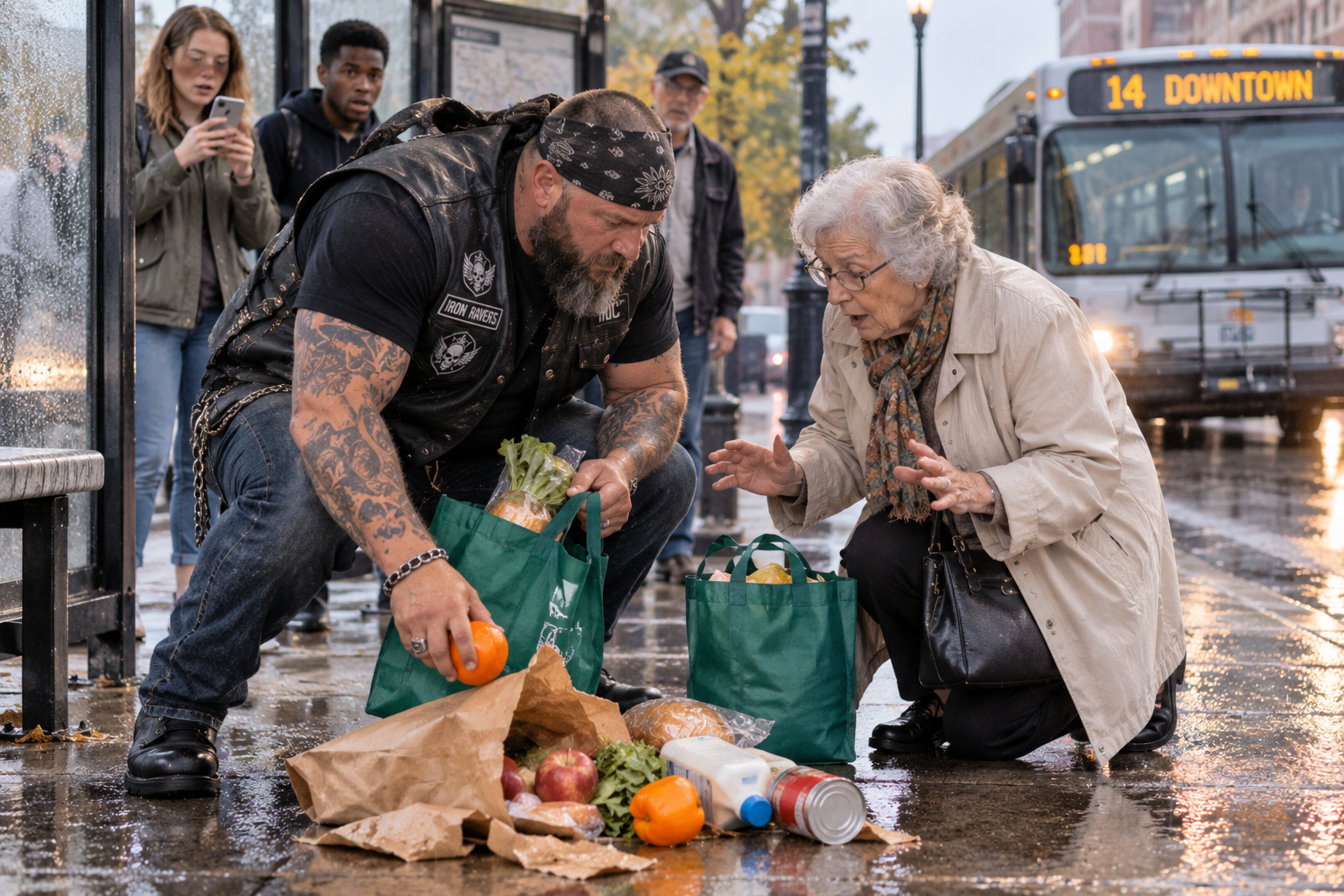
Funny thing is, none of it would’ve happened if I hadn’t grabbed a collapsing paper bag from an old woman’s hands without explaining myself.
Everyone at that bus stop thought they understood what they were seeing.
They didn’t.
Neither did I.
Because sometimes the smallest act of paying attention doesn’t just save groceries from hitting wet pavement.
Sometimes it opens a door into a part of your own family you never knew existed.