The Hateful Eight: Eight Strangers, One Blizzard, and a Secret That Turns a Remote Cabin Into a Trap
The Hateful Eight: Eight Strangers, One Blizzard, and a Secret That Turns a Remote Cabin Into a Trap
Eight strangers. A violent Wyoming blizzard. One isolated building with nowhere to run.
That deceptively simple setup becomes a pressure cooker in The Hateful Eight (2015), Quentin Tarantino’s revisionist Western mystery that transforms a snowbound shelter into a claustrophobic game of suspicion, deception, and survival.
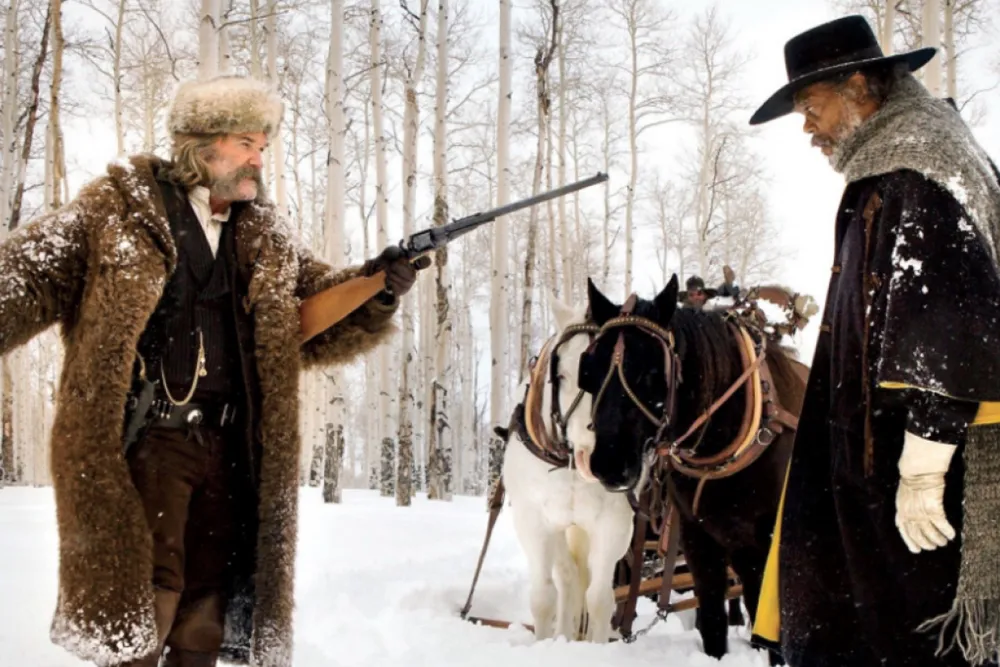
Set several years after the American Civil War, the film begins with bounty hunter Major Marquis Warren, played by Samuel L. Jackson, stranded in the frozen Wyoming wilderness. His journey brings him into contact with fellow bounty hunter John Ruth, played by Kurt Russell, who is transporting wanted fugitive Daisy Domergue, played by Jennifer Jason Leigh, to Red Rock.
But a rapidly worsening storm forces the travelers to abandon their original plans and seek refuge at Minnie’s Haberdashery.
That is where the real mystery begins.
Inside, they encounter several strangers already waiting for the blizzard to pass. Among them are Chris Mannix, portrayed by Walton Goggins, who claims he is traveling to become Red Rock’s new sheriff; mysterious Englishman Oswaldo Mobray; cowboy Joe Gage; former Confederate general Sanford Smithers; and Bob, who says he is looking after the establishment while Minnie is away.
On the surface, they are simply travelers trapped by the same storm.
Almost immediately, however, Warren senses that something is wrong.
Small details refuse to fit together. Stories sound convincing until someone asks the wrong question. Old Civil War loyalties create immediate hostility, while nearly everyone inside the building appears to have a reason to distrust somebody else.
And there is another problem: John Ruth is convinced someone may be waiting for an opportunity to free Daisy.
With the blizzard making escape nearly impossible, Minnie’s Haberdashery becomes less of a refuge and more of a locked-room mystery.
A Western Built Around Suspicion
Rather than relying on sweeping horseback chases and traditional frontier heroics, The Hateful Eight spends much of its running time placing its characters in the same confined space and allowing suspicion to slowly consume them.
Tarantino turns conversations into confrontations.
A casual remark can expose a contradiction. A forgotten object can suddenly become evidence. Even something as ordinary as a cup of coffee can carry enormous consequences.
The audience is placed in essentially the same position as the characters: watching everyone closely and trying to determine who is telling the truth.
Samuel L. Jackson’s Major Warren becomes especially important to that dynamic. He observes the room carefully, challenges the stories he hears, and recognizes details others might dismiss.
Yet Warren is hardly presented as a conventional Western hero.
That is part of the film’s central tension. Almost everyone inside Minnie’s has secrets, prejudices, questionable motives, or a violent history. The title itself warns audiences not to expect an easy division between heroes and villains.
An Extraordinary Ensemble
Much of the movie’s power comes from its ensemble cast.
Alongside Jackson, Russell, Leigh and Goggins, the film features Tim Roth, Demián Bichir, Michael Madsen and Bruce Dern, with each character bringing another source of uncertainty into the room.
Jennifer Jason Leigh’s performance as Daisy Domergue became particularly notable, earning her an Academy Award nomination for Best Supporting Actress.
But the film’s performances work because they operate as pieces of the same puzzle.
A glance across the room matters. A character remaining strangely quiet matters. A story that initially sounds unimportant may become crucial later.
That structure encourages viewers to remember what they saw and heard because Tarantino repeatedly returns to earlier details and changes their meaning.
The Blizzard Is Only Keeping Them Together
Outside, the Wyoming landscape is almost completely consumed by snow.
Inside, another storm is forming.
The characters carry the unresolved divisions of post-Civil War America into the cabin with them. Union and Confederate histories remain painfully close, and racial hostility, revenge and personal resentment repeatedly threaten the fragile peace.
The physical isolation makes everything worse.
Nobody can simply walk away.
As suspicion grows, the central question becomes increasingly difficult to ignore: Did these people arrive at Minnie’s Haberdashery by coincidence, or is someone inside following a plan?
That question pushes The Hateful Eight from Western drama toward murder mystery.
Then the situation changes.
Evidence begins emerging that suggests at least one person inside has been lying about something far more important than their identity.
From that point forward, every previous conversation deserves to be reconsidered.
Quentin Tarantino’s Snowbound Mystery
Released in 2015, The Hateful Eight was written and directed by Quentin Tarantino and became his distinctive take on the classic locked-room mystery.
Instead of a glamorous mansion or luxury train, the suspects are trapped inside an isolated stagecoach stopover.
Instead of a polished detective calmly interviewing them, the investigation unfolds among bounty hunters, fugitives, soldiers and strangers who have very little reason to cooperate.
The film was also notable for its visual presentation. Cinematographer Robert Richardson shot it using Ultra Panavision 70, creating unusually expansive imagery for a story that eventually becomes intensely confined.
Ennio Morricone composed the score, which won the Academy Award for Best Original Score.
That combination creates one of the movie’s strangest pleasures: enormous, beautiful images of the American frontier surrounding characters who gradually find themselves trapped within just a few rooms.
Nothing Inside Minnie’s Is Quite What It Seems
What makes The Hateful Eight so effective is not simply discovering who is lying.
It is realizing how many clues were visible before their significance became clear.
Tarantino repeatedly encourages the audience to form conclusions and then introduces another piece of information that forces those conclusions to be reconsidered.
The movie becomes increasingly violent as the mystery unfolds, but beneath that brutality is an elaborate game of observation.
Who arrived first?
Who knows Minnie?
Whose story contains a contradiction?
And why do certain seemingly ordinary details inside the haberdashery feel wrong?
By the time those answers begin emerging, the blizzard outside almost feels secondary.
The eight strangers were worried about surviving the storm.
They should have been worried about surviving one another.
The Hateful Eight turns that simple premise into a dark, unpredictable Western mystery where almost everyone has something to hide — and one carefully concealed truth transforms a temporary shelter into a trap.