Part 2: The Report Her Family Never Knew Existed
Part 2: The Report Her Family Never Knew Existed
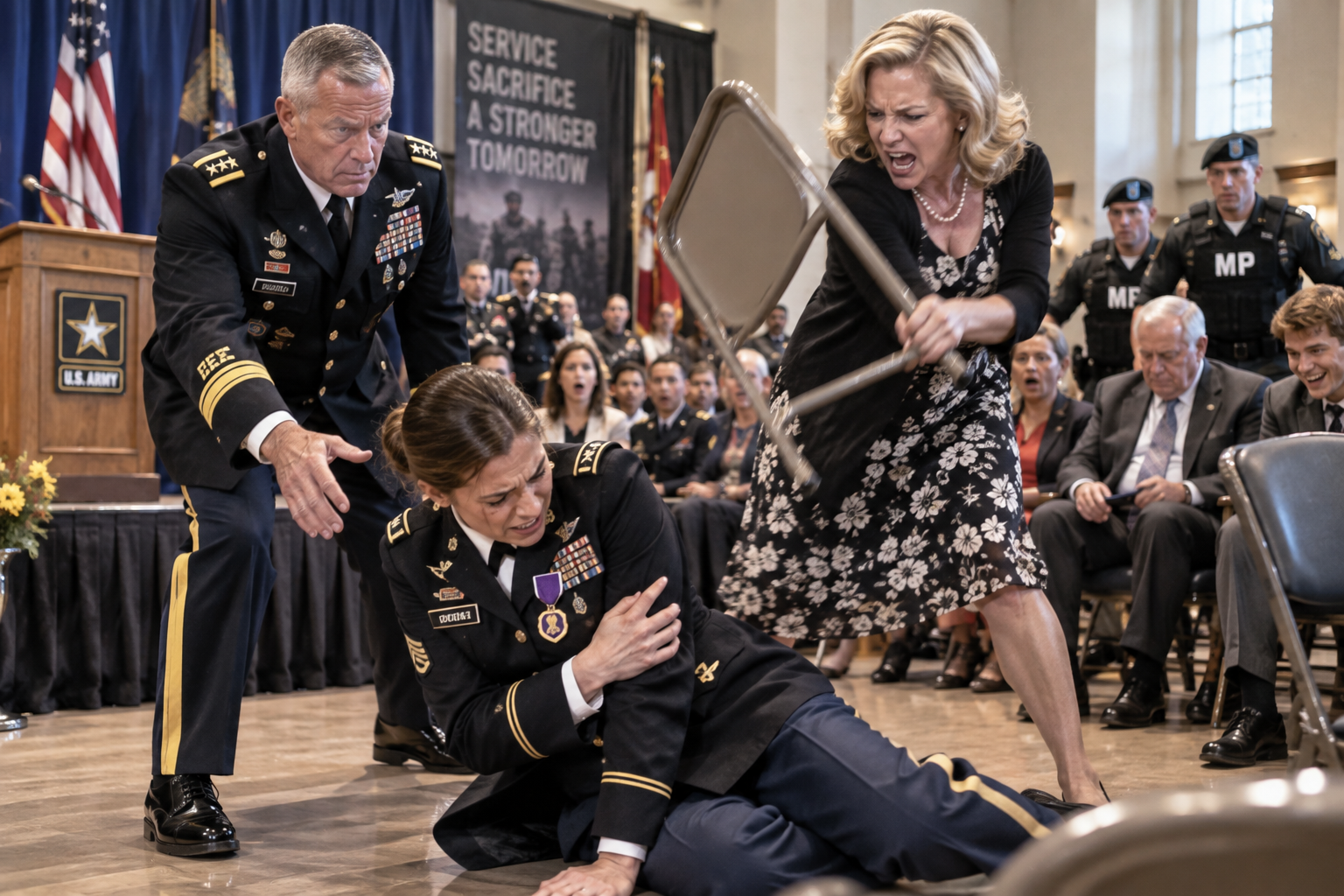
General Hayes held the sealed report in both hands.
Emma forgot about Linda.
Forgot about the MPs moving down the aisle.
Even the pain in her arm seemed distant.
“Sir,” she whispered. “You don’t have to do this.”
Hayes looked at her.
“For three years, Captain, you protected everyone else’s privacy. Today I’m only reading what has been cleared for release.”
Then he faced the audience.
Three years earlier, Emma had been serving overseas when a convoy carrying American personnel was forced to stop after a serious incident blocked its planned route.
Communications were unreliable.
Several soldiers were injured.
The safest extraction point was miles away.
Emma had been wounded too.
But she noticed something others initially missed: the route they were preparing to use would leave the group dangerously exposed.
She helped reorganize the evacuation, coordinated alternate movement with supporting personnel, and remained with the last group until everyone who could be moved was accounted for.
Thirty-seven Americans eventually reached safety.
Emma never told her family.
Not because she was ashamed.
Because some details remained restricted, and because she hated turning the worst day of other people’s lives into a story about herself.
Hayes lowered the report.
“The Purple Heart recognizes Captain Porter’s wounds.”
He paused.
“But many people in this room know her for what she did after she was wounded.”
Several soldiers in the rear stood.
Then more.
Emma recognized some of them.
Men and women from that deployment.
Her father finally looked up.
His face had changed.
For years, Linda had called Emma’s military career attention-seeking. Her father had repeatedly avoided confrontation because silence was easier.
Now that silence had nowhere to hide.
Linda pointed toward Emma again.
“She never told us any of this!”
Emma finally answered.
“You never asked.”
That ended the argument.
The MPs took control of the immediate situation while medical personnel examined Emma. Linda’s actions were documented and handled through the appropriate civilian and military installation procedures; nobody in the auditorium needed to decide the legal outcome themselves.
Imaging later confirmed a fracture.
As Emma waited for treatment, her father appeared outside the examination room.
He stood there alone.
“Emma…”
She didn’t answer.
“I should have stood up.”
“Yes.”
He seemed surprised by how quickly she said it.
“I didn’t know what to do.”
Emma looked at him.
“You’ve had years to decide.”
He lowered his eyes.
For once, Emma didn’t rescue him from the uncomfortable silence.
She had spent too much of her life doing that.
Weeks later, her arm was immobilized and healing when General Hayes visited her office.
“You angry with me?” he asked.
“For reading the report?”
He nodded.
“A little.”
“Fair.”
Emma smiled.
Then Hayes placed something on her desk.
It was a photograph from the ceremony.
Not the attack.
Not the medal presentation.
The photograph showed Emma catching his elbow when he’d stumbled.
“You know what I noticed?” Hayes asked.
“What?”
“You’d just received one of the most significant recognitions of your career, there were cameras everywhere, and the second somebody beside you needed help, you forgot the cameras existed.”
Emma looked at the photograph.
“That wasn’t bravery.”
“I know.”
Hayes smiled.
“That’s why it mattered.”
Months later, Emma returned to duty.
Her relationship with her father didn’t magically repair itself. Apologies couldn’t erase years of silence, and Emma no longer pretended they could.
But she gave him the opportunity to prove his words through actions.
As for the Purple Heart, Emma eventually placed it inside a small display case.
Beside it she kept no photograph of herself.
Instead, she placed a picture of thirty-seven soldiers standing together after returning home.
Because Linda had believed the medal was what made Emma important.
Her father had believed staying silent kept the family together.
Both had misunderstood her.
Emma Porter never needed a medal to prove who she was.
The clearest evidence was thirty-seven people who were still able to go home because, on the worst day of her life, she refused to leave anyone behind.