Part 2: The Camera They Forgot to Check
Part 2: The Camera They Forgot to Check
“Sir, they planted the wrong bag.”
Calvin said it softly.
Officer Brett Cheney still heard him.
His smile disappeared.
“What did you say?”
Calvin kept both hands visible against the SUV.
“Nothing.”
Cheney looked down at the plastic evidence bag he’d just pulled from Nate’s document case.
Then toward the highway.
The first black government SUV was getting closer.
His partner stepped beside him.
“We need to go.”
Cheney snapped, “Shut up.”
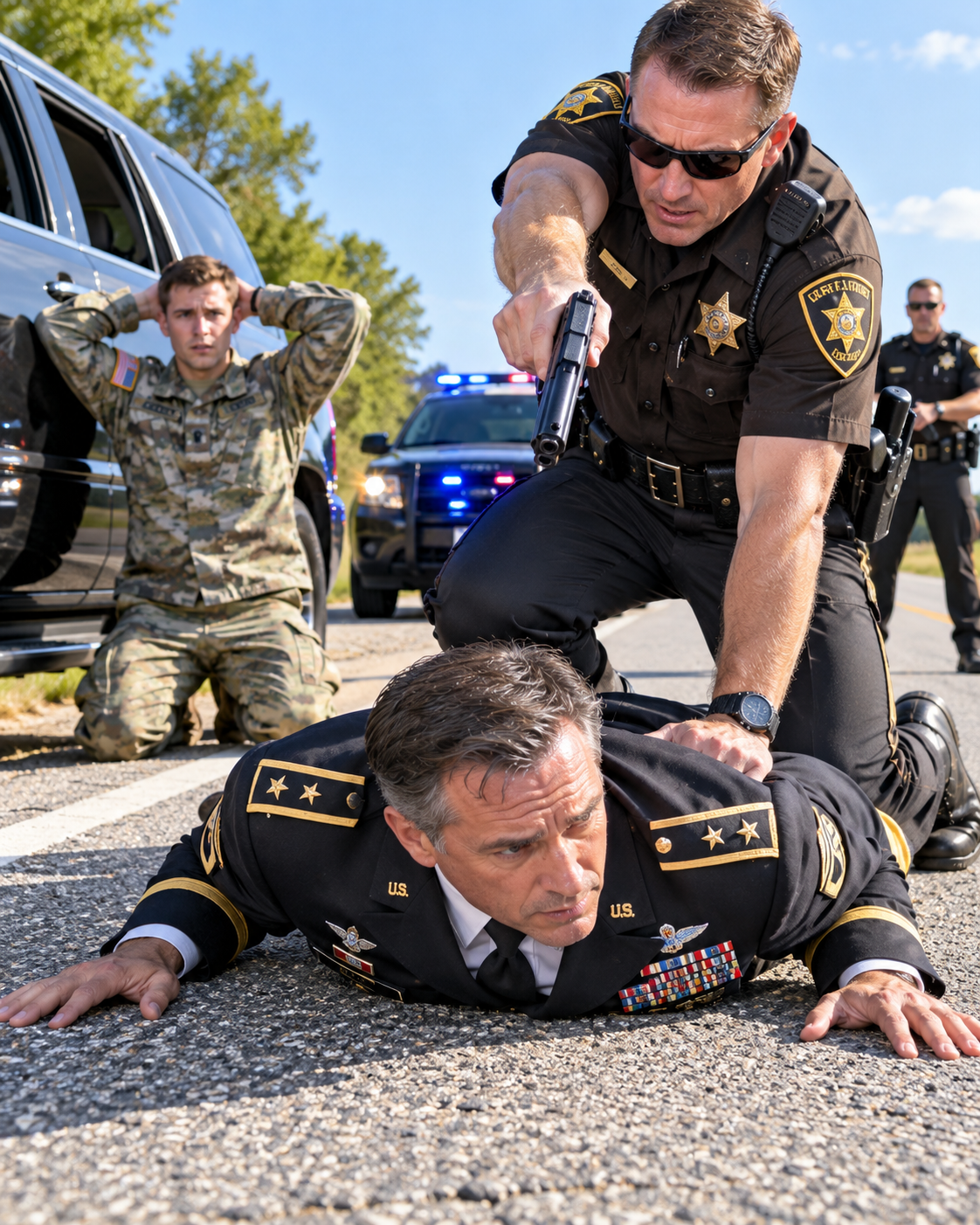
Major General Nathaniel Langford remained on his knees.
Calm.
Watching.
He had spent decades learning that frightened people became dangerous when they realized a plan was collapsing.
So Nate didn’t threaten them.
He didn’t mention rank again.
He simply said:
“Officer, put the bag down and step away from my vehicle.”
Cheney raised his pistol.
“Don’t tell me what to do.”
Nate didn’t move.
The black SUV stopped thirty yards away.
Two investigators stepped out, hands visible.
Behind them came a Georgia State Patrol vehicle.
No helicopters.
No dramatic military assault.
Nate’s wife hadn’t “sent the Army.”
After losing contact with him, she’d followed an emergency notification procedure. Nate’s command confirmed his unexpected stop, while the unusual circumstances were relayed to appropriate civilian authorities.
What arrived was much more dangerous to a dishonest officer than a helicopter.
Independent witnesses.
One investigator called across the shoulder.
“Officer Cheney, lower the weapon.”
For several seconds, nobody moved.
Then Cheney slowly holstered it.
Nate stood only when instructed.
The investigators separated everyone.
The plastic bag remained where Cheney had dropped it.
Nobody touched it until it could be photographed and properly collected.
Then Nate pointed toward his windshield.
“Check the fleet camera.”
Cheney’s face changed again.
The camera wasn’t classified.
It wasn’t secret surveillance.
It was a commercially available security system installed after military vehicles in Nate’s organization had experienced several break-ins.
The recording was reviewed later under proper procedures.
What it showed transformed the stop.
Cheney had approached Nate’s SUV already carrying something small in his left hand.
While his partner kept Calvin turned toward the vehicle, Cheney opened the rear passenger door.
His body briefly blocked the camera.
But not completely.
The footage appeared to show his hand entering the document case before withdrawing.
Investigators didn’t declare guilt beside the highway.
They preserved the video.
They collected the officers’ body cameras.
They secured dispatch records.
Then they discovered something else.
Cheney’s body camera hadn’t malfunctioned.
According to its internal log, it had been manually deactivated shortly before the stop.
His partner’s camera had been turned off too.
That alone didn’t prove the larger allegation.
But it gave investigators another question that demanded an answer.
And Nate’s case wasn’t the first.
Within days, attorneys and investigators began reviewing earlier complaints involving the same officers.
Several motorists had previously alleged that evidence appeared during searches after body cameras were inactive.
Some complaints lacked sufficient evidence.
Others had been dismissed after defendants accepted plea agreements.
Now those cases received new scrutiny.
One involved a 22-year-old warehouse worker.
Another involved a traveling nurse.
A third involved a retired schoolteacher who had spent thousands of dollars defending himself before the charge was dropped.
The investigation widened.
Cheney and his partner were placed on administrative leave.
Search and personnel records were preserved.
Prosecutors began reviewing affected cases.
Nate refused every interview request.
Reporters wanted the obvious headline:
TWO-STAR GENERAL TARGETED IN CORRUPT TRAFFIC STOP.
But Nate believed that missed the point.
Three weeks later, he finally spoke publicly.
Not in uniform.
Not from a Pentagon podium.
He stood outside a courthouse in a plain navy suit.
“What happened to me matters,” he said. “But my rank is the least important part.”
Cameras clicked.
“If procedures protect only people powerful enough to force an investigation, then those procedures aren’t protecting the people who need them most.”
That evening, Nate finally reached his mother’s house.
She opened the door, looked at him for three seconds and said:
“You’re late.”
Nate laughed.
“Long story.”
“I saw the news.”
“Then you know the story.”
His mother shook her head.
“I know television’s version.”
She hugged him.
Inside, Calvin was already sitting at the kitchen table eating peach cobbler.
Nate stared at him.
“You got here before me?”
“Your mother likes me better, sir.”
“Apparently.”
For the first time since the highway stop, Nate laughed without forcing it.
Months later, the investigations and court proceedings were still moving through the system. Some allegations were substantiated; others remained disputed. Cases connected to the officers were reviewed individually rather than automatically erased.
Nate never claimed that his uniform had saved him.
It hadn’t.
His rank had helped people notice quickly.
The camera had preserved what happened.
Civilian investigators had followed the evidence.
And that distinction stayed with him.
Because on that Georgia highway, Cheney had believed he was confronting an important man.
He wasn’t.
He was confronting the same thing every public official should face when exercising authority:
A record of what actually happened.
Nate had commanded thousands of soldiers.
He had served overseas.
Stars sat on his shoulders.
But none of those things should have been necessary for his word to matter.
That became the lesson he repeated whenever anyone asked about the traffic stop.
The system hadn’t proven itself because a general was protected.
It would prove itself only when the next person pulled onto that shoulder had no stars, no title, no powerful contacts—and still received exactly the same protection.