Part 2: The Reason Sergeant Major Brooks Was Really There
Part 2: The Reason Sergeant Major Brooks Was Really There
“Marcus, that man is the reason I’m in this prison.”
I looked through the bars.
Officer Daniel Crowe was still standing near the end of the tier.
He wasn’t watching us.
At least, he was pretending not to.
“What did he do?”
Samuel folded the legal document carefully.
“That’s what my attorney is trying to prove.”
Eight years earlier, Samuel had been working as a security consultant after retiring from the Army. A veterans’ housing nonprofit hired him to review missing funds from a renovation program.
Nearly $600,000 had moved through subcontractors that seemed legitimate on paper.
Samuel followed the invoices.
One company led to another.
Eventually, the trail reached a construction business partly controlled by Crowe’s brother-in-law.
Crowe had been a county investigator then.
Samuel reported what he’d found.
Two weeks later, police searched Samuel’s office.
They found financial records prosecutors said connected him to the missing money.
Samuel insisted the documents weren’t his.
Nobody believed him.
The decorated retired soldier became the easiest headline in the case:
VETERAN STOLE FROM VETERANS.
He was convicted.
Crowe later left county employment and became a corrections officer.
“What about the money?” I asked.
“Never found in my possession.”
“Then why were you convicted?”
Samuel looked at me.
“Because trials aren’t movies, Marcus. Sometimes a pile of circumstantial evidence is enough to persuade a jury.”
Now his new attorney had discovered something.
Metadata from archived accounting files indicated several documents attributed to Samuel had been created after investigators had already seized his office computer.
More importantly, an evidence-transfer record carried Crowe’s employee number during a period when Crowe had denied handling the material.
It didn’t prove Samuel innocent by itself.
But it was enough to support his request for a new hearing.
Then I understood.
“Does Crowe know?”
Samuel glanced toward the tier.
“I think he does now.”
The next morning, Samuel asked to speak privately with the prison’s investigative staff.
He reported the cafeteria incident and disclosed the potential conflict involving Crowe.
Lieutenant Harris—the officer who had recognized him—didn’t try to solve the case himself.
He documented the concern and escalated it.
Crowe was reassigned away from Samuel’s housing unit while the matter was reviewed.
Bull was disciplined separately for the cafeteria confrontation.
That surprised me.
I’d expected Samuel’s story to end with some legendary old soldier beating everybody who came near him.
Instead, he spent the next several weeks doing something much harder.
Waiting.
His attorney filed records.
Investigators interviewed witnesses.
Forensic specialists examined archived digital evidence.
Then one afternoon, Samuel received an envelope.
He read the first page twice.
His hands began trembling.
“What?”
He handed it to me.
A judge had granted an evidentiary hearing.
Not freedom.
Not yet.
But a courtroom.
A chance to challenge the evidence that had put him there.
Months later, testimony established serious problems with how parts of the original investigation had been documented and preserved. The disputed digital records could no longer be treated with the certainty presented at Samuel’s first trial.
The court eventually vacated his conviction and ordered further proceedings.
Prosecutors reviewed the remaining evidence.
Without the disputed material, they chose not to retry him.
Samuel Brooks walked out of Redstone at seventy-three.
I didn’t.
I still had four months left on my sentence.
Before leaving, Samuel stopped outside our cell.
“You know what kept me alive in places much worse than this?”
I expected something about Special Forces.
Instead he tapped the battered paperback in his hand.
“Routine.”
He pointed toward my bunk.
“Make it every morning.”
Then toward the small desk where I’d begun studying for my GED.
“Finish what you started.”
Finally, he pointed at me.
“And when somebody tries to turn you into the worst thing you’ve ever done, don’t help them.”
I swallowed hard.
“You coming back?”
Samuel smiled.
“Marcus, nobody should voluntarily come back here.”
Four months later, I walked through the release gate carrying everything I owned in one plastic bag.
My mother was waiting.
So was my little sister.
And leaning against an old pickup twenty feet behind them was a thin seventy-three-year-old man holding two cups of coffee.
Samuel.
I laughed.
“You said you weren’t coming back.”
“I said I wasn’t coming inside.”
He handed me a cup.
A year later, I was working for a commercial electrical contractor.
Samuel helped me study for certification exams.
He never became some mythical grandfather who solved my life.
He simply answered the phone.
Sometimes that was enough.
Crowe’s conduct became part of a separate investigation. Samuel never celebrated whatever consequences followed.
When I once asked why, he said:
“Justice isn’t revenge wearing a clean shirt.”
I remembered that.
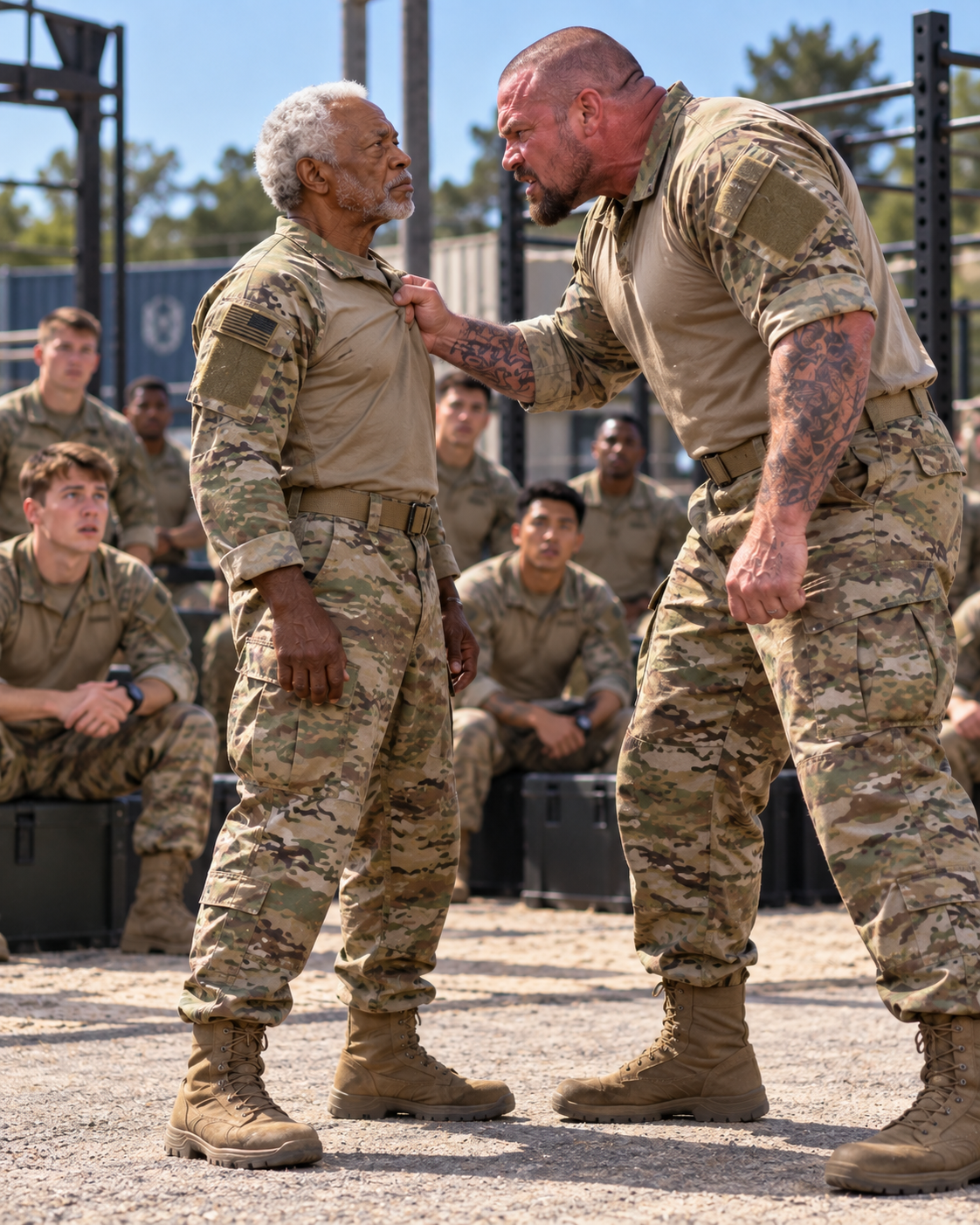
I also remembered the morning Bull shoved him.
Everyone in that cafeteria thought Samuel’s strength was revealed when he redirected a man nearly twice his size.
We were wrong.
His real strength came afterward.
He had spent twenty-eight years learning how to fight.
Then prison gave him every reason to become bitter.
Yet when his chance finally came, he didn’t use fists.
He used records.
Dates.
Evidence.
And patience.
The last time I visited him, that battered paperback was sitting on his porch.
I finally asked what book he’d been reading all those years.
Samuel handed it to me.
Inside the cover, he’d written one sentence:
“Strength is what remains when nobody is afraid of you.”
I looked at him.
“You write that?”
Samuel smiled.
“Had plenty of time.”
And only then did I understand why the quietest man in Redstone had never needed anyone there to fear him.