Part 2: The Riders Who Came to Stand Witness
Part 2: The Riders Who Came to Stand Witness
Friday arrived cold and gray.
By noon, Walter Hayes had considered closing the diner six times.
Ruth refused.
“If we hide,” she said, pouring coffee, “we’ll spend the rest of our lives wondering when they’re coming back.”
Walter looked through the window.
Two Montana Highway Patrol vehicles were parked near the fuel pumps. A county investigator sat inside an unmarked SUV farther down Route 12.
After receiving the threatening photograph, authorities had taken it seriously.
Walter and Ruth had been advised not to confront anyone.
They agreed.
At 4:38 p.m., Walter heard the first motorcycle.
One Harley rolled into the parking lot.
Then three more.
Then twenty.
Within half an hour, motorcycles stretched along the legal parking areas beside Route 12 and onto private land whose owners had agreed to accommodate them.
Walter stepped outside.
He couldn’t count the riders.
Hundreds, certainly.
More continued arriving.
But nobody blocked traffic.
Nobody carried weapons openly.
Nobody threatened anyone.
The riders simply parked, removed their helmets and waited.
A tall biker with a silver beard approached Walter.
“Ray Dawson.”
They shook hands.
“You’re the man I spoke with?”
Ray nodded.
Walter looked at the growing crowd.
“What exactly are you planning?”
“Nothing stupid.”
Ray pointed toward several men and women carrying folders.
“Some of these people knew what our four riders were investigating. Others have information of their own.”
“About Rusk?”
“About property acquisitions along Route 12.”
That was when Walter understood.
They hadn’t come to fight.
They had come to testify.
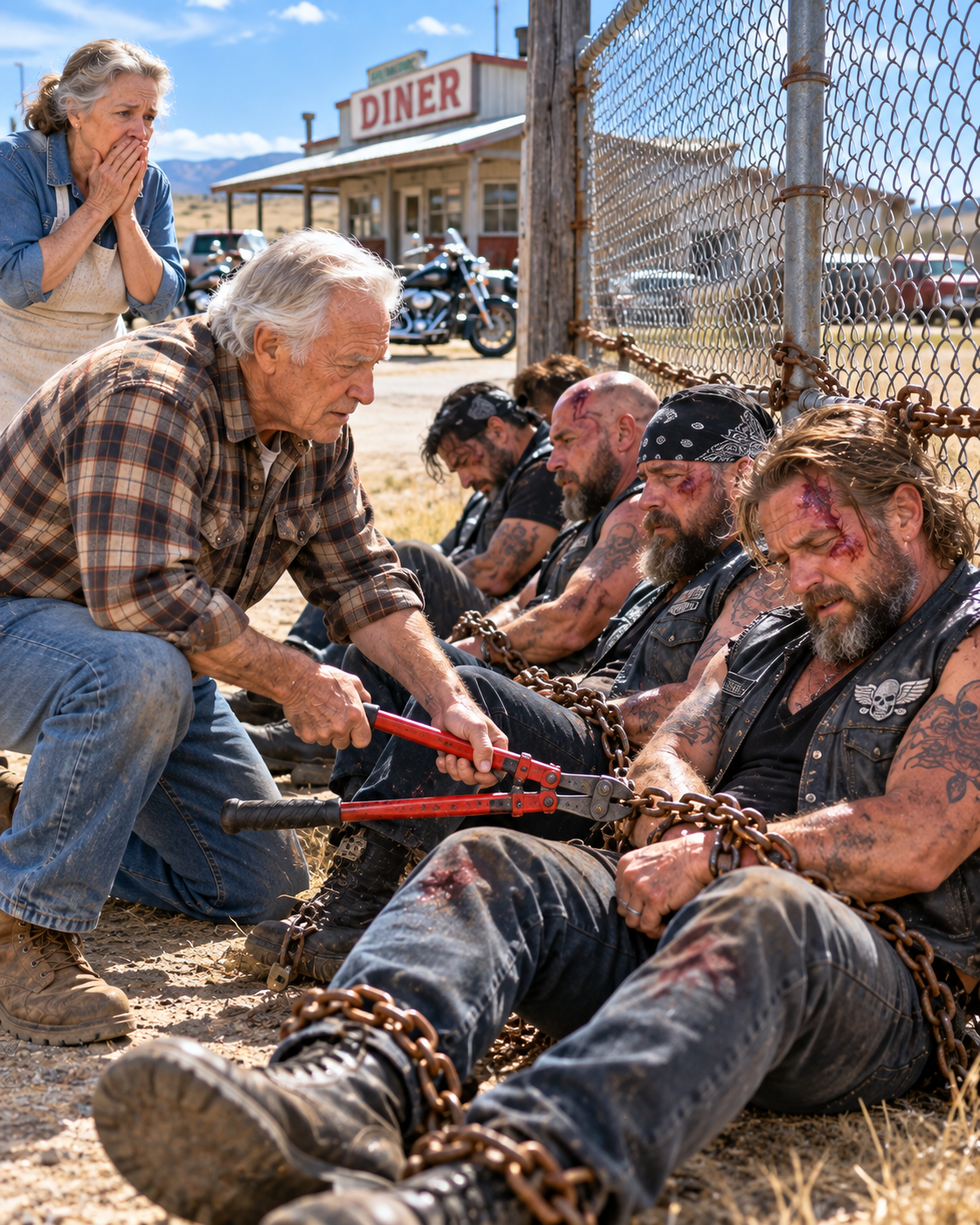
The four bikers Walter rescued belonged to a motorcycle organization that regularly helped veterans and rural families with transportation and emergency assistance.
Months earlier, one member had noticed several elderly property owners complaining about aggressive purchase offers.
The riders started collecting public records and connecting people with an attorney.
The map Walter found was part of that work.
According to the documents they had gathered, companies with overlapping business connections had been buying land along a proposed commercial transportation corridor.
Buying land wasn’t illegal.
Pressuring owners might be.
Threatening them certainly was.
And the handwritten payment list raised questions investigators now wanted answered.
At 5:46 p.m., a black pickup appeared.
Walter recognized it immediately.
The same truck he’d seen beyond the pasture.
It slowed.
Then stopped across the highway.
Nobody moved.
Ray remained beside Walter.
“Stay here.”
“No.”
Ray looked at him.
Walter shook his head.
“My property. My threat. But we do this correctly.”
He pulled out his phone.
The police already had the vehicle description.
Officers approached the truck.
The driver wasn’t Deacon Rusk.
It was one of his employees.
Inside the vehicle, investigators reportedly found items that required further examination, including photographs of several properties.
Walter’s diner was among them.
That still didn’t prove who had ordered the threats.
The employee was questioned.
The investigation continued.
Rusk denied involvement.
Walter didn’t celebrate.
Neither did Ray.
Evidence needed to establish responsibility.
Then the case widened.
The original four riders recovered and provided statements.
One remembered the building where they’d been held.
Another remembered a company logo on a vehicle.
Investigators compared their accounts with surveillance footage, phone records and property documents.
The supposed payment list wasn’t treated as proof by itself.
It became a roadmap.
Some names on it had innocent explanations.
Others raised harder questions.
One belonged to a county employee who had accessed property records repeatedly outside his normal duties.
Another payment corresponded closely with the date an elderly rancher withdrew a complaint about intimidation.
The badge-related name the biker had warned Walter about was referred for independent review rather than handled locally.
Weeks became months.
Eventually, prosecutors brought charges against several individuals connected to the assaults on the riders and threats against property owners. Rusk’s exact legal responsibility was determined through the evidence developed in the investigation rather than by the bikers gathered outside Walter’s diner.
For Walter, that distinction mattered.
He had taught American government for thirty-one years.
He wasn’t interested in replacing one kind of intimidation with another.
One evening, Ray asked him:
“Were you disappointed?”
“About what?”
“We brought all those motorcycles and nobody punched anybody.”
Walter stared at him.
Then both men laughed.
“No,” Walter said. “That’s exactly why it worked.”
The story people told afterward became exaggerated.
Some claimed two thousand bikers had surrounded the diner.
Walter never knew the number.
Others claimed the riders had come to defend him from an army of criminals.
That wasn’t true either.
What happened was less dramatic.
And better.
They came so Walter and Ruth wouldn’t stand alone.
They brought witnesses.
Documents.
Former property owners.
Veterans.
Local residents.
People willing to put their names on statements.
That frightened dishonest people far more than fists ever could.
Six months later, the four bikers returned to Hayes Route 12 Diner.
This time they came on motorcycles.
Walter recognized the oldest rider immediately.
His name was Mason “Bear” Callahan.
“You look better without a fence attached to you,” Walter said.
Mason grinned.
“Usually how I travel.”
Ruth brought four plates of pie.
When Mason tried paying, she slapped his hand away from his wallet.
“You spent a night chained behind my garbage cans. Pie’s included.”
Before leaving, Mason gave Walter something.
A small framed photograph.
It showed Walter standing beside Ruth outside the diner that Friday evening.
Motorcycles filled the background.
On the back, Mason had written:
COURAGE ISN’T STANDING ALONE.
IT’S STANDING UP LONG ENOUGH FOR GOOD PEOPLE TO FIND YOU.
Walter hung it beside the cash register.
Years later, travelers still asked about the photograph.
Walter never told them he had saved four bikers.
“I cut a chain,” he’d say. “That’s all.”
But Ruth always corrected him.
“You opened the door.”
There was a difference.
Walter had known helping those men could bring trouble to his home.
He had helped anyway.
And when trouble eventually came looking for him, the riders didn’t repay courage with violence.
They repaid it with presence.
Because sometimes protection isn’t two thousand people promising to fight for you.
Sometimes it’s two thousand people standing peacefully where everyone can see them and saying:
Whatever happens next will have witnesses.