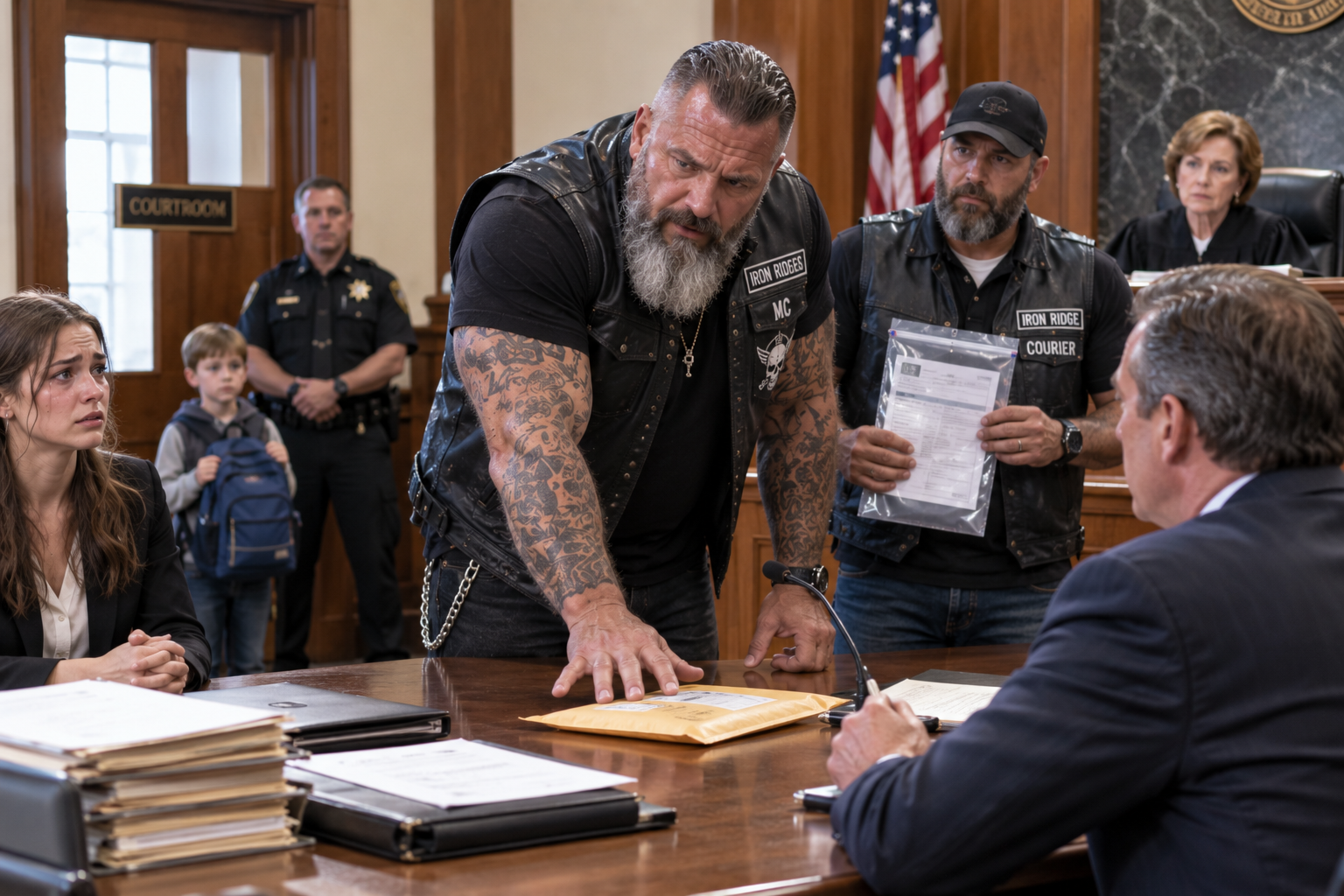
Part 2: The Envelope That Changed the Hearing
Part 2: The Envelope That Changed the Hearing
Derek’s attorney stood immediately.
“Your Honor, we need a recess.”
The judge didn’t look away from the courier record.
“You’ll get one after I understand what I’m looking at.”
Leon explained carefully.
His company stored the original electronic request associated with each shipment. The custody notice had initially been addressed to Elena’s apartment.
Seventeen minutes later, someone using credentials associated with Derek’s business account changed the destination.
The replacement address?
Mercer Iron & Cycle.
Wade’s motorcycle shop.
That was why Wade had received the envelope.
“I almost threw it away,” Wade admitted. “Then I saw ‘Family Court’ stamped across it.”
He tried returning it.
The courier marked the address discrepancy.
Wade kept the unopened envelope while the company investigated.
Then, two weeks earlier, he saw Elena outside the courthouse with Noah.
The boy was carrying the same backpack he had with him today.
Wade recognized Elena’s name from the envelope.
That’s when he contacted Leon.
The judge ordered the documents preserved and paused the custody proceeding so the disputed notice history could be examined properly.
Nobody instantly lost custody.
Nobody was dragged away in some dramatic courtroom spectacle.
The evidence needed authentication.
And Derek was entitled to respond.
But the hearing was no longer about Elena supposedly ignoring court orders.
Now the court had to determine whether she had actually received proper notice—and whether someone had deliberately interfered with delivery.
Outside the courtroom, Noah sat beside a social-services liaison.
His backpack rested between his sneakers.
Wade noticed a toothbrush sticking from one pocket.
“You moving somewhere?” he asked gently.
Noah nodded.
“Dad said I’m living with him now.”
Wade looked toward Elena.
She covered her mouth.
Nothing had been decided yet, but Noah had apparently been told otherwise.
Wade crouched several feet away.
“Court isn’t finished, buddy.”
Noah looked suspiciously at his leather vest.
“Are you a lawyer?”
Wade smiled.
“Absolutely not.”
That earned the smallest laugh.
During the recess, courier records were formally requested. Elena’s attorney also produced emails showing she’d repeatedly asked why she hadn’t received documents referenced by Derek.
The pattern mattered.
When proceedings resumed, the judge declined to make the planned custody change based on the disputed notice record. Existing arrangements were temporarily preserved while the delivery issue and related allegations were reviewed.
Derek denied intentionally changing anything.
He suggested an employee could have entered the wrong address.
The judge didn’t decide that question that afternoon.
She ordered the relevant electronic records retained.
That was enough for Wade.
Evidence first.
Consequences afterward.
Weeks later, additional records tied the address modification to a login used from Derek’s office. How responsibility should be assigned became a matter for attorneys and the court, not the Iron Ridge Riders.
The custody case was reconsidered with corrected notice information and a fuller record focused on Noah’s welfare.
Elena wasn’t declared a perfect parent.
Derek wasn’t reduced to a cartoon villain.
The court examined school records, parenting history, communication, housing, and the circumstances surrounding the disputed exchanges.
But one thing had changed permanently:
Elena could no longer be blamed for ignoring notices she could show she hadn’t properly received.
Months afterward, Wade was repairing a Harley when Elena and Noah entered his shop.
Noah still carried the backpack.
Wade pointed at it.
“You planning another move?”
“No.”
The boy opened it.
Inside was the battered court envelope.
Elena had asked permission to keep it after the evidentiary process no longer required the original.
“I thought you might want this back,” she said.
Wade shook his head.
“Burn it.”
Noah looked horrified.
“My mom says we’re supposed to keep important documents.”
Wade laughed.
“Your mom’s smarter than me.”
Noah carefully returned it to the backpack.
Then he noticed a row of motorcycles.
“Can I see them?”
“Hands in your pockets.”
Noah immediately obeyed.
As they walked through the shop, Elena stayed behind.
“Why did you come to court that day?”
Wade looked confused.
“You didn’t know me.”
“No.”
“You could’ve mailed the envelope to my lawyer.”
“Probably.”
“Instead you walked into that courtroom with half the gallery thinking you were there to cause trouble.”
Wade wiped grease from his hands.
“Thirty years ago, somebody made a decision about me because I wasn’t there to explain myself.”
He glanced toward Noah.
“I promised myself I’d never watch that happen to somebody else if I had evidence in my hand.”
Across the shop, Noah was examining a motorcycle without touching it.
The backpack remained securely on both shoulders.
That morning at court, it had contained everything a seven-year-old thought he needed to leave home.
Now it held one old envelope.
And Wade finally understood why he’d kept that envelope for months without knowing Elena, Noah, or Derek.
Sometimes the most important thing a biker carries isn’t something that belongs to him.
Sometimes it’s proof that somebody else deserves to be heard before a life-changing decision is made.