Part 2: The Letter Walter Mercer Never Knew Existed
Part 2: The Letter Walter Mercer Never Knew Existed
Rook didn’t open the envelope immediately.
He simply stared at his father’s name.
Walter Mercer had been dead twenty years.
Yet the handwriting on that envelope had waited more than half a century to reach his son.
“Who wrote this?” Rook asked.
“I did,” Elijah said.
His voice trembled.
The letter had been written only weeks after Walter gave him those boots.
Inside were three pages.
The first began:
Mr. Mercer, you probably don’t remember me. I’m the barefoot kid from the machine shop.
Elijah had gotten the job.
His first paycheck bought his mother’s heart medication.
His second caught up their rent.
Within two years, he’d become one of the shop’s most dependable workers.
He wanted Walter to know.
But Elijah hadn’t known his address.
So he carried the letter inside his toolbox, hoping someday the loud motorcycle—or that crooked eagle tattoo—would appear again.
It never did.
“Why does it say ‘Walter Mercer’s Son’?”
Elijah looked at Rook.
“Because about fifteen years later, I finally learned Walter’s full name.”
A customer had recognized Elijah’s description.
By then Walter had moved away.
The customer mentioned he had a young son named Dean.
Elijah rewrote the envelope.
“If I couldn’t thank your father, I figured maybe someday I could tell you what kind of man he was.”
Rook finally read the last paragraph.
Then he sat down beneath the oak tree.
I’d known Rook for eighteen years.
I’d seen him bury friends.
I’d seen him keep his head during crashes and tornado warnings.
I’d never seen his hands shake.
Elijah had written:
Your father gave away something he needed because he saw a stranger needed it more. If he ever has children, tell them their father changed one life before breakfast and probably never thought about it again.
Rook covered his face.
“My old man never told me.”
Elijah smiled.
“Men like him usually don’t.”
The following Sunday, Rook returned carrying a cedar box.
Inside were Walter’s old boots.
Elijah recognized them instantly.
The leather was cracked.
The heels had been replaced twice.
Inside one boot, Walter’s initials were still faintly visible.
Elijah ran his thumb over them.
Then he laughed.
“These were too big for me.”
Rook laughed too.
“You probably stretched them.”
For almost an hour, the eighty-two-year-old cobbler worked silently.
He cleaned the leather.
Conditioned it.
Repaired a loose stitch near the heel.
Then his fingers stopped inside the right boot.
“Dean.”
Rook leaned closer.
Something had been trapped beneath the old insole.
A thin piece of folded paper.
Rook carefully pulled it free.
It wasn’t another mysterious confession.
It was an old machine-shop pay stub.
Elijah stared at the employee number.
Then remembered.
After his first month at the factory, he’d slipped one of his pay stubs into Walter’s boot before returning the boots through a mutual acquaintance.
He’d forgotten doing it.
On the back, nineteen-year-old Elijah had written:
THEY KEPT ME. MOM HAS HER MEDICINE. THANK YOU.
Walter had kept it.
All those years, Elijah believed his gratitude had never reached the man who helped him.
But it had.
Rook looked at him.
“He knew.”
Elijah’s eyes filled.
“He knew.”
That changed everything.
The debt Elijah had spent fifty-three years trying to repay had never actually been unpaid.
Walter simply hadn’t demanded anything back.
Four months later, Elijah died quietly at home.
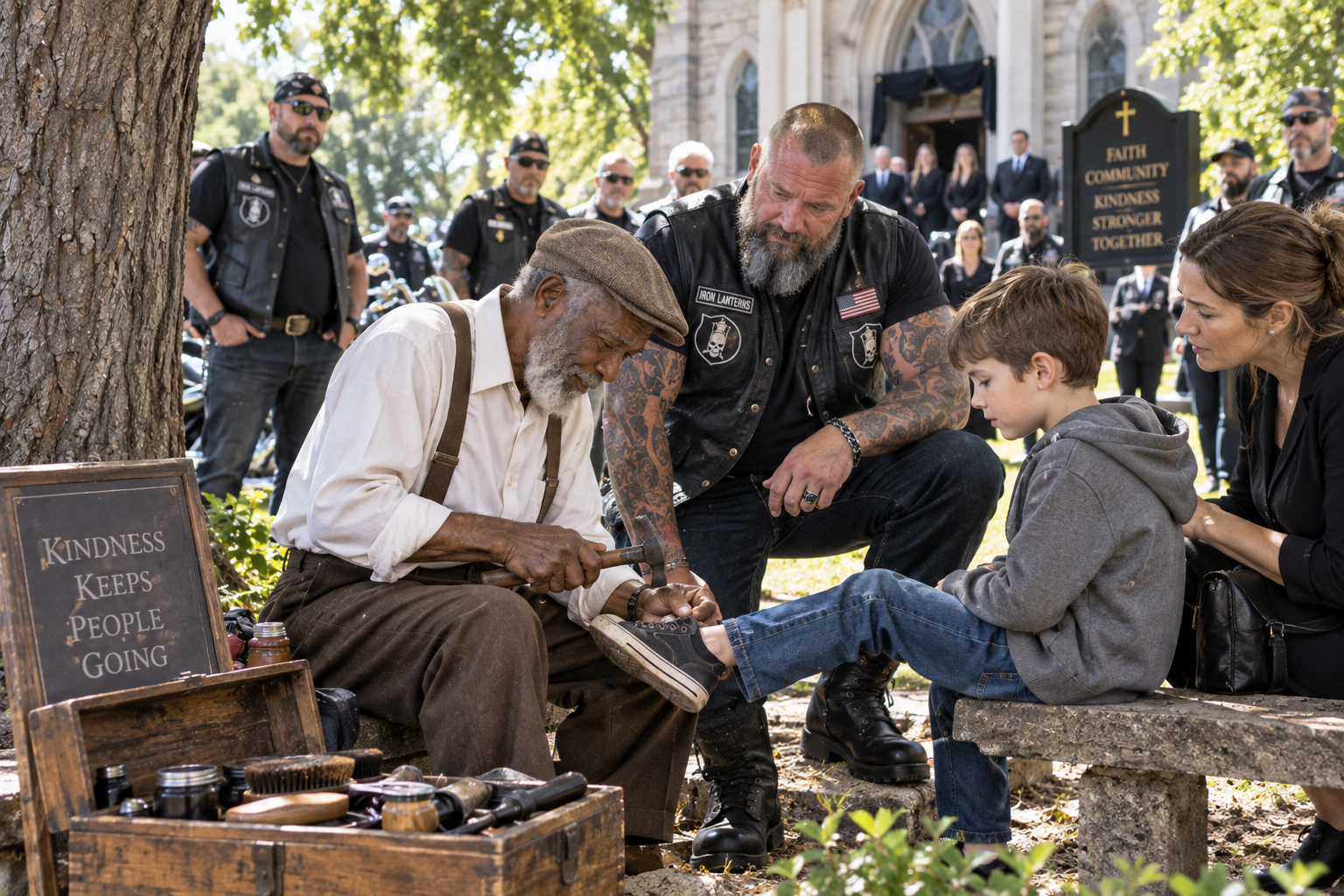
At his funeral, the church parking lot filled with motorcycles again.
But this time we weren’t only there to mourn.
There were nurses.
Construction workers.
Waitresses.
Veterans.
Former factory employees.
Parents with children.
Dozens brought shoes Elijah had repaired over the years.
His three daughters told us something else.
Their father had worried about only one thing near the end.
“What happens to Sundays?”
Rook answered that.
The Iron Lanterns bought Elijah’s old repair equipment from his estate with his daughters’ permission. Two retired members who actually understood leatherwork took classes from a local cobbler.
Others learned simple repairs.
We weren’t pretending to be craftsmen overnight.
Anything beyond our ability went to a professional shop—and the club paid the bill.
But every Sunday, somebody still sat beneath that oak tree.
A loose heel?
We handled it.
A child needed replacement shoes rather than another repair?
We bought them.
Work boots beyond saving?
We found another pair.
No speeches.
No photographs required.
No one had to prove they were poor enough.
And we kept Elijah’s rule.
No charge.
Walter’s boots now sit inside a glass case at the clubhouse.
Beside them are two pieces of paper.
Elijah’s fifty-three-year-old letter.
And that faded pay stub.
Rook stopped polishing the boots twice a year.
“They’ve done enough sitting around,” he told me.
So once every year, on the Sunday closest to Walter’s birthday, he removes them from the case and carries them to the church.
He places them beside Elijah’s empty stool.
Then he picks up a shoe and gets to work.
People sometimes talk about kindness as though it has to be enormous to matter.
Walter Mercer didn’t build Elijah a house.
He didn’t give him thousands of dollars.
He gave him a worn pair of boots and walked home barefoot.
That was enough to get one young man through a factory gate.
That job helped his mother get medicine.
That young man became a cobbler.
That cobbler repaired thousands of shoes.
And decades later, a motorcycle club continued what he started.
All because one biker understood something his son wouldn’t fully understand until fifty-three years later:
You don’t always know how far a good deed will travel.
Sometimes you just give someone the shoes—and let them decide where to walk next.