The Sanctuary of Broken Things
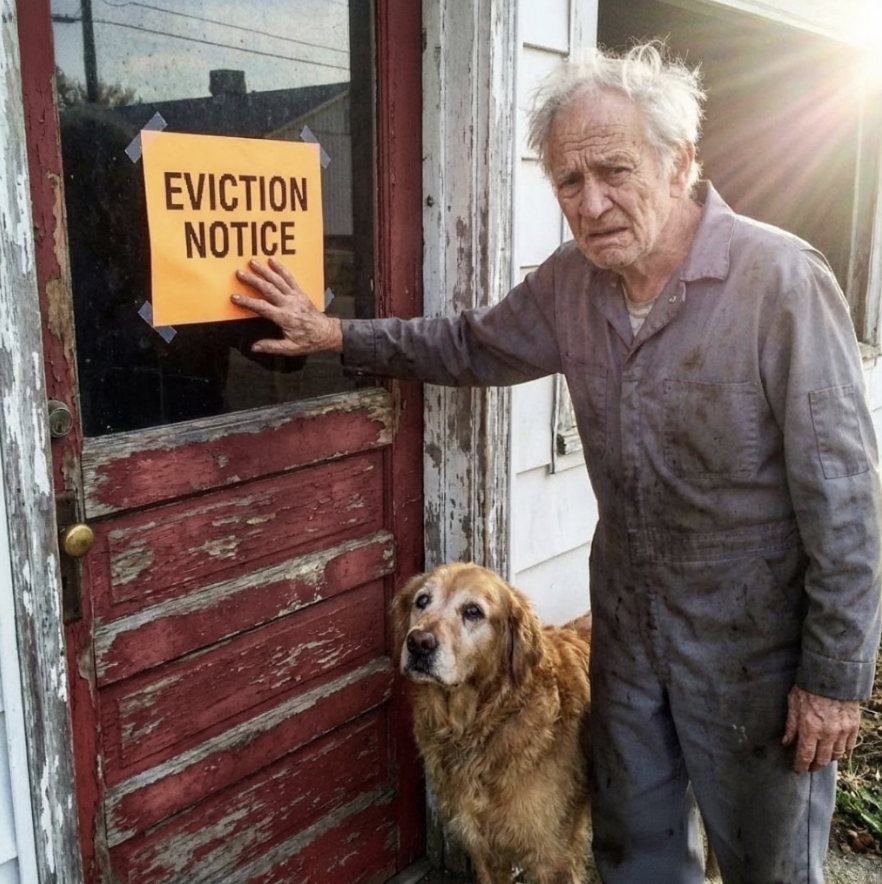
They pinned the eviction notice to my door at dawn, declaring my shop a “blight on the district,” but they didn’t realize you can’t bulldoze a fortress built by people the world had already thrown away.
I’ve been fixing things since 1974. Toasters, tube radios, grandfather clocks that stopped ticking when their owners stopped breathing. My shop, Arthur’s Analog Repair, sits on the corner of a street that used to mean something, back before the factories closed and the town turned gray.
Nowadays, nobody fixes anything. If a screen cracks, you buy a new one. If a microwave hums too loud, you toss it. It’s a disposable world. They built everything to fail—even the people.
My only employee was Rusty. He was a Golden Retriever who’d lost his front left leg to a speeding sedan five years ago. Most people would’ve put him down, said he was too old to handle the trauma. But I stitched him up, and he limped on. He wasn’t fast, and he had more gray on his muzzle than gold, but he had a way of looking at you that made your chest hurt less.
It started with a kid named Leo.
Leo was maybe fifteen, wearing a hoodie in July, hiding bruises that had nothing to do with sports. He stood in my doorway, soaking wet from a summer storm, holding a shattered portable gaming console.
“Can you fix it?” he asked, voice cracking. “My dad… he smashed it. It’s the only thing I have.”
I grunted, adjusting my spectacles. “I don’t do microchips, kid. I do gears and gaskets.”
I was about to wave him off. I’m an old man; I like my silence. But then Rusty clacked his claws on the linoleum. He limped over to the boy, leaned his heavy weight against Leo’s shins, and let out a long, contented sigh.
Leo froze. Then, his hand dropped to scratch behind Rusty’s ears. The tension left the boy’s shoulders for the first time since he’d walked in.
“Sit,” I pointed to a stool. “Grab that small screwdriver. If you want it fixed, you’re gonna learn how the circuit connects.”
Leo came back the next day. Then the day after.
He didn’t just bring the console. He brought friends. They were the “bad kids.” The dropouts, the ones with parents lost to the pill crisis, the ones teachers sat in the back of the class. They drifted into my shop like stray cats.
I didn’t run a charity. I ran a workshop. Rule number one: You don’t get a free ride. You want to hang out? You strip copper wire. You sand the rust off old fan blades. You learn that just because a gear is stripped doesn’t mean the machine is dead.
Rusty was the foreman. He’d hobble from kid to kid, resting his chin on a knee when someone got frustrated, nudging a hand when someone looked like they were about to cry. He was a three-legged therapist working for dog biscuits.
We became a sanctuary of broken things.
But in a town trying to gentrify, a dusty shop filled with “delinquents” doesn’t look good on a brochure.
The “Urban Renewal Committee” sent a man in a suit. He didn’t look at the kids working on the workbenches. He looked at the peeling paint and the zoning map.
“Mr. Arthur,” he said, checking a box on his clipboard. “This building is slated for redevelopment. We’re building a mixed-use retail space. You’re in violation of codes A through Z. You have thirty days to vacate.”
“I own the deed,” I said.
“And the city owns the right to eminent domain when safety is a concern,” he smiled, a smile that didn’t reach his eyes. “It’s for the greater good.”
I didn’t tell the kids. I just started packing. I felt the weight of my seventy years pressing down. I was just an old grease-monkey fighting a tidal wave. What could I do?
The day the bulldozer arrived, the sky was a bruised purple. I locked the front door, ready to hand over the keys. Rusty was whining, pacing back and forth on his three good legs.
Then I saw them.
They weren’t police. They weren’t protesters with signs.
It was Leo. And Sarah, and Mike, and thirty other kids I’d taught to solder and screw.
They formed a line in front of the shop. They weren’t holding weapons. They were holding things.
Leo held a vintage radio, polished to a shine. Sarah held a toaster from the 1950s that worked better than anything you could buy at a big-box store today. Mike held a restored bicycle.
The foreman of the construction crew leaned out of his cab. “Move it, kids! We got a schedule.”
Leo stepped forward. He didn’t look like the scared kid in the hoodie anymore. “You say this place is trash,” he yelled, his voice shaking but loud. “But this place fixed us. You want to tear it down? You go through us.”
The foreman revved the engine. The black smoke billowed. It was a scare tactic.
The kids flinched. Instinct took over. They were used to backing down when authority raised its voice. The line wavered.
That’s when Rusty moved.
He barked—a deep, chest-rattling sound I hadn’t heard in years. He broke from my grip and hobbled past the kids. He planted himself on the cracked asphalt, right between the terrifying steel blade of the dozer and the line of teenagers.
He stood on his three legs, head high, staring down a twenty-ton machine. He didn’t growl. He just stood there, tail still, refusing to move.
The foreman killed the engine. The silence that followed was louder than the machinery.
A crowd had gathered. Phones were out. The image was undeniable: A three-legged dog and a group of “throwaway” kids defending a crumbling repair shop against a faceless corporation.
The video hit the local feed an hour later. Then the state feed.
By noon, the “Urban Renewal Committee” phone lines were jammed. By evening, a lawyer who had seen the video called me, offering to represent us pro bono to fight the zoning claim. He said something about “historical significance” and “community value.”
We didn’t just save the building. We forced them to listen.
The city backed off. They called it a “pilot program for vocational mentorship” to save face, but we knew the truth.
I’m still here. The sign out front still needs paint. I’m still grumpy, and I still don’t fix smartphones.
But every day, I watch Rusty sleeping in a sunbeam, surrounded by kids who are learning that patience is stronger than impulse.
People ask me why I didn’t just sell the land and retire to Florida. They ask if it was worth the legal fees, the stress, the fight.
I look at the kids—kids who are going to trade schools now, kids who stopped using, kids who look you in the eye when they speak.
And I tell them this:
“In a society that profits from your insecurity and thrives on throwing things away, the most revolutionary thing you can be is someone who fixes.
We aren’t broken. We’re just a little rusty. And everything—everything—can be repaired if you don’t give up on it.”