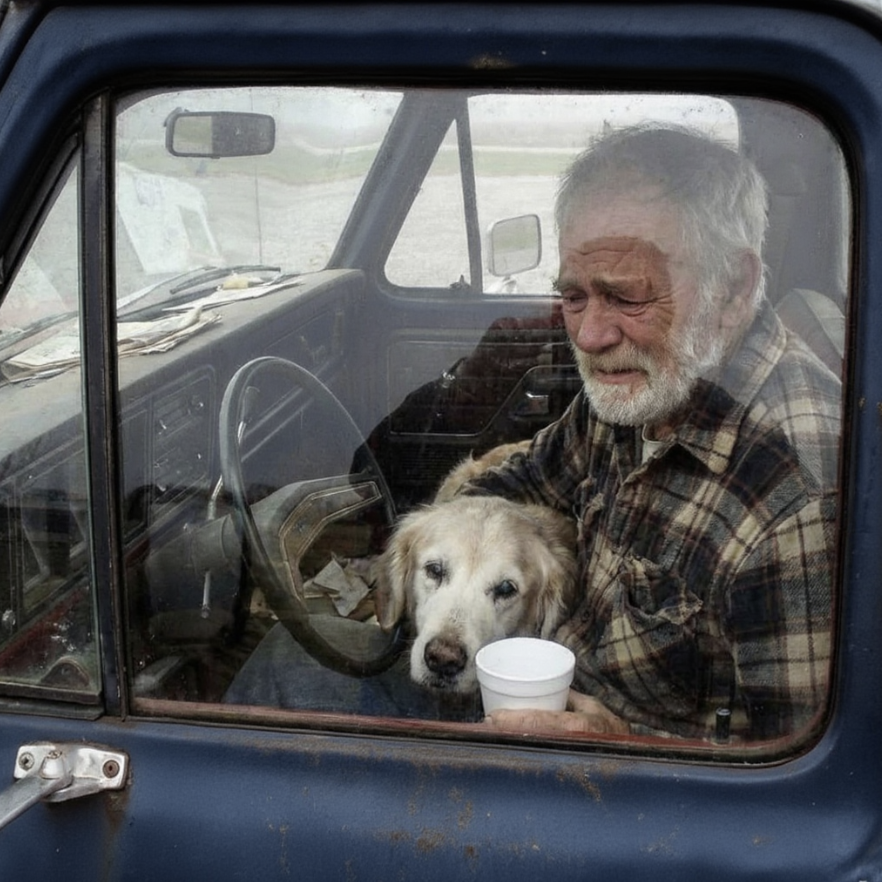
The Silent Retirement of Frank and Barnaby
I woke up to find my 74-year-old father and his arthritic Golden Retriever missing. No note, just an empty driveway and a silence so loud it broke my heart.
My house is usually a symphony of automated efficiency. The smart blinds rise at 6:30 AM. The espresso machine whirs at 6:45 AM. The voice assistant reads the news headlines—usually something polarizing about the economy or the latest election polls—at 7:00 AM.
But the real engine of this household wasn’t the high-speed fiber optics or the smart thermostat. It was Dad. And it was Barnaby, his thirteen-year-old Golden Retriever with the cloudy eyes and the white face.
Dad moved in three years ago after Mom passed. We called it “downsizing” for him, but in reality, it was free labor for us.
By the time I typically stumbled into the kitchen, clutching my phone and checking emails, Dad would have already been up for two hours. He didn’t use the fancy espresso machine. He used an old, battered French press. He would have already walked Barnaby, oiled the hinges of the back gate so they didn’t squeak, and unloaded the dishwasher.
I never saw him do it. I just expected it done.
Yesterday was the breaking point, though I didn’t realize it until the taillights of his truck had long faded.
It was my son Leo’s 10th birthday. We threw a party that looked more like a tech convention. I bought Leo the latest VR headset. My wife, Sarah, bought him a “Cyber-Pet”—a robotic dog that learns commands, does backflips, and, most importantly, doesn’t shed.
The living room was chaotic. Wrapping paper everywhere. The TV blaring. Dad was in the corner, sitting in his armchair, hand-feeding Barnaby a small piece of unseasoned burger meat he’d saved from the grill.
Leo was entranced by the robot dog. “Look, Dad!” he shouted. “It doesn’t drool! It’s so much faster than Barnaby.”
I laughed. “Yeah, and it won’t need hip surgery, either.”
It was a throwaway joke. A cheap shot.
Then Sarah chimed in, stressing about the rug. “Honestly, Frank,” she said to my dad, not unkindly, but with that tone of exhausted practicality. “Maybe we should look into… arrangements for Barnaby? The hair is getting into the air filters again. And he tripped Leo last week. It’s just becoming a lot.”
The room didn’t go silent. The TV kept blaring. The robot dog barked a synthesized, perfect bark. But Dad went still. He looked at Barnaby, who was resting his heavy head on Dad’s knee, looking up with that absolute, unshakeable adoration that only dogs possess.
“He’s not a lot,” Dad said softly. “He’s family.”
“We know, Dad,” I said, eyes on my phone, answering a work text. “We’re just talking about logistics. We can talk about it later.”
Dad didn’t argue. He just stood up, his knees popping audibly, and walked Barnaby to the back door. “Come on, old boy,” he whispered. “Let’s get out of their way.”
I didn’t think twice about it. I went to bed thinking about my quarterly review.
This morning, the house was freezing. The thermostat was offline. The coffee pot was cold. The back gate was banging in the wind—the latch evidently needed jiggling, a trick only Dad knew.
I went to the garage. His spot was empty. His tools were gone. The vintage 1978 pickup truck he’d been restoring for “someday”—the one I called a rust bucket—was gone.
And on the workbench, where he usually left a list of groceries he needed, was his house key.
Panic, cold and sharp, spiked in my chest. I checked the security cameras.
The footage from 4:00 AM broke me.
It showed Dad packing a single duffel bag. He wasn’t rushing. He folded his flannel shirts neatly. Then, he walked into the living room. He didn’t take the silverware or the expensive electronics. He took the framed photo of Mom off the mantle.
Then, he went to Leo’s room. The camera showed him standing over my sleeping son for a long minute. He pulled the blanket up to cover Leo’s shoulder, then gently placed a small, wooden object on the nightstand. It wasn’t a store-bought toy. It was a hand-carved dog, whittled from cedar, that looked exactly like Barnaby.
He walked out to the truck. He lifted Barnaby—all 70 pounds of dead weight—into the passenger seat with a tenderness that made my own back ache. He buckled the dog in.
They drove away into the dark.
I tracked his phone. He hadn’t turned it off. He wanted to be found, or maybe he just didn’t care. He was three towns over, at a roadside diner we used to go to when I was a kid.
I drove like a maniac. When I pulled into the gravel lot of “Betty’s Diner,” there it was. The rust bucket. The window was down, and Barnaby’s gray snout was resting on the sill, sniffing the breeze.
I ran inside.
The diner smelled like bacon grease, old vinyl, and cheap coffee—the smell of a time before everything became digital and sanitized.
Dad was sitting in a booth, reading a physical newspaper. He had a plate of pancakes in front of him and a coffee mug in his hand. He was laughing. Actually laughing. The waitress, a woman his age, was refilling his cup and chatting with him.
He looked ten years younger. He didn’t look like the “Default Grandpa.” He looked like Frank.
I walked over, my legs feeling like jelly. “Dad.”
He looked up. His eyes were clear. There was no anger in them, which somehow made it worse. There was just a resolved distance.
“Hi, Mark,” he said.
“You left,” I choked out. “You just… left.”
“I didn’t leave,” he said calmly, taking a sip of coffee. “I retired.”
“Retired from what? You’re already retired.”
“I retired from being furniture,” he said. He gestured to the window, where Barnaby was napping in the truck. “And Barnaby retired from being a nuisance.”
“Dad, I’m sorry. The joke about the robot dog… Sarah’s comment… we didn’t mean it.”
“You did mean it,” he said. “And that’s okay. You live in a world of upgrades, Mark. Faster phones, smarter houses, newer cars. If something breaks, you replace it. If something gets old, you hide it.”
He leaned forward. “But Barnaby isn’t an obsolete model. And neither am I. We have miles left on us. We just need to be on a road where we aren’t treated like traffic.”
I looked at his hands—rough, calloused hands that had built my first treehouse, fixed my first car, and quietly maintained my entire adult life without asking for a dime. I thought about the silent hum of my smart home, efficient and cold. I thought about the robot dog that felt nothing when you touched it.
I sat down in the booth opposite him. I didn’t demand he come home. I didn’t guilt him with access to his grandson.
“Can I buy you breakfast?” I asked, my voice trembling.
Dad looked at me. He saw the fear in my eyes. The realization.
“I’ve already eaten,” he said. He paused, looking out the window at his truck. “But the coffee here is good. It’s not from a machine.”
“I’ll have a cup,” I said.
We sat there for two hours. We didn’t talk about my job. We didn’t talk about politics. We talked about the engine in his truck. We talked about how Barnaby used to chase ducks in the park.
I eventually convinced him to come back, but not before we made a deal. No more invisible labor. No more treating him like a fixture. He wasn’t there to serve us; he was there to live with us.
When we got home, the first thing I did was kick the robot dog into the closet. The second thing I did was sit on the floor with Barnaby, burying my face in his scruffy, “smelly” neck. He smelled like dust and unconditional love.
We live in a culture obsessed with the new, the fast, and the efficient. We treat the people who built our foundations like background apps—running silently, draining their battery, until they shut down.
Don’t wait for the empty driveway to realize what keeps your world standing.
Old dogs, old trucks, and old parents don’t need to be fixed or upgraded. They just need to be seen. And sometimes, they need to be the one sitting in the driver’s seat.