The Golden Leash
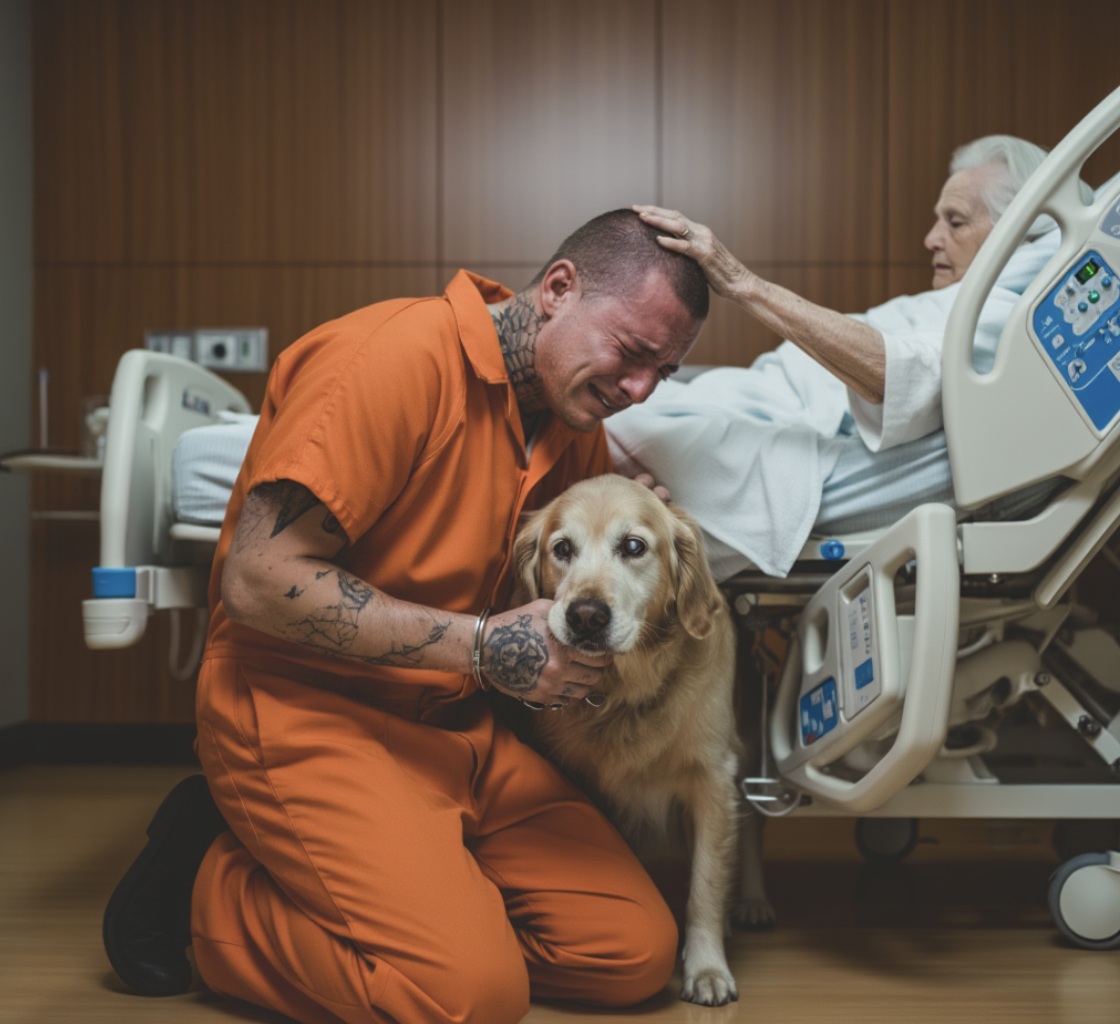
The shackles around my ankles scraped against the sterile hospital tile, a jagged rhythm that made the nurses flinch. They saw a monster with face tattoos; she just saw her boy.
For the last five years, I had been Inmate 8940. To the state, I was a statistic, a violent offender with a hair-trigger temper and a rap sheet longer than the Bible in the chapel. To the world, I was trash. But to the ninety-year-old woman dying in Room 304, I was just Ethan.
The correctional officer behind me cleared his throat. “You got twenty minutes, Perez. Don’t make me regret this.”
I didn’t answer. My throat was too tight. I was wearing bright orange, my wrists were bound in steel, and my face was covered in ink that screamed “stay away.” But as I stepped through that door, the armor I’d built around myself in the yard crumbled.
The room smelled of antiseptic and fading lilies. And there she was. Grandma Mae.
She looked so small. The woman who had worked double shifts at the diner to feed me when my parents bailed, the woman who had slapped the back of my head when I skipped school, was now disappearing into the white sheets.
But she wasn’t alone.
Curled up on the linoleum floor next to the bed was a lump of golden fur. Buddy. Her twelve-year-old Golden Retriever. He was gray in the muzzle now, his hips bad, his eyes cloudy. The hospital had made an exception for him—hospice care rules, I guessed.
When I stepped in, the chains rattled. Buddy’s head snapped up.
In the prison yard, if a dog sees you, it’s usually a K-9 unit ready to tear your arm off. I flinched. But Buddy didn’t growl. He didn’t bare his teeth. He let out a low, whining chuff and thumped his tail against the floor. Thump. Thump. Thump.
He remembered me. Even after the drugs, the fights, and the years away, he remembered the boy who used to throw tennis balls in the backyard.
“Ethan?” Her voice was like dry leaves scraping together.
I shuffled to the side of the bed, the officer staying by the door. I dropped to my knees, ignoring the pain of the hard floor. “I’m here, Grandma. I’m here.”
She opened her eyes. They were milky, but they found mine. She didn’t look at the spiderweb tattoo on my neck or the tear drop by my eye. She looked right into me.
“You look… tired, baby,” she whispered.
I choked out a laugh that turned into a sob. “Yeah. I’m tired, Grandma.”
She reached out a hand. Her skin was paper-thin, bruised purple from IVs. I was terrified to touch her. My hands were rough, scarred from brawls, stained with the mistakes of a angry life. I didn’t want to contaminate her purity with my filth.
But then, I felt a wet nose nudge my elbow.
Buddy had pulled himself up. He limped over and shoved his head under my cuffed hands, forcing them up onto the bed, right next to hers. He rested his heavy chin on my knee, letting out a long sigh.
He was bridging the gap. Connecting the convict to the saint.
“Buddy missed you,” she said softly. “We both did.”
“I’m sorry,” I whispered, my head bowing until my forehead touched the cool metal of the bed rail. “I’m so sorry I wasn’t there. I’m sorry I messed up.”
“Listen to me,” she said, her grip suddenly tightening on my fingers. It was shocking how much strength she had left. “Look at me.”
I looked up.
“You made mistakes, Ethan. But you are not a mistake. Do you hear me?”
I nodded, tears finally spilling over, washing over the ink on my cheeks.
“I’m going to see your grandpa soon,” she said, her breath catching. “But I can’t go in peace if I’m worried about you rotting in that cage. I need a promise.”
“Anything,” I said. “Anything.”
“This anger…” She touched the tattoo on my hand. “You have to let it go. It’s protecting you from nothing. It’s just keeping you lonely.”
She looked down at the old dog resting his head on my knee.
“Buddy is old, Ethan. My neighbor, Mrs. Higgins, she can feed him, but she can’t love him. Not like we do. When you get out… you promise me you’ll take care of him? You promise me you’ll walk him in the sun, not in the shadows?”
It wasn’t just about the dog. We both knew that. She was asking me to take care of the only innocent thing left in our lives. She was giving me a responsibility, a reason to be free.
“I promise,” I choked out. “No more fighting. No more bars. I’m coming home. For you. For Buddy.”
“That’s my boy,” she whispered. Her eyes drifted shut, a small smile gracing her lips. “My good boy.”
The officer cleared his throat. “Time’s up, Perez.”
Leaving that room was the hardest thing I’ve ever done. As the guard pulled me up, Buddy let out a sharp bark—just once. He watched me leave, his tail giving one slow wag. He was waiting.
Grandma Mae died that night.
But I didn’t die with her.
For the next eighteen months, I was a ghost in the system. I walked away from every challenge. I took every GED class available. I read until my eyes burned. When the guys in the block tried to provoke me, I didn’t see their fists; I saw a frail hand holding mine. I felt the phantom weight of a golden head on my knee.
I got out on early parole for good behavior three months ago.
The first stop I made wasn’t a bar. It wasn’t a friend’s house. It was Mrs. Higgins’ porch.
Buddy was lying on a rug, looking older, slower. But when I opened the gate, he stood up. He sniffed the air. And then, he ran. It was a clumsy, limping run, but he collided with me, nearly knocking me over.
I buried my face in his fur, smelling dust and old dog shampoo, and I wept.
Today, I work construction. It’s hard work, honest work. My back aches, and people still stare at my tattoos sometimes. But I don’t care.
Every evening at sunset, I go to the park. I sit on a bench with an old, limping Golden Retriever. He rests his head on my knee, exactly like he did in that hospital room.
I stroke his ears and look at the sky, whispering to the woman who saved me.
I realized something out here, in the fresh air. The world will judge you by your worst moments. But love? Love judges you by your potential.
We all have a past that leaves scars. But it is never too late to be the person your dog thinks you are, and the man your grandma prayed you’d be.