The Six O’Clock Anchor
I came back home with a checklist: fix the leaking roof, clear out the garage, and convince my mother it was finally time to sell the house. I didn’t expect a crippled, fourteen-year-old Golden Retriever to teach me how to be a human being again.
My name is Mark. I’m forty-five, a project manager for a logistics firm in Chicago. My life is measured in KPIs, quarterly goals, and efficiency. I optimize things. That’s what I do. So when my father passed away last year, leaving my mother alone in a sprawling, creaking Craftsman bungalow two hours outside the city, I saw it as a problem to be solved.
The house was too big. The yard was a jungle. And then there was Duke.
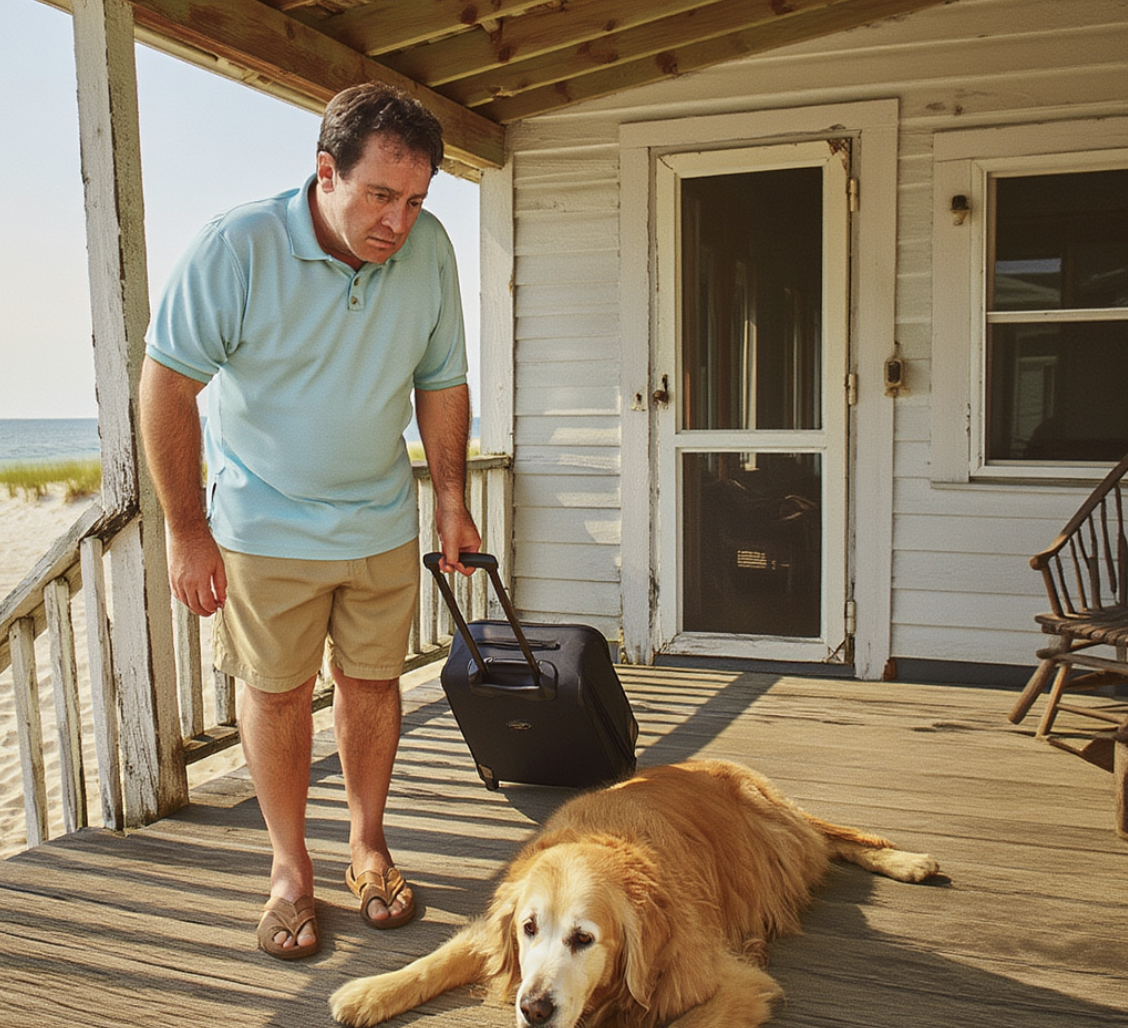
Duke was Dad’s dog. A Golden Retriever who had been the unofficial mayor of Elm Street back in his prime. But that was a decade ago. When I pulled into the driveway, dragging my suitcase and my stress up the walkway, I didn’t see the majestic beast from my memories.
I saw a heap of matted fur blocking the front door.
“Duke, move,” I said, nudging him gently with my foot.
He didn’t even lift his head. He just opened one cloudy eye, let out a groan that sounded like rusty hinges, and went back to sleep.
“Leave him be, Mark,” my mother’s voice came through the screen door. She looked smaller than I remembered, shrinking inside one of Dad’s old cardigans. “It takes him a while to get the engine running these days.”
For the first two weeks, I was a whirlwind of annoyance. I fixed the gutters. I aggressively pruned the hydrangeas that had taken over the walkway. I spent my days on conference calls, pacing the living room, tripping over Duke.
The dog was an obstacle. He smelled like old carpet and wet earth. He had bad hips, worse breath, and a stubborn streak that rivaled my own. I suggested to Mom that maybe it was time to “make a difficult decision” regarding Duke.
Mom just looked at me over her coffee mug, her eyes sharp. “He’s not a piece of furniture you can just toss out because the upholstery is worn, Mark. He’s family.”
I dropped it. But I didn’t understand it. Not until the Tuesday of my third week.
I was on a call with a client when the clock on the mantel chimed six times. 6:00 PM.
Immediately, the energy in the room shifted. Duke, who had been resembling a dead rug for the last four hours, suddenly lifted his head. Mom stood up, poured two glasses of iced tea, and opened the back door.
“Coming, old man?” she whispered.
What followed was painful to watch. It took three tries for Duke to stand up, his legs trembling violently. Slowly, they processed out to the back porch.
My curiosity got the better of me. I followed them.
Mom sat on the old wooden porch swing. Duke didn’t lie down immediately. He circled three times and collapsed with a heavy sigh onto the floorboards, directly beneath the swing, resting his head on Mom’s feet. And then, they just… sat.
By Friday, I couldn’t take it anymore. I walked out onto the porch with a beer in hand. “What are we doing?” I asked. “It’s just a backyard, Mom.”
“Is it?” She took a sip of tea. “Look there. The fireflies are starting early this year. And see that patch of dirt by the fence? That’s where your father buried your hamster, Mr. Peanuts, in 1989. And that branch… that’s where Duke tore down the tire swing because he wanted to drag the tire into the living room.”
She looked down at the dog. Duke’s eyes were closed, his tail giving a faint, rhythmic thump against the floor every time the swing moved back.
“He misses your father,” Mom said, her voice thick. “This was their time. Dave would drink a cold one, Duke would chew on a tennis ball. Now, Duke can’t chew the ball, and Dave is gone. So, we just sit. We remember.”
I looked at Duke. I really looked at him.
I saw the scars on his nose from chasing raccoons. I saw the cloudiness in his eyes. I saw the way he pressed his body against Mom’s legs, acting as a literal anchor for her grief. He was in pain—I could see the tremors in his hindquarters—but he wouldn’t be anywhere else. He was holding his post.
He wasn’t an obstacle. He was the glue.
“Can I sit?” I asked.
Mom scooted over. The chains protested, but they held.
I sat there for an hour. I didn’t check my email. I didn’t think about the roof. I listened to the cicadas start their evening chorus. I watched the light fade from gold to bruised purple. I felt the vibration of the dog snoring against the wood.
It became our routine. Every day at 6:00 PM. The world outside was chaotic—stock markets crashing, elections looming, deadlines approaching—but on that porch, time stopped.
I learned more about my parents in those quiet evenings than I had in forty years of rushing through life. I learned that Dad hated his job but loved the commute because he listened to audiobooks. I learned that Mom always wanted to paint but never found the time.
I stopped trying to “fix” the house and started living in it. I hired a neighborhood kid to mow the lawn, not so we could sell it, but so Duke could walk through it without tripping.
Three months later, the call came.
It wasn’t Duke. It was Mom. A stroke in her sleep. Peaceful, they said. Quick.
The aftermath was a blur of paperwork, casseroles from neighbors, and hollow condolences. I moved through it like a zombie. The house, once too big, now felt like a cavern.
Three days after the funeral, I found myself standing in the kitchen. The clock on the mantel chimed.
Bong. Bong. Bong. Bong. Bong. Bong.
6:00 PM.
I froze. My chest tightened so hard I thought I couldn’t breathe.
Then I heard it.
Scrape. Scrape. Whine.
I looked down. Duke was standing there. He looked worse than ever. The stress of the last few days had taken a toll on him. He was trembling, looking up at me with those milky, confused eyes. He looked at the back door. Then back at me.
He was waiting.
I swallowed the lump in my throat that felt like a golf ball. “Okay, buddy. Okay.”
I opened the door.
It took him five tries to get up the small lip of the doorframe. I wanted to lift him, to carry him, but I remembered Mom’s words. He has his pride.
We made it to the porch. The sun was doing its golden thing, indifferent to my grief. The swing looked terrifyingly empty.
I sat down. The chains groaned—a lonely sound without her counterweight.
Duke stood in the center of the porch. He looked at the empty spot on the swing where Mom used to sit. He sniffed the air, whining a high-pitched, broken sound that shattered me. He paced a tight circle, confused. He waited for the hand to come down and scratch his ears.
The hand didn’t come.
He looked at me. I was crying, silent tears running down my face, dripping onto my shirt.
“She’s not coming, Duke,” I choked out. “It’s just us.”
The old dog stared at me for a long time. It felt like he was analyzing my soul, weighing my worthiness.
Then, he let out a long exhalation. He walked over to me.
But he didn’t lie down on the floorboards.
Instead, he mustered every ounce of strength he had left. He groaned, muscles straining, and hoisted his front paws up onto the swing, right next to my leg. He rested his heavy, gray chin on my knee.
He looked out at the yard.
He wasn’t asking to be petted. He was telling me that he was still on duty. He was telling me that the pack had gotten smaller, but the watch continues.
I wrapped my arms around his neck, burying my face in his fur that smelled like old earth and loyalty. We stayed like that until the sun went down and the fireflies came out to dance for the ghosts of the people we loved.
I’m not selling the house.
I realized something on that porch. We spend our whole lives trying to build the perfect life, to optimize our time, to get somewhere else. But the only destination that matters is the one where you’re sitting next to someone—or something—that loves you enough to just sit and watch the dark close in.