The Slow Clock
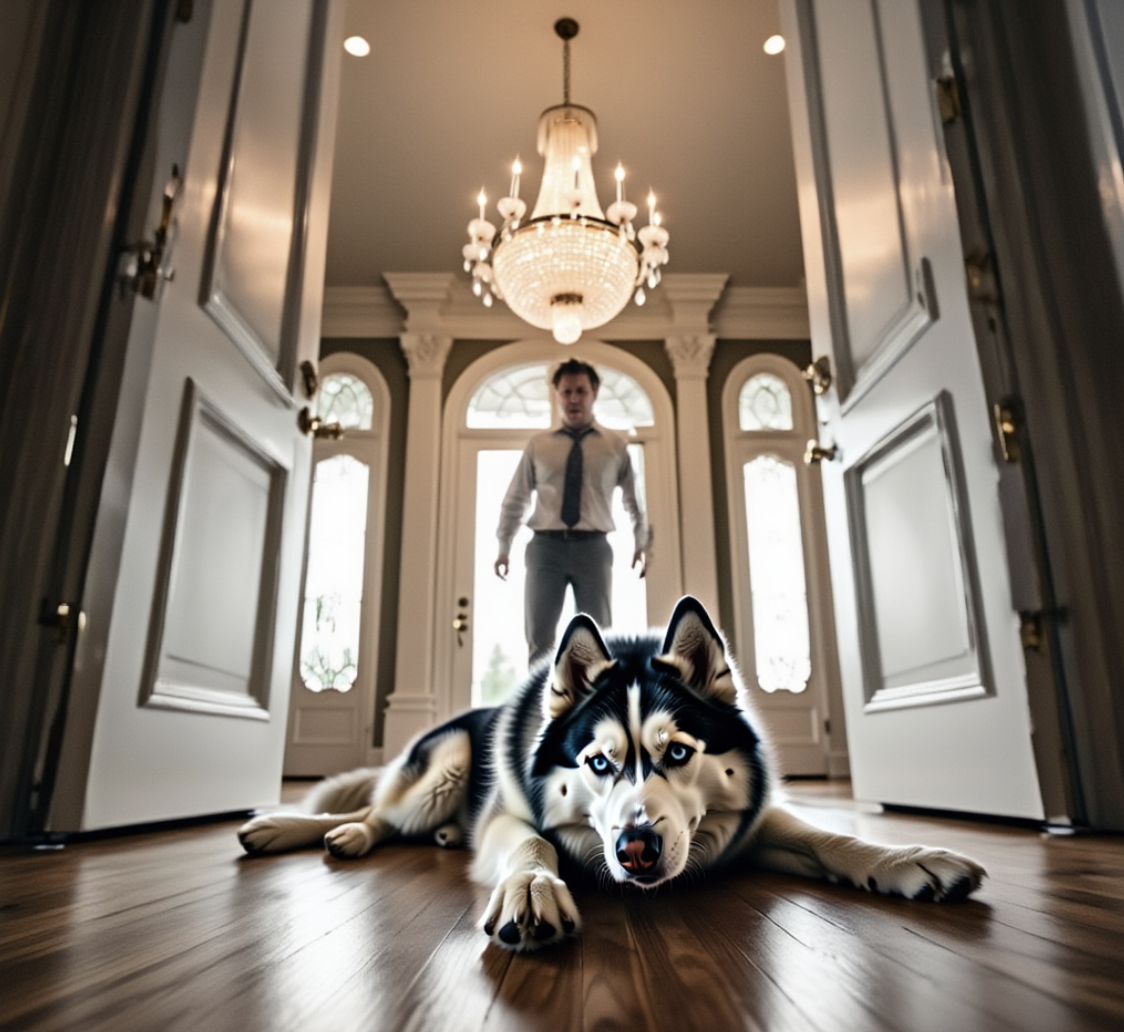
I pushed open the door to my childhood home, and for the first time in twenty years, my dog didn’t run to greet me. That’s when I knew.
I’d been putting off the visit. A project deadline, a new client, the playoffs—the excuses were endless and, in the bright glare of the city, they felt important. But Mom’s last voicemail had a different tone. Not guilt-tripping, just… quiet. “Kodiak‘s really slowing down, Mark,” she’d said. “He misses you.”
So, I took the long drive down the interstate, my mind still buzzing with unread emails and the lingering stress of the quarter. I pulled into the driveway, the old basketball hoop still rusting over the garage, and walked up the familiar path.
The door creaked open, and the smell of home—that impossible mix of old wood, coffee, and whatever Mom was cooking—hit me first. Then, the silence.
It was deafening.
Kodiak, my grey and white shadow, my partner-in-crime for two decades, was lying on his mat by the kitchen. He lifted his head. His muzzle, once framed by sharp black markings, was now a soft, snowy white. His eyes, cloudy with cataracts, struggled to focus. He didn’t stand. He just… thumped his tail. Once. Twice. A slow, rhythmic thump… thump… on the worn rug.
“Hey, old man,” I whispered, dropping my bag. My throat tightened.
“He’s just having a slow day,” Mom said, walking in from the kitchen, wiping her hands on her apron. She smiled, but her eyes didn’t. They were tired. “It’s so good to see you, honey.”
I hugged her. She felt smaller than I remembered. Thinner. When had her shoulders started to stoop?
“You look good, Mom.”
“Oh, you,” she brushed it off. “Go say hi to your friend. He’s been waiting.”
I knelt by Kodiak’s mat. He pushed his nose into my hand, his breathing heavy. This was the dog who had pulled me on a sled, who had howled joyfully every time I’d come home from college. Now, the effort to lift his head seemed to exhaust him.
The next afternoon, I grabbed the old red leash from the hook. It was stiff. “Want to go for a walk, Bud?”
His tail gave that same, slow thump. He used his front paws to pull himself up, his back legs trembling with the effort.
We didn’t go to the park. We just went to the end of the block.
The walk was a symphony of lasts. I remembered how he used to pull, straining with all his muscle, desperate to chase a squirrel or a blown leaf. Now, I held the leash slack, matching my pace to his agonizingly slow, arthritic gait. He stopped every few feet, his chest heaving. He looked up at me, not with the bright spark of adventure I remembered, but with a look of apology. As if he was sorry he couldn’t be that dog for me anymore.
I realized it wasn’t just Kodiak who was old. The memory was old. The kid he used to run with was gone, replaced by a man in a quarter-zip who checked his work email while his dog struggled to walk. I felt a hot, sharp shame.
That night, Mom made her pot roast. The smell was the same, but the process was different.
“Mom, you need help with that jar?”
She was struggling with the pickles, her knuckles white as she tried to twist the lid. “Oh, these new lids are just impossible,” she laughed, but it was a strained sound.
I took the jar from her. “Here, let me.”
It opened with an embarrassingly easy pop.
I stood there, holding the jar, and looked at her hands. The hands that had taught me to tie my shoes, that had bandaged my knees, that had held me in a fever. They were trembling, just slightly. The skin was paper-thin, mapped with blue veins.
The pillars of my world—the unwavering strength of my mother, the boundless energy of my dog—were crumbling. And they were doing it quietly, politely, while I was busy planning my next product launch.
I couldn’t sleep. Around 2 AM, I heard a sound—a soft whimper from downstairs.
I crept down the stairs. The moonlight cut across the kitchen floor, and in that pale light, I saw my mother. She was in her old bathrobe, sitting on the cold linoleum, her back against the cabinets.
Kodiak’s head was in her lap. She was stroking his white muzzle, her own tears falling silently onto his fur.
I stopped, hidden by the shadow of the doorway.
“It’s okay, my sweet boy,” she whispered, her voice cracking. “It’s so hard getting old, isn’t it? We’re just… we’re just slowing down.” She rocked him gently. “You’ve been the best boy. The best friend a mom could ask for… It’s okay. You can rest when you’re tired. I’ll be okay.”
I leaned against the wall, my hand over my mouth, as a sob I didn’t know I was holding tore through me.
She wasn’t just comforting her dog. She was comforting herself. In that dark, quiet kitchen, my mother and her oldest friend were facing the end of a chapter, and they had been doing it alone.
The next morning, I made the coffee. I sat on the floor and fed Kodiak his breakfast by hand, scratching him behind the ears he could barely lift. I didn’t check my phone.
I sat with Mom at the kitchen table and asked about her garden. About her book club. About her. We just talked, and for the first time in years, I wasn’t just visiting. I was present.
When it was time to leave, I held Mom for a long time. “I’ll be back in two weeks,” I said. Not a vague “soon.” A promise.
“I know you will,” she said, squeezing me tight.
As I drove away, I looked in the rearview mirror. Mom was waving from the porch, Kodiak lying at her feet, his tail giving one last, slow thump against the wood.
We’re all running—chasing promotions, deadlines, and futures we’ve been told to want. We forget that the people who gave us that future are on a different clock. Their time isn’t running out; it’s just slowing down.
Don’t wait for the silence. Don’t wait for the voicemail. Go home. Put down your phone. Notice the slow steps, the trembling hands, the white muzzles. The invincible heroes of your childhood are becoming human, and they need you. Don’t just love them. Show up for them. Because time doesn’t wait for us to be ready.