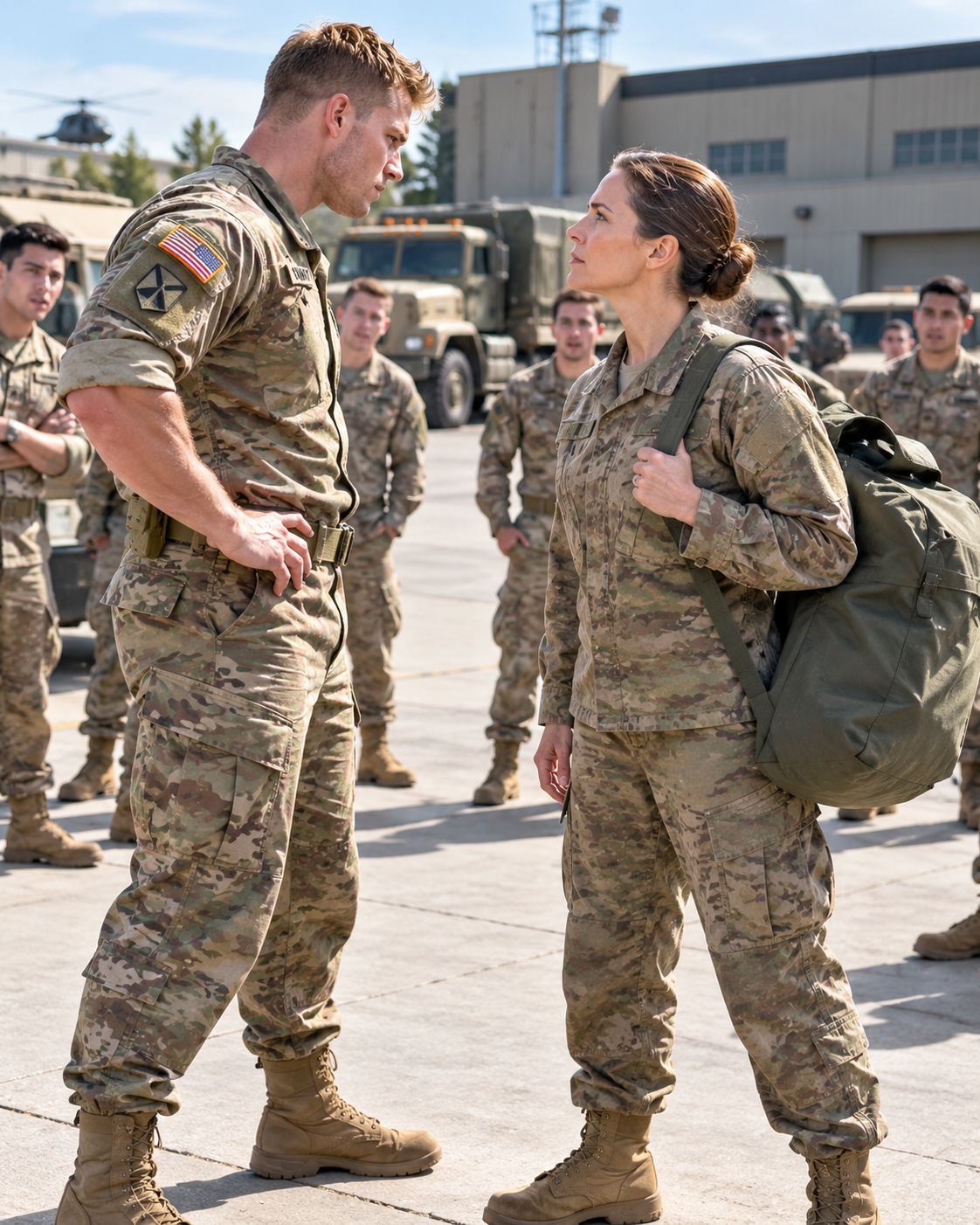
Part 2: What the Private Had Recorded
Part 2: What the Private Had Recorded
General Morgan watched Bennett’s video twice.
Then she handed the phone to Colonel Hayes.
“Don’t delete that.”
“Yes, ma’am.”
Specialist Dawson swallowed.
“What exactly did you record, Private?”
Bennett looked uncomfortable.
“About fifteen minutes before the general arrived.”
The video showed Dawson near the motor pool gate confronting a young private carrying a sealed equipment case.
The soldier had repeatedly explained that the case was being transferred under written instructions and that Dawson could verify the paperwork with the duty NCO.
Dawson hadn’t verified anything.
Instead, he’d ordered the private to open the sealed case in front of several soldiers.
When the private refused, Dawson mocked him.
Then he took the case from his hands.
General Morgan looked at Dawson.
“Where is it?”
“In the operations office, ma’am.”
“Did you open it?”
“No, ma’am.”
That answer probably saved the situation from becoming worse.
Morgan turned toward Colonel Hayes.
“Secure the case. Preserve the video. Get statements from everyone who witnessed both incidents.”
Dawson’s breathing changed.
“General, I was trying to maintain security.”
Morgan studied him.
“Then why didn’t you call security?”
Silence.
“Why didn’t you verify the transfer order?”
Dawson had no answer.
Morgan pointed toward the canvas covering her own insignia.
“And why did you reach for something on my uniform after I specifically told you not to?”
“I thought—”
“I know what you thought.”
Her voice remained calm.
“That is exactly what we’re going to examine.”
Nobody was punished in the training yard.
Morgan wouldn’t allow that.
She hadn’t traveled to Fort Carson to conduct public humiliation.
She was there because the command had received repeated complaints about something much less dramatic but potentially more damaging:
junior personnel being pressured to ignore procedure whenever somebody more confident told them to.
Dawson was only one piece of that problem.
Over the following days, investigators and command staff reviewed training practices, security procedures and supervisory behavior.
Bennett’s video became useful evidence, but it wasn’t treated as proof of every complaint.
Witnesses were interviewed separately.
Records were checked.
The soldier carrying the equipment case had, in fact, possessed valid transfer documentation.
He had also done exactly what his training required when Dawson demanded that he break the seal.
He refused.
Dawson, meanwhile, had no authorization to inspect the contents himself.
His mistake wasn’t being cautious.
Caution was appropriate.
His mistake was substituting confidence for verification.
That distinction became the center of General Morgan’s briefing.
Three days later, she stood inside a classroom with Dawson, Bennett, Perez and several unit leaders.
Her rank was visible now.
But she began by covering the silver star with her hand.
“Forget this.”
Everyone watched.
“If I had been a civilian contractor, would Specialist Dawson’s decision have been correct?”
Nobody answered.
Morgan looked toward Bennett.
“No, ma’am.”
“Why?”
“Because he should’ve verified your credentials through the proper channel instead of making assumptions.”
“Exactly.”
She uncovered the star.
“This doesn’t make me right.”
Then she pointed toward the regulations projected behind her.
“Procedure makes the procedure right.”
Dawson looked down.
Morgan wasn’t finished.
“If you only behave professionally after discovering someone’s rank, then you haven’t learned professionalism.”
That sentence stayed with the room.
Dawson’s conduct was later addressed through his normal chain of command after the review was completed. He received corrective action and additional training appropriate to the findings.
But Morgan rejected suggestions that he simply be made an example of.
“A frightened soldier learns to hide mistakes,” she told Colonel Hayes.
“I want soldiers who know how to correct them.”
Several weeks later, Morgan returned to Fort Carson.
This time, she wore ordinary operational fatigues again.
As she crossed the training yard, she saw Dawson near the same walkway.
A civilian technician was approaching with an unfamiliar equipment container.
Dawson stepped forward.
For one second, Morgan wondered whether anything had changed.
“Sir,” Dawson said, “I don’t recognize that case. May I see your authorization?”
The technician produced paperwork.
Dawson didn’t touch the container.
He called the appropriate office.
Waited.
Verified the transfer.
Then stepped aside.
“Thank you, sir. You’re good.”
The technician continued walking.
Dawson noticed Morgan.
His posture straightened.
“General.”
Morgan nodded toward the departing technician.
“Better.”
“Yes, ma’am.”
Then Bennett approached from behind carrying his phone.
Dawson glanced at it.
“You recording me again?”
Bennett grinned.
“No.”
“Good.”
Perez appeared behind them.
“I would’ve.”
For the first time, Dawson laughed with them instead of needing them to laugh at somebody else.
Morgan continued toward the command building.
She hadn’t come to Fort Carson hoping to expose one arrogant specialist.
The problem had always been larger than one man.
Rank can intimidate people into obedience.
Confidence can imitate authority.
And embarrassment can make otherwise ordinary people double down on bad decisions.
The Army didn’t need Dawson to become afraid of generals.
It needed him to understand something much more useful.
When something looks wrong, verify it.
When somebody outranks you, follow lawful authority—not ego.
And when you don’t know who someone is, professionalism should come before assumptions, not after the silver star appears.