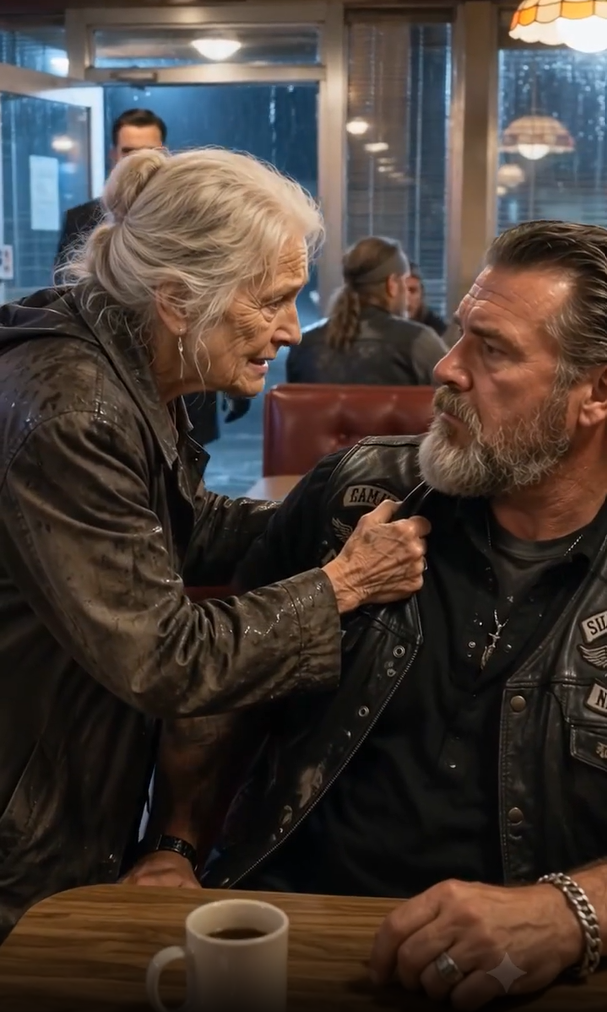
Part 2: The Woman Who Wasn’t His Mother
Part 2: The Woman Who Wasn’t His Mother
The bald biker didn’t move.
“Don’t let him take me.”
Those five words changed the entire diner.
The man in the black coat slowly removed his hand from the elderly woman’s wrist.
Then he smiled.
“She’s confused. I’m her son.”
The woman shook her head violently.
“No. My son is dead.”
Every biker at the table went still.
The gray-bearded man she’d begged to impersonate her grandson finally spoke.
“My name’s Ray Dawson. What’s yours, ma’am?”
“Margaret Ellis.”
“And him?”
Margaret looked toward the stranger.
“Victor Hale. My late husband’s business partner.”
Victor’s smile disappeared.
“Margaret has dementia.”
“Maybe,” Ray said calmly. “Then we’ll call someone qualified to determine what she wants.”
He signaled the waitress.
“Call 911.”
Victor immediately objected.
“There is absolutely no reason—”
“Good,” Ray interrupted. “Then you won’t mind waiting.”
Nobody touched Victor.
Nobody blocked the door.
They simply stayed with Margaret.
That distinction mattered.
When officers arrived, Victor produced paperwork claiming he was helping manage Margaret’s affairs.
Margaret produced something else.
A small envelope she’d hidden inside her jacket.
On the front she’d written:
IF I SAY I WANT TO GO HOME WITH VICTOR, DON’T BELIEVE ME.
Inside was the phone number of her attorney, her doctor’s office, and her actual grandson, Andrew Ellis.
The officers separated everyone and began verifying the story.
What emerged wasn’t a dramatic kidnapping plot.
It was quieter.
And uglier.
After Margaret’s husband died, Victor had begun helping with bills and transportation. Over time, Margaret said, he started making decisions she hadn’t approved.
He pressured her to sell her house.
He discouraged visits from neighbors.
That morning, they’d argued after Margaret learned an appointment had been scheduled with a real-estate attorney.
At a gas station, Margaret walked away and boarded a local bus.
Victor followed her to the diner.
Her memory wasn’t perfect.
But neither was she incapable of making decisions simply because Victor said so.
Her attorney confirmed that Victor did not have authority to physically compel her to leave with him.
The officers contacted adult protective services so the financial concerns could be reviewed properly.
Then Margaret’s grandson arrived.
Andrew was thirty-two, rainwater dripping from his jacket.
“Grandma.”
Margaret’s entire body relaxed.
Andrew crossed the diner and hugged her.
“I’ve been calling you for two hours.”
Margaret started crying.
“I didn’t know who else to ask.”
Then she remembered Ray.
She pointed toward the enormous biker.
“So I borrowed a grandson.”
Andrew looked at him.
Ray shrugged.
“Temporary position.”
For the first time all evening, Margaret laughed.
The investigation continued afterward.
Some of Margaret’s concerns were supported by financial records; others were misunderstandings created by poor communication and her increasing difficulty keeping track of paperwork.
Her family and attorney arranged safeguards around major financial decisions, regular check-ins, and professional support that allowed Margaret to retain as much independence as possible.
Victor was removed from managing her affairs while the disputed transactions were reviewed through the proper channels.
But Margaret never forgot the diner.
Three months later, she returned on a sunny afternoon.
Ray and the Iron Ravens were sitting in the same booth.
Margaret walked directly toward him.
“Grandson.”
Ray looked up.
“Grandma.”
The entire table burst out laughing.
She handed him a photograph.
It showed Margaret with her real grandson, Andrew.
On the back she’d written:
THANK YOU FOR BELIEVING ME LONG ENOUGH TO CHECK.
Ray stared at that sentence.
That was the part he remembered.
He hadn’t known whether Margaret’s story was true when she grabbed his vest.
He hadn’t needed to.
He only needed to recognize that a frightened person was asking for time, distance, and verification.
Sometimes helping someone doesn’t mean deciding who’s right within thirty seconds.
Sometimes it means making sure nobody is forced anywhere while the truth is being established.
And that rainy night, Margaret hadn’t needed a gang of bikers to fight for her.
She needed something far simpler.
Someone willing to stand beside her and say:
“Before she goes anywhere, we’re going to listen to what she has to say.”