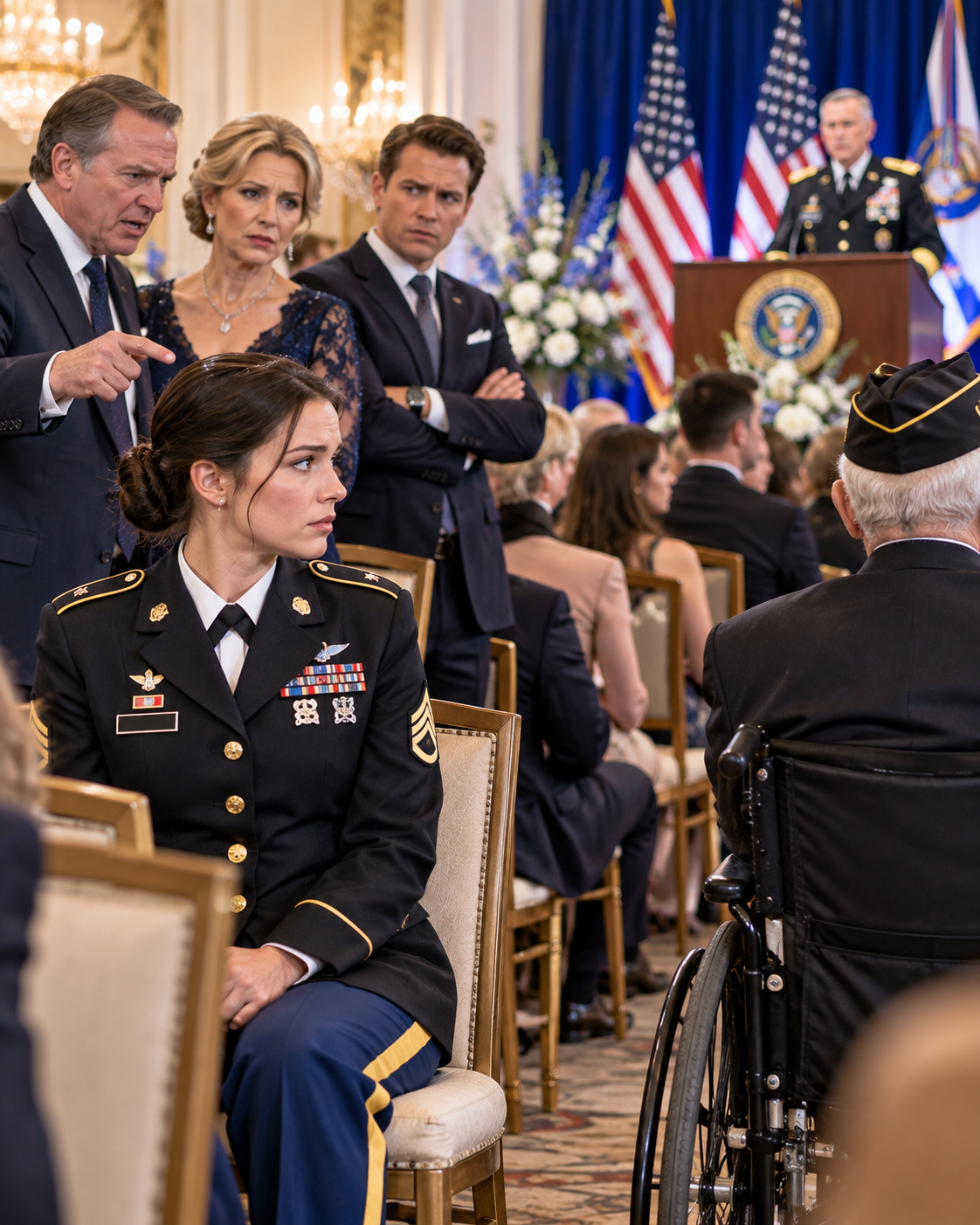
Part 2: The Uniform They Wanted Her to Hide
Part 2: The Uniform They Wanted Her to Hide
Maya stopped halfway out of her chair.
“Grandpa.”
Her grandfather, Walter Parker, ignored her warning.
At ninety, his voice wasn’t powerful anymore.
But the ballroom was silent enough that it didn’t need to be.
“My granddaughter came here wearing the uniform of the United States Army,” Walter said. “And somebody in this family made her feel like she should be ashamed of it.”
Maya’s father stared at the floor.
Daniel shifted uncomfortably.
“Dad, this isn’t the place—”
Walter turned toward him.
“Then where was the place to tell my granddaughter her service wasn’t impressive enough?”
Daniel said nothing.
Maya finally approached her grandfather.
“This is supposed to be your ceremony.”
Walter looked up at her.
“Then an old soldier gets to decide what matters at his own ceremony.”
A few people laughed softly.
The tension eased.
Walter took Maya’s hand.
“Go.”
Maya walked toward the stage.
Not triumphantly.
Not looking toward Daniel.
She simply marched forward, stopped before the general and came to attention.
The citation was read.
It described an overseas evacuation operation several months earlier.
Maya had been part of a joint support element responsible for coordinating casualty movement when changing conditions made the planned evacuation route unusable.
Communications were unreliable.
Vehicles had been separated.
Several injured personnel needed to be moved quickly.
Maya reorganized the casualty collection sequence, coordinated alternate transportation and helped keep personnel moving until the evacuation chain was restored.
She hadn’t done it alone.
That was the first thing she told the general when informed she would be recognized.
So when the presentation ended and the microphone was offered to her, Maya almost refused it.
Then she saw her grandfather.
She accepted.
“This commendation has my name on it,” she said, “but there were soldiers, medics, aircrews and support personnel whose names aren’t being read today. I was one person in a team that did its job.”
She paused.
“And since this is my grandfather’s day, I’ll add one thing.”
Walter smiled.
“He’s the reason I joined.”
Maya looked toward him.
“He taught me that service isn’t supposed to make you more important than the person beside you. It’s supposed to make you responsible for them.”
Walter lowered his head.
His eyes filled.
The ballroom stood again.
This time Maya’s family stood too.
Afterward, people surrounded her.
Officers shook her hand.
Several veterans wanted to meet her.
A young sergeant quietly told her he appreciated what she’d said about the team.
The senators and executives her father had worried so much about?
Most simply congratulated her and moved on.
There was no magical transformation where the entire ballroom suddenly treated Maya like the most important person there.
And Maya preferred it that way.
She had never needed celebrity.
She had needed respect from her own family.
Daniel found her near the hallway.
For once, he wasn’t smiling.
“I didn’t know.”
Maya looked at him.
“You didn’t know about the commendation.”
“No.”
“That isn’t the problem.”
Daniel understood.
Maya continued.
“You thought my career deserved less respect before you knew about the award.”
That landed harder.
Daniel looked away.
“I was an ass.”
“Yes.”
He almost smiled.
Maya didn’t.
Then her father approached.
Her mother followed several steps behind.
“Maya…”
Her father struggled for words.
“I shouldn’t have said what I said.”
“No.”
“I thought today needed to look a certain way.”
Maya glanced around the ballroom.
“And I didn’t fit the picture?”
Her father didn’t answer immediately.
Finally:
“No. You didn’t fit the picture I had in my head.”
It wasn’t a perfect apology.
But at least it was honest.
Maya’s mother stepped forward.
“I should have said something.”
Maya looked at her.
Her mother’s eyes were wet.
“I heard him. I knew it was wrong. And I stayed quiet because I didn’t want an argument before the ceremony.”
“That hurt more than what Dad said.”
“I know.”
Maya didn’t immediately forgive any of them.
She didn’t need to manufacture a beautiful family moment because people were watching.
“Then do better next time.”
Her father nodded.
“So will I,” her mother said.
Daniel extended his hand.
Maya looked at it.
Then ignored it and hugged him.
“Still an ass,” she whispered.
“Understood.”
Later that evening, after most guests had left, Maya found Walter alone near the stage.
His military photograph from decades earlier stood beside his wheelchair.
“You embarrassed Dad,” Maya said.
Walter grinned.
“I’ve been his father for sixty-three years. I’ve earned privileges.”
Maya laughed.
Then Walter became serious.
“Come here.”
He reached inside his jacket and removed a small box.
Inside was an old Army insignia he’d kept from his service.
“I wanted Daniel to have this once.”
Maya shook her head.
“Grandpa, don’t give it to me because of today.”
“I’m not.”
He closed the box.
“I’m asking you to hold onto it.”
“For what?”
Walter looked toward the family gathered across the ballroom.
“For whoever serves next.”
Maya understood.
Not necessarily a soldier.
Not necessarily somebody wearing a uniform.
Just whoever in the next generation chose a life built around service rather than status.
She slipped the box carefully into her pocket.
Before leaving, Walter asked one final question.
“Did you really ask the Pentagon to wait until after my ceremony?”
“Yes.”
“Why?”
“Because today was supposed to be about you.”
Walter shook his head.
“No.”
He looked at Maya’s uniform.
“Today was supposed to be about what service looks like after all these years.”
Then he smiled.
“Turns out it looks better on you.”
Maya laughed and pushed his wheelchair toward the exit.
Behind them, her father picked up Maya’s presentation case.
Daniel carried Walter’s photographs.
Her mother took the flowers.
Nobody discussed salaries.
Nobody mentioned job titles.
And Maya never forgot the strange lesson of that afternoon.
Her family had believed the uniform needed an impressive medal before it deserved their respect.
But the medal hadn’t changed what Maya was worth.
It had only forced them to notice what had been standing in front of them all along.
Respecting someone’s service after the applause is easy.
The harder test is respecting it before you know there’s going to be applause.