Peaky Blinders: The Brutal Crime Saga That Turned Cillian Murphy’s Tommy Shelby Into a TV Icon
Peaky Blinders: The Brutal Crime Saga That Turned Cillian Murphy’s Tommy Shelby Into a TV Icon
A war veteran returns home carrying memories he cannot escape.
Waiting for him is Birmingham — a city of factories, smoke, bookmakers, political unrest and criminal organizations fighting for control.
At the center of it all stands Thomas Shelby.
That is the world of Peaky Blinders, the acclaimed British crime drama created by Steven Knight that transformed Cillian Murphy’s Tommy Shelby into one of modern television’s most recognizable antiheroes.
But Peaky Blinders is much more than a gangster story.
Across six seasons, it becomes a sprawling drama about family, ambition, trauma, loyalty and the terrible price of power.
And the higher Tommy climbs, the more difficult it becomes to determine whether he is building an empire — or destroying himself.
Welcome to Birmingham After the Great War
The story begins in Birmingham in 1919.
Tommy Shelby has returned from World War I alongside other men permanently changed by what they experienced.
Back home, the Shelby family runs an illegal betting operation through the Peaky Blinders gang.
Tommy, however, wants more.
He is intelligent, calculating and almost unnervingly calm under pressure. While others see streets and betting shops, Tommy sees opportunities to expand the family’s influence far beyond Birmingham.
Then a shipment of guns unexpectedly falls into his hands.
That mistake attracts dangerous attention from the authorities and brings Chief Inspector Chester Campbell, played by Sam Neill, into Birmingham.
Suddenly, Tommy is no longer simply competing with rival gangs.
He is playing a much larger game.
Cillian Murphy Creates an Unforgettable Antihero
Cillian Murphy’s performance is the foundation of the series.
Tommy rarely needs to raise his voice to dominate a scene.
His stillness often says more than dialogue.
Behind his immaculate suits and controlled expression is a man carrying psychological wounds from the war. His ambition becomes both his greatest weapon and one of the forces gradually isolating him from everyone around him.
Tommy repeatedly believes he can calculate his way out of danger.
Often, he can.
But every victory creates another enemy.
Every expansion of the Shelby empire demands another compromise.
And every attempt to protect his family seems to pull them deeper into the dangerous world he created.
The Shelby Family Is the Heart of the Story
Despite the violence and criminal politics surrounding them, Peaky Blinders works because its central conflict is ultimately about family.
Paul Anderson plays Arthur Shelby, Tommy’s volatile older brother, whose loyalty is matched by his inability to escape his own demons.
Helen McCrory gives one of the series’ defining performances as Polly Gray, the formidable Shelby family matriarch.
Polly understands both the business and Tommy.
That makes her one of the few people capable of challenging him directly.
Their relationship becomes essential to the series because Polly recognizes something Tommy sometimes refuses to admit:
Winning does not necessarily mean surviving intact.
Then the Enemies Become More Dangerous
As the Shelby organization expands, the scale of the threats changes dramatically.
Local rivalries give way to larger criminal organizations, political conspiracies and international forces.
Among the show’s most memorable additions is Alfie Solomons, played by Tom Hardy.
Alfie is unpredictable, charismatic and almost impossible for Tommy to completely read. Whenever the two men share a scene, cooperation and betrayal seem equally possible.
Later seasons introduce even more dangerous opponents, including fascist politician Oswald Mosley, played by Sam Claflin.
By this point, Tommy has moved far beyond the streets where his story began.
He enters Parliament.
He interacts with powerful political figures.
He gains wealth and influence that the younger Tommy Shelby could only have imagined.
Yet his victories never provide the peace he expects.
Stephen Graham Enters the Peaky Blinders World
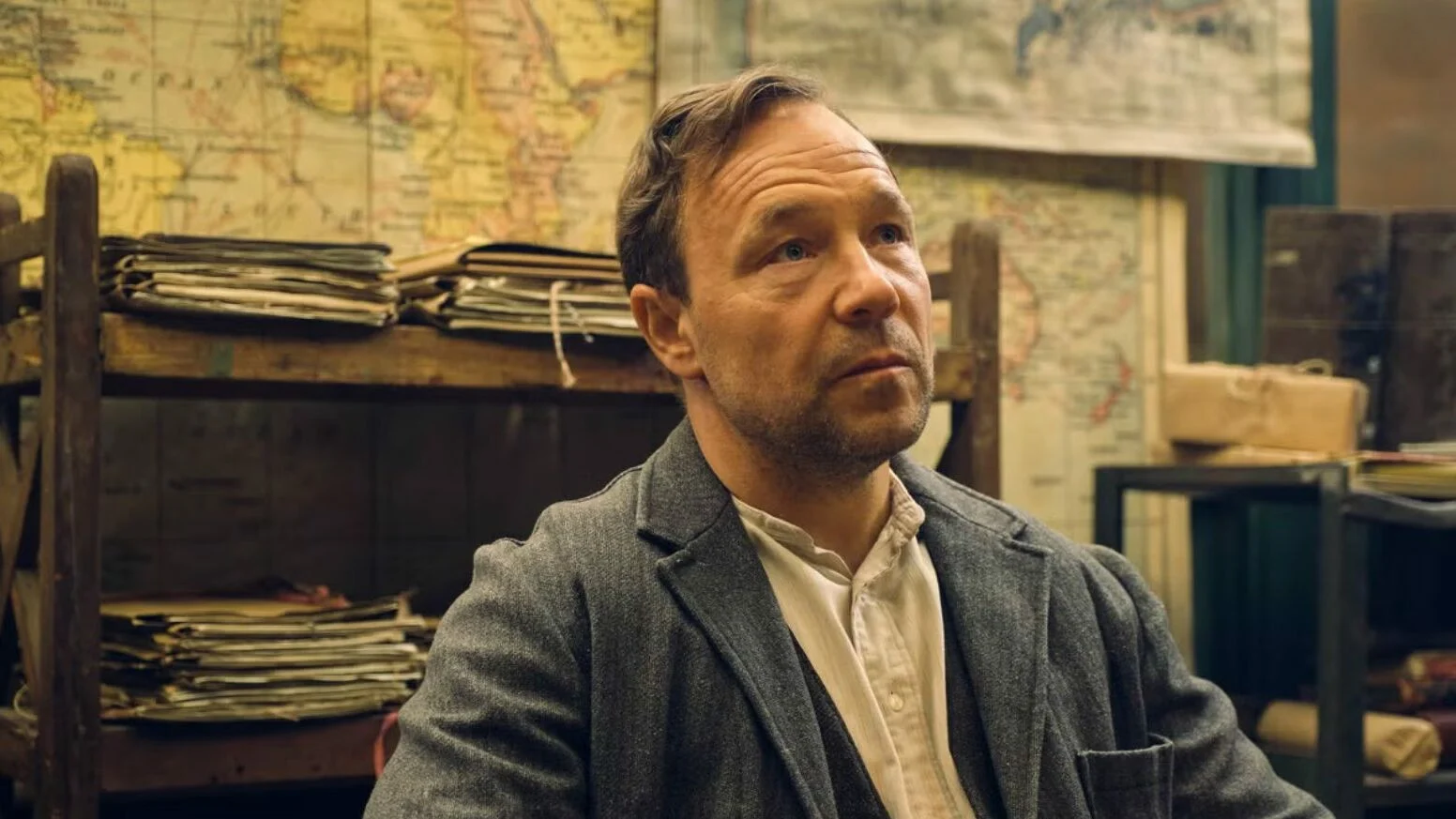
Stephen Graham joins the series in its sixth season as Hayden Stagg, a dock worker in Liverpool.
His appearance is relatively brief compared with the show’s central characters, but his confrontation with Arthur Shelby creates one of the season’s most memorable exchanges.
Stagg does something unusual.
He doesn’t simply challenge Arthur physically.
He sees through him.
He recognizes the addiction, pain and self-destruction behind Arthur’s intimidating reputation because he understands that world himself.
That makes their encounter different from a conventional gangster confrontation.
For a moment, the violence surrounding the Shelby organization gives way to something unexpectedly human.
It is exactly the kind of scene at which Graham excels: tense, restrained and emotionally uncomfortable.
Power Never Solves Tommy Shelby’s Real Problem
Throughout Peaky Blinders, Tommy keeps moving upward.
More money.
More property.
More political influence.
More control.
Yet the series repeatedly returns to the same contradiction.
Tommy can defeat enemies, manipulate powerful men and survive situations that should destroy him.
What he cannot easily defeat is his own past.
The war follows him.
Loss follows him.
The consequences of his decisions follow him.
This is why the show’s quiet scenes can be as powerful as its confrontations. Beneath the gangster mythology is a man who keeps acquiring everything he once thought he wanted while becoming increasingly uncertain about what any of it is worth.
Why Peaky Blinders Became a Global Phenomenon
Part of the series’ appeal comes from its instantly recognizable style.
The industrial Birmingham setting, sharp tailoring, smoky interiors and modern soundtrack create a world that feels historical without behaving like a conventional period drama.
But style alone would not have sustained six seasons.
The characters did that.
Tommy, Arthur, Polly, Ada, Alfie and the wider Shelby family repeatedly force viewers to question where loyalty ends and ambition begins.
The show also understands that its protagonist’s intelligence does not protect him from consequences.
Tommy Shelby can usually find another strategy.
He cannot always repair what that strategy costs.
The Man Behind the Legend
By the later stages of Peaky Blinders, Tommy Shelby has become almost mythological within his own world.
He began as a bookmaker in postwar Birmingham.
He becomes a wealthy businessman, political figure and power broker capable of moving between criminal and establishment circles.
But underneath the expensive suits remains the soldier who came home from France carrying something he could never completely leave behind.
That is the tragedy hidden inside the fantasy of Peaky Blinders.
Tommy spends years becoming powerful enough that almost nobody can control him.
Yet some of his most dangerous battles cannot be solved with money, guns, politics or another carefully constructed plan.
And that may be the real reason Peaky Blinders continues to resonate: beneath the swagger and criminal empire is a story about people discovering that every victory has a price — and eventually, even Thomas Shelby has to face the bill.