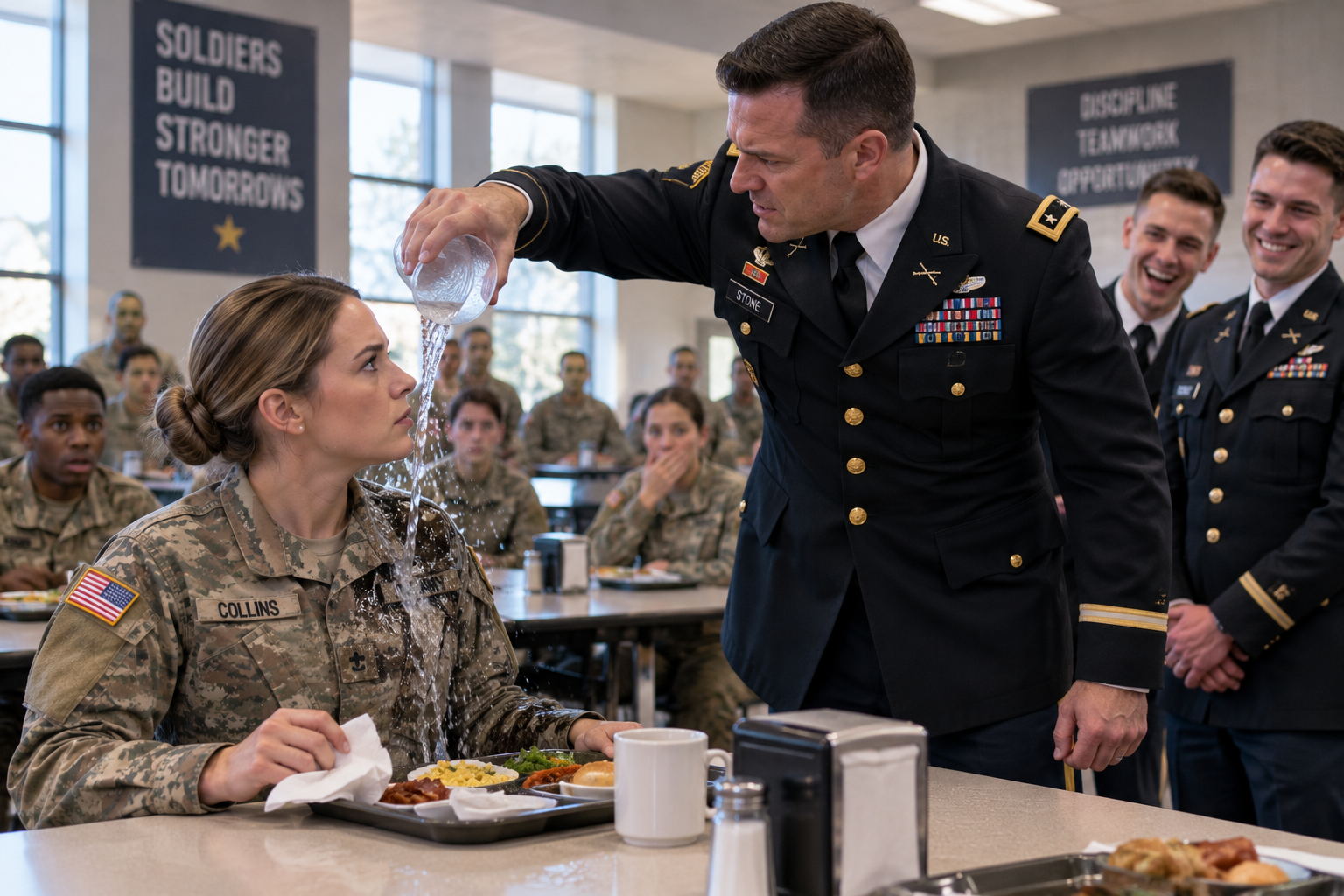
Part 2: The Captain Who Failed His Own Test
Part 2: The Captain Who Failed His Own Test
Stone stared at the folder as if the words might disappear.
“Command climate review?”
Sarah closed it.
“Yes.”
The two lieutenants behind him stopped smiling.
Sarah Collins wasn’t a junior officer who had wandered into the wrong cafeteria. She was Lieutenant Colonel Sarah Collins, temporarily assigned to Fort Ridgeline as part of an independent leadership assessment.
She had deliberately arrived without announcing herself to most of the installation.
Stone’s face reddened.
“You should have identified yourself.”
Sarah looked at the water still dripping from her sleeve.
“Would that have changed how you treated me?”
He didn’t answer.
“That,” Sarah said, “is why I didn’t.”
The older sergeant remained beside the table.
Sarah opened the folder again.
Stone’s name appeared repeatedly.
Complaints about public humiliation.
Junior personnel being pushed out of common spaces.
Soldiers afraid to challenge him.
Several reports had been dismissed as misunderstandings because nobody had documented enough to establish a pattern.
Until that morning.
Stone glanced around the cafeteria.
Dozens of witnesses had seen everything.
“I was enforcing standards,” he said.
Sarah looked at the identical tables surrounding them.
“Show me the regulation reserving this table for command officers.”
Silence.
“There isn’t one, is there?”
Stone’s jaw tightened.
“No, ma’am.”
Sarah turned toward the two lieutenants.
“And pouring water on another service member?”
Neither answered.
Their laughter suddenly seemed much less amusing.
Sarah didn’t yell.
She didn’t threaten anyone’s career.
She simply requested that witnesses provide factual statements and that the cafeteria’s available security footage be preserved. The incident would be reviewed through the proper command process along with the earlier complaints.
Stone finally understood what was happening.
“You came here looking for a reason to remove me.”
“No,” Sarah replied. “I came here looking for evidence that the complaints were either true or false.”
She glanced at her soaked sleeve.
“You supplied your own evidence.”
Stone lowered his eyes.
Later that afternoon, he was temporarily relieved of supervisory duties while the command reviewed the allegations.
But Sarah’s report didn’t focus only on him.
It also addressed something she considered more dangerous: the people who had learned to laugh whenever someone powerful humiliated someone with less visible authority.
The following morning, Sarah returned to the cafeteria.
Same table.
Same chair.
This time she wore her full uniform with her rank clearly visible.
Several people immediately stood.
Sarah raised a hand.
“Sit down. Finish breakfast.”
Then she noticed one of the young lieutenants from the previous morning.
He approached slowly.
“Ma’am, I owe you an apology.”
“For laughing?”
“Yes.”
Sarah shook her head.
“Don’t apologize because you discovered my rank.”
The lieutenant looked confused.
“Then what should I do?”
“Next time you see someone being treated that way, don’t join the crowd.”
He nodded.
Sarah sat down with her coffee.
Around her, enlisted personnel, officers, and civilian employees occupied the same ordinary tables.
Nobody was ordered to move.
Nobody needed permission to belong.
And Stone’s imaginary “command table” disappeared forever.
Because Sarah’s investigation ultimately reinforced a lesson Fort Ridgeline should never have needed:
Rank can give someone authority. It never gives them ownership of another person’s dignity.