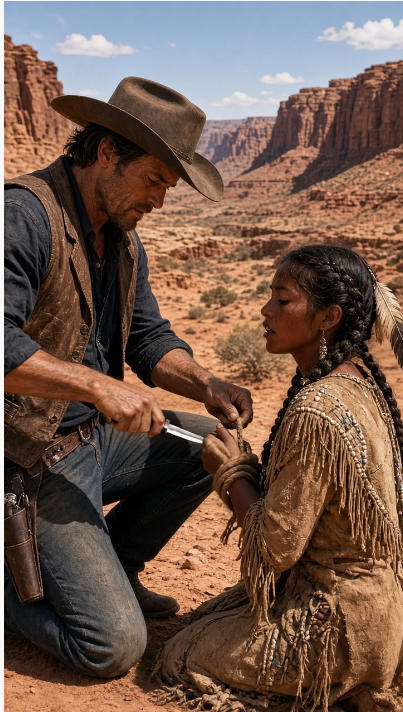
Part 2: The Woman He Freed Wasn’t Running From Anyone
Part 2: The Woman He Freed Wasn’t Running From Anyone
The cowboy’s name was Luke Mercer.
For the first mile, the woman said nothing.
She rode his spare mare while Luke led them north through the red canyons toward his ranch.
Finally, she spoke.
“My name is Kaya.”
Luke nodded.
He didn’t ask who had tied her up.
Not yet.
But as sunset approached, Kaya suddenly pulled her horse to a stop.
“Those men will come for you.”
Luke turned in the saddle.
“What men?”
“The ones who left me there.”
Luke studied her face.
“Why?”
Kaya hesitated.
“Because you cut the rope.”
That wasn’t an answer.
Before Luke could press her, he noticed dust rising behind them.
Riders.
Six of them.
Luke immediately guided Kaya into a narrow sandstone passage.
“Stay behind me.”
But when the riders appeared, Kaya stepped forward instead.
“Don’t.”
Luke frowned.
The six men stopped twenty yards away.
They weren’t outlaws.
Two wore badges.
At their center sat a wealthy rancher Luke recognized immediately.
Charles Whitmore.
Whitmore controlled more cattle, land, and water than anyone within fifty miles.
His eyes settled on Kaya.
“You took something that belongs to me, Mercer.”
Luke’s voice went cold.
“She belongs to herself.”
Whitmore smiled.
“I’m not talking about the woman.”
Kaya reached beneath her beaded tunic.
She pulled out a folded document.
Luke stared.
It was a land survey.
Kaya explained that her father had spent years fighting Whitmore over a spring hidden inside Red Canyon. Whitmore claimed the water belonged to his ranch.
But an older territorial survey proved otherwise.
The spring lay on land legally protected for Kaya’s community.
Whitmore had bribed a clerk to make the original record disappear.
Kaya had found the surviving copy.
That was why she’d been captured.
They hadn’t tied her in the desert to frighten her.
They had been waiting for nightfall.
Luke looked at Whitmore.
“You left her there to die.”
One deputy lowered his eyes.
Whitmore simply said, “Give me the paper.”
Luke didn’t reach for his gun.
Instead, he laughed.
That confused everyone.
“You’re too late.”
Whitmore’s smile disappeared.
Before freeing Kaya, Luke had noticed the territorial seal on the document lying partly beneath her. He hadn’t understood what it meant, but he’d placed a tracing of the seal and a written description inside the mail pouch carried by a stagecoach they’d passed two hours earlier.
It was already headed toward the county seat.
Whitmore could destroy this copy.
He couldn’t stop the questions coming afterward.
One deputy slowly moved away from Whitmore.
Then the other did the same.
Neither wanted to hang his career on a land fraud that might already be sitting on a judge’s desk.
Whitmore rode away alone.
Three weeks later, territorial officials arrived.
The original survey was found in an archived ledger.
Kaya had been telling the truth.
Whitmore’s claim was invalid.
The spring was protected.
An investigation also uncovered payments made to the county clerk and several altered property records. Whitmore lost far more than the water he had tried to steal.
Luke expected Kaya to leave once the hearings ended.
She did.
She returned to her family.
That surprised people in town.
They had already begun inventing romantic stories about the mysterious woman and the lonely cowboy.
Luke ignored them.
He hadn’t cut Kaya’s ropes so she would owe him a life.
Freedom with conditions wasn’t freedom.
Winter came.
Then spring.
One warm April morning, Luke was repairing his ranch fence when he heard horses.
He looked up.
Kaya was riding toward him.
Behind her came several members of her family leading packhorses loaded with timber and supplies.
Luke leaned against the fence.
“Lose your way?”
Kaya smiled.
“No.”
She pointed toward the dry creek running across Luke’s property.
During the legal survey, her people had discovered something else.
The protected spring fed an underground channel extending beneath Luke’s struggling ranch.
There was enough water for both communities if managed carefully.
“You helped save our water,” Kaya said. “My father believes water should remember its friends.”
Together, they built a small irrigation channel.
Luke’s dying pasture turned green.
Over the following years, the ranch became a stopping place where travelers could water horses without payment.
Kaya visited often.
Eventually, often became every week.
Then every few days.
Neither hurried what came afterward.
Years later, Luke still kept the knife he’d used that afternoon in Red Canyon.
People assumed it reminded him of the day he rescued Kaya.
Luke always corrected them.
“I didn’t rescue her.”
He would look across the ranch toward Kaya riding home beneath the evening sun.
“I only cut a rope.”
Because the most important thing Luke Mercer gave her that day wasn’t protection.
It wasn’t a horse.
And it wasn’t his hand.
It was the freedom to decide where she wanted to go after she stood up.