Part 2: The Medal That Came Home
Part 2: The Medal That Came Home
Walter stared at the object hanging from Hammer’s chain.
It was a battered military dog tag.
Not Hammer’s.
His father’s.
Walter reached toward it with trembling fingers.
“Thomas Dawson.”
Hammer nodded.
“My dad wore it until the day he died.”
Walter turned the tag over.
A tiny cross had been scratched into the metal.
Walter’s knees weakened.
“I made that mark.”
More than fifty years earlier, Walter had found Thomas wounded and separated from his unit after fighting tore through their position.
Walter had carried and dragged him for miles toward an aid station.
Thomas kept slipping in and out of consciousness.
At one point, he became convinced he wouldn’t survive.
Walter had removed Thomas’s dog tag, scratched the small cross into its back with the tip of a pocketknife, then pressed it into his hand.
“Hold onto this,” Walter had told him. “If you can still feel it, you’re still here.”
Thomas survived.
Evacuation separated the two soldiers afterward.
Neither ever found the other again.
Hammer swallowed hard.
“My father told me that story my entire childhood.”
Walter stared at him.
“He remembered me?”
“He never knew your name.”
Hammer’s voice cracked.
“But he remembered everything else.”
Thomas had eventually returned to Tennessee, married, raised three children, and opened a small repair shop.
Hammer grew up there.
Whenever he complained that something was too difficult, Thomas showed him that scratched dog tag.
“A stranger carried me when he didn’t have to,” Thomas would say. “So don’t tell me people only look after themselves.”
Walter lowered himself into a chair.
For eleven months after June died, he had believed he was becoming invisible.
Now eight bikers were standing inside his living room because something he’d done half a century earlier had quietly shaped an entire family.
Hammer sat beside him.
“My father got forty more years because you stopped for him.”
Walter shook his head.
“I just did what anybody would’ve done.”
“No,” Hammer said. “You did what somebody did.”
That distinction stayed with everyone.
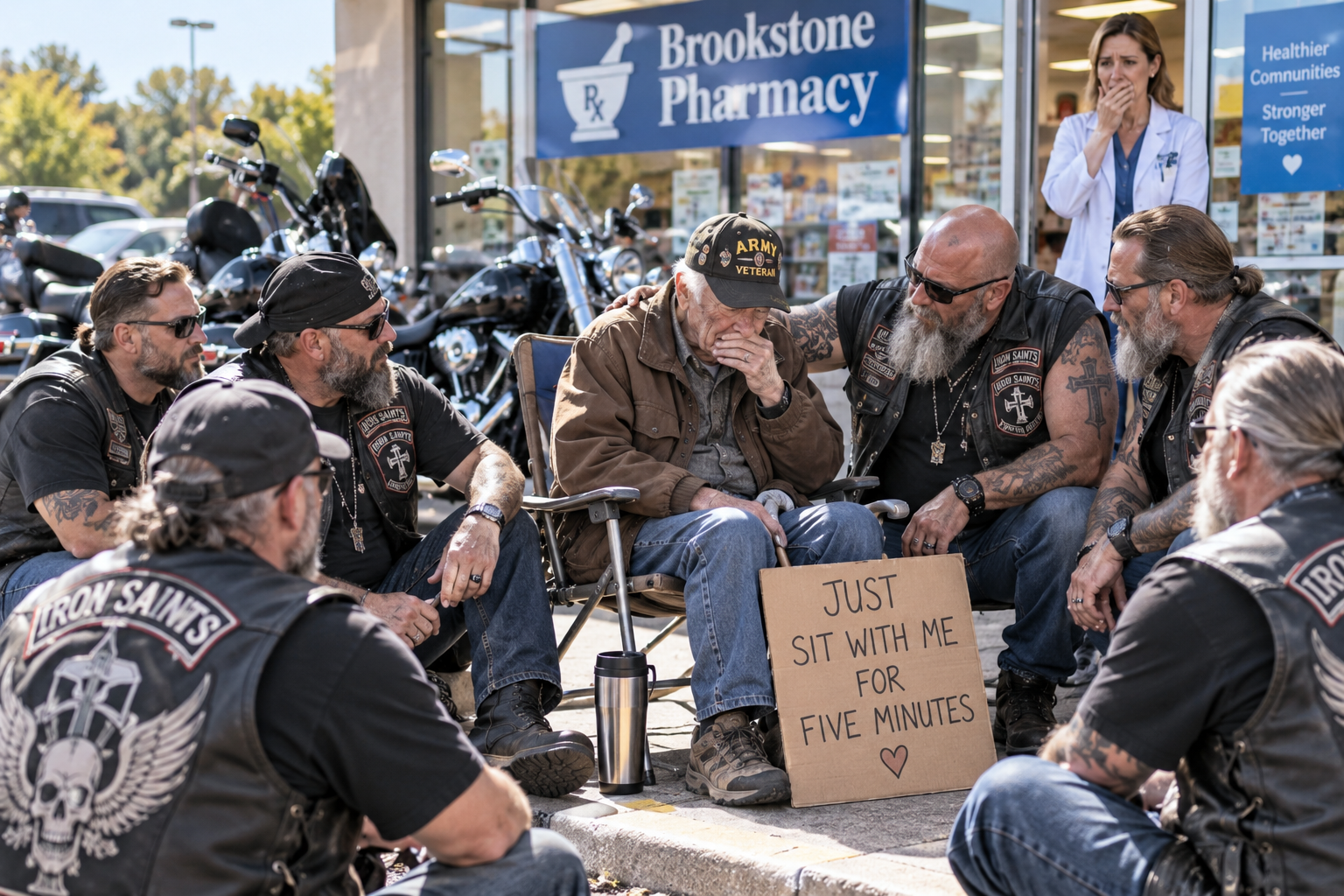
The following Friday, Walter returned to the pharmacy.
Same folding chair.
Same cardboard sign.
But this time eight motorcycles were already waiting.
Hammer sat first.
Then his brothers.
A customer asked what they were doing.
“Five minutes,” Hammer answered.
She sat too.
Five became ten.
Ten became twenty.
Within months, the Iron Saints began organizing weekly “Five-Minute Chairs” at veteran centers, pharmacies, diners, and community events—not as therapy or charity, but simply as an invitation for people who felt alone to have someone listen.
Other riding groups heard about it.
Some copied the idea.
Walter never cared how large it became.
He cared about Thursday afternoons.
That was when Hammer visited his house.
Sometimes they talked about Vietnam.
Usually they didn’t.
They talked about motorcycles, baseball, June’s terrible habit of burning toast, and Thomas Dawson’s obsession with rebuilding engines that should have been thrown away.
One afternoon, Hammer brought Walter a small wooden box.
Inside was the dog tag.
Walter immediately pushed it back.
“No. Your father gave that to you.”
Hammer closed Walter’s fingers around it.
“He wanted me to remember the man who carried him.”
Walter’s eyes filled.
“Then you should keep it.”
Hammer smiled.
“I don’t need the tag anymore.”
“Why?”
Hammer pulled a chair beside him.
“Because I found the man.”
After Walter eventually stopped sitting outside the pharmacy, Anna kept his cardboard sign.
It was framed near the entrance.
Not because Walter needed strangers anymore.
He had plenty of people stopping by.
It remained because his simple request had exposed something most people were too busy to notice.
Sometimes the person beside you doesn’t need money.
Doesn’t need advice.
Doesn’t even need you to solve anything.
Sometimes they just need you to sit down—and stay for five minutes.