Part 2: The Man They Left Behind
Part 2: The Man They Left Behind
Walter didn’t speak again until the waitress had swept the broken coffee cup from the floor.
Then he pulled out the chair across from me.
“Your father didn’t abandon anyone, Garrett. That’s what you need to understand first.”
He told me the tattoo came from a promise made by seven soldiers after a disastrous evacuation overseas decades earlier. Their unit had been ordered out after a helicopter extraction went wrong.
One soldier was missing.
Staff Sergeant Samuel Reed.
Walter had been badly wounded. My father, Thomas, carried him nearly two miles toward the extraction point while the others searched for Reed.
Eventually, the order came over the radio.
They had to leave.
“Your father refused,” Walter said. “Two men had to drag him onto that helicopter.”
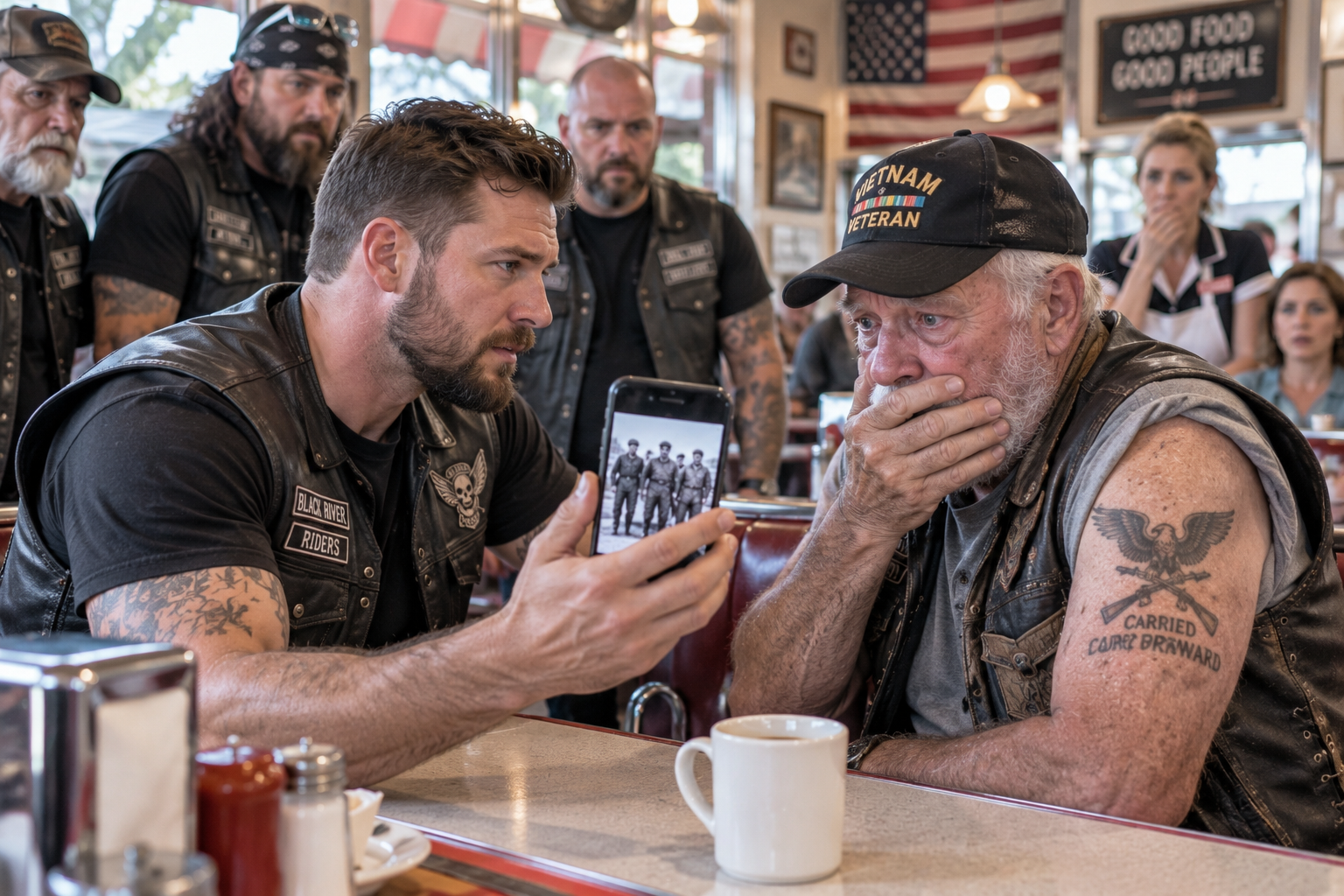
I looked again at the photograph.
Seven young soldiers.
Seven matching tattoos.
But Walter shook his head.
“There were supposed to be eight.”
Months later, the surviving men got the eagle and crossed rifles tattooed on their arms. Carried Forward meant that wherever they went afterward, Reed went with them.
My father never told me.
Walter knew why.
“Guilt.”
After returning home, Thomas spent years trying to learn what happened to Reed. He wrote letters, contacted former soldiers and requested records whenever he could.
Then Walter showed me something else.
A folded photocopy of an old military document.
It wasn’t proof of some hidden conspiracy.
It was a personnel-recovery report.
Samuel Reed had survived the initial incident.
He’d been recovered days later by another unit, badly injured but alive.
My father never learned that.
“How is that possible?”
Walter lowered his eyes.
“Because I was supposed to tell him.”
After his own injuries, Walter spent months recovering. Addresses changed. Men scattered. Records moved slowly in those days.
Then shame did the rest.
Every year Walter waited made the phone call harder.
Eventually, he convinced himself Thomas had probably learned through official channels.
He hadn’t.
My father died still believing Reed never came home.
I wanted to be angry.
Part of me was.
“You had thirty years.”
“I know.”
Walter didn’t defend himself.
That’s when he removed one final photograph from his vest.
Three elderly men stood together outside a veterans center.
Walter was one.
Samuel Reed was another.
The photograph had been taken six months earlier.
Reed was alive.
I stared at it until the faces blurred.
“He’s still here?”
Walter nodded.
“And he knows who you are.”
That afternoon, we drove to a small veterans center outside town.
Samuel Reed was eighty-one.
He walked with a cane, but when he saw me, he stopped.
“Tommy’s boy.”
Before I could answer, the old soldier hugged me.
Then he told me the part Walter couldn’t.
My father hadn’t failed him.
The search Thomas helped organize before evacuation had forced the unit to mark Reed’s last known position. That information was later passed along and helped another patrol narrow the recovery area.
“Your father spent his life thinking he left me,” Reed said. “But part of the reason they found me was because he refused to forget where I was.”
I couldn’t speak.
Reed looked at the photograph on my phone.
Then at the motorcycle vest I wore.
“You ride?”
“Every chance I get.”
He smiled.
“Tommy always wanted a bike.”
I laughed.
“He eventually bought one.”
For the first time that day, Reed’s face softened completely.
Three weeks later, I returned with Walter and six Black River Riders.
We didn’t hold a ceremony.
No speeches.
No television cameras.
We simply rode to my father’s grave.
Walter placed the torn half of the photograph against the headstone.
Reed had brought the other half.
They fit perfectly.
For decades, each man had carried one piece.
Walter rolled up his sleeve.
The faded eagle was barely visible now.
Reed had the same tattoo.
I finally understood the words beneath it.
CARRIED FORWARD.
They weren’t about pretending the past didn’t hurt.
They meant refusing to let someone disappear simply because the road kept moving.
Before leaving, Walter apologized to me again.
I told him I couldn’t erase thirty years with one conversation.
But I also wasn’t going to waste another thirty carrying anger my father never asked me to inherit.
Walter nodded.
Then Samuel Reed placed his hand against Thomas Cole’s headstone.
“Tommy,” he whispered, “you didn’t leave me behind.”
The wind moved through the cemetery trees.
Nobody said anything for a while.
I’d spent my whole life believing toughness meant carrying your own weight without complaint.
Those old soldiers taught me something different.
Sometimes the heaviest thing a man carries isn’t what happened.
It’s the truth he waited too long to tell.