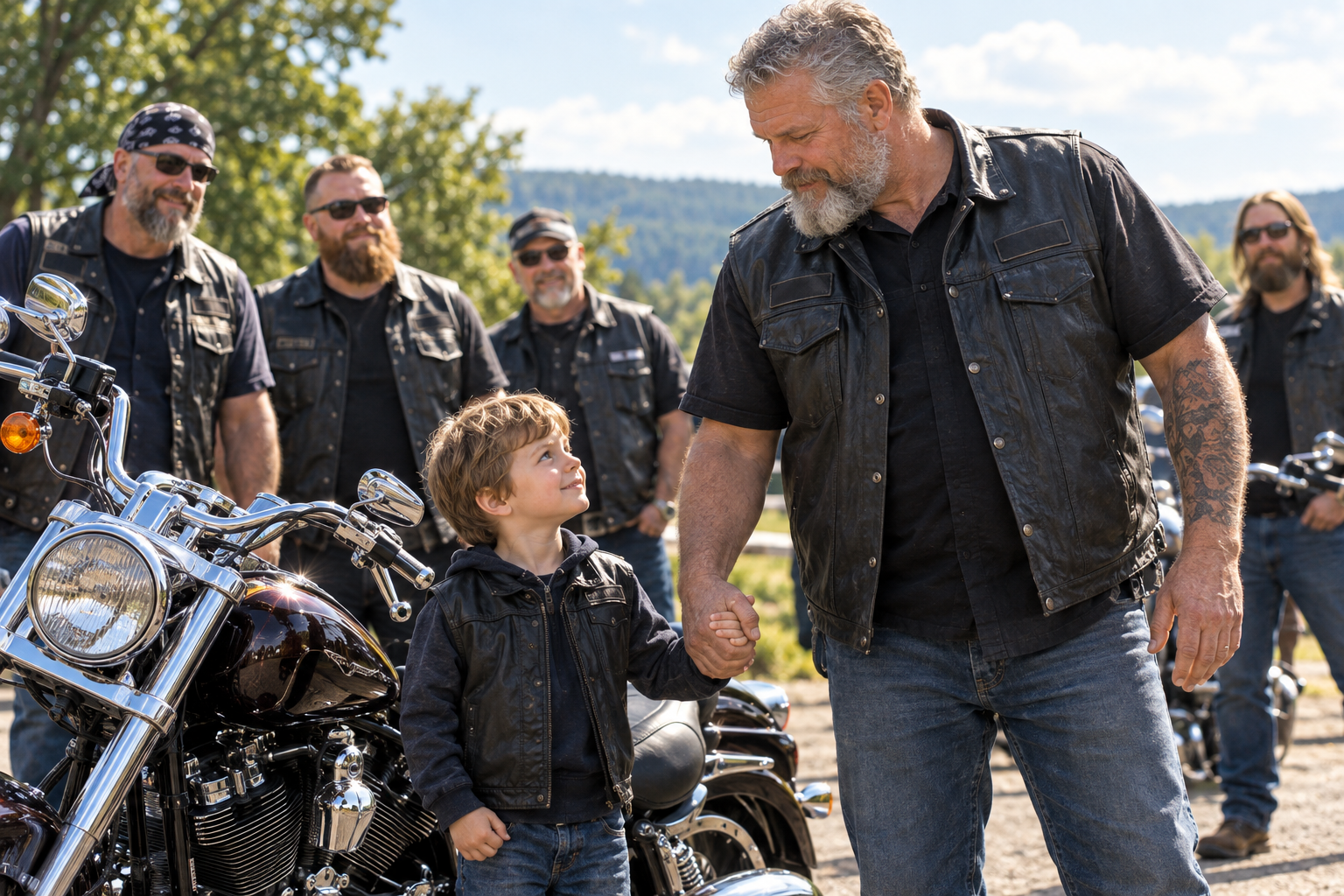
Part 2: The Motorcycle Key Daniel Left Behind
Part 2: The Motorcycle Key Daniel Left Behind
I hadn’t opened that cabinet in eight months.
Daniel had used my garage whenever his own was too cramped. After he died, Rachel asked me not to touch his things.
So I didn’t.
Until Leo handed me that key.
I unlocked the cabinet.
Inside sat a dusty black toolbox.
Leo pointed.
“That one.”
There was a small envelope taped beneath the lid.
My name was written across it.
FRANK.
Daniel’s handwriting.
My hands started shaking.
Inside was a storage-unit receipt and a short note.
Frank—
If you’re reading this, something probably happened before I got the chance to finish what I started.
Don’t let Rachel sell it.
It’s for Leo.
And please remind them both that they were the best part of my life.
I had to sit down.
The storage unit was fifteen minutes away.
I called Rachel before doing anything else.
When I mentioned the key, she went silent.
Then she started crying.
“Dad, Daniel rented that unit two weeks before the accident.”
She had assumed it contained work equipment.
That evening, Rachel, Leo, and I went together.
The manager verified the paperwork before opening the unit.
When the metal door rolled upward, Leo squeezed my hand.
There was a motorcycle inside.
Daniel’s old Harley.
But it wasn’t the bike from his fatal accident.
This one was an unfinished restoration project.
Beside it stood a child-sized workbench.
On the wall were photographs of Daniel and Leo in my garage.
A box contained tools labeled with future birthdays.
LEO — AGE 8.
LEO — AGE 12.
FIRST REAL TOOL SET.
Rachel covered her mouth.
Daniel had been rebuilding the Harley so that one day he and Leo could finish it together.
Not so a child could ride it.
So a father could teach his son how machines worked.
There was one more thing.
A small camera.
Its memory card contained several short videos.
In the final one, Daniel sat beside the unfinished motorcycle.
He looked exhausted from work.
But happy.
“If you’re watching this someday, little man, Grandpa Frank is probably pretending he knows more about motorcycles than me.”
I laughed through tears.
Then Daniel became serious.
“Take care of your mom. But listen carefully—taking care of her doesn’t mean fixing everything.”
Rachel began sobbing.
Daniel couldn’t possibly have known the exact burden Leo would place on himself years later.
But the words fit anyway.
“Sometimes Mom will be sad. Sometimes you’ll be sad. That’s okay. You don’t have to make sadness disappear.”
Leo looked at his mother.
Daniel smiled into the camera.
“Your job is to grow up. Make messes. Ask too many questions. Drive your mother crazy. Let the adults handle the adult stuff.”
Rachel pulled Leo into her arms.
“Did Daddy know?” he whispered.
“Know what?”
“That I couldn’t fix you?”
Rachel knelt.
“Leo, look at me.”
He did.
“You were never supposed to.”
“But you cry.”
“I know.”
“Because you miss Daddy?”
“Every day.”
Leo’s eyes filled.
“So how do I make you happy?”
Rachel kissed his forehead.
“You don’t have to. You just have to be my little boy.”
Something changed in his face.
Not everything.
Grief doesn’t disappear because somebody says the perfect sentence.
But a burden finally moved away from where it never belonged.
The next week, Rachel began seeing a grief counselor she’d been avoiding for months. We also found age-appropriate support for Leo, because his “inside hurt” deserved more than Grandpa pretending he knew how to solve everything.
And every Saturday, the three of us worked on Daniel’s motorcycle.
Mostly, Leo handed me the wrong wrench.
Sometimes he asked questions.
Sometimes Rachel cried.
Eventually, we stopped hiding those tears from him.
We simply explained them.
Two years later, the Harley was finished.
Leo was seven.
Far too young to ride it.
So he sat on the stationary bike in my garage, wearing Daniel’s oversized gloves, making engine noises while Rachel laughed.
Above my workbench, I hung Daniel’s note.
But the most important thing he left us wasn’t the motorcycle.
It was permission.
Permission for Rachel to grieve.
Permission for me not to have every answer.
And permission for a five-year-old boy to stop believing he was responsible for holding his family together.
I’ve spent most of my life thinking strength meant being the person who could carry the most weight.
Leo taught me differently.
Sometimes strength means noticing when someone too small has picked up a burden that never belonged to them—and gently taking it back.