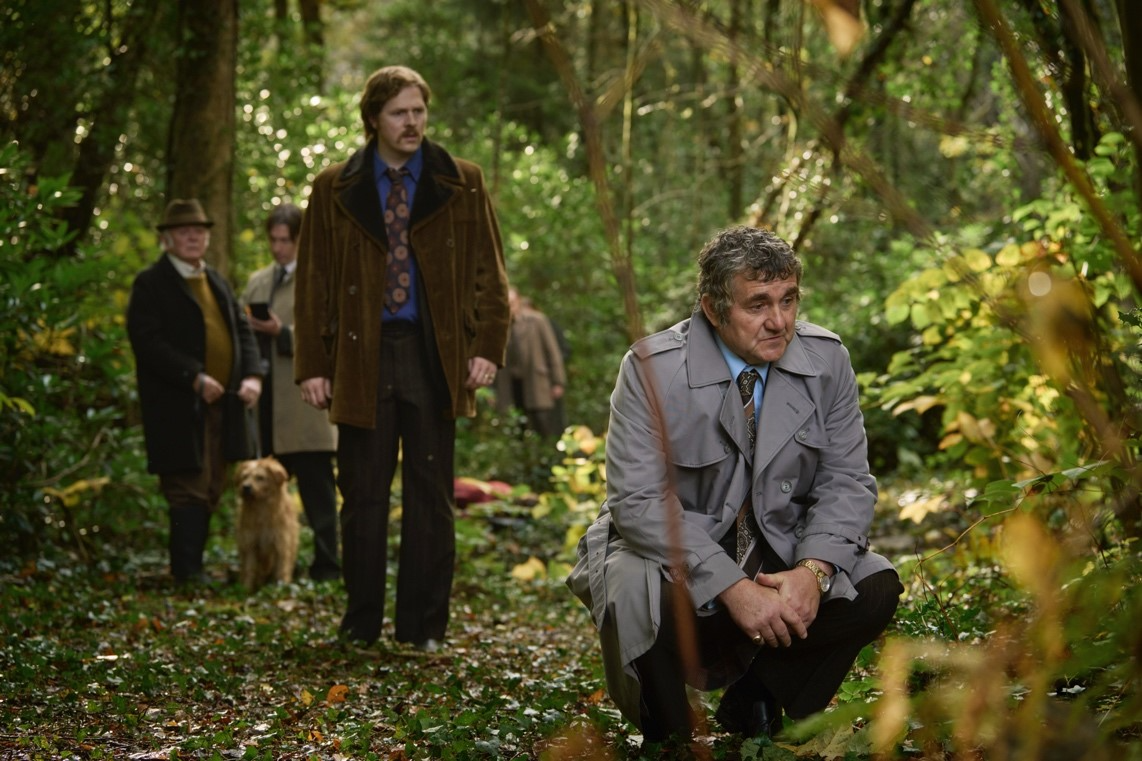
Steeltown Murders: The Haunting Welsh True-Crime Drama Where the Past Refuses to Stay Buried
Steeltown Murders: The Haunting Welsh True-Crime Drama Where the Past Refuses to Stay Buried
Three young women were killed. Decades passed without justice. Then advances in forensic science gave investigators something they never had before — another chance to find the truth.
BBC’s Steeltown Murders turns one of Wales’ most haunting real-life investigations into a gripping four-part true-crime drama, moving between two different eras as detectives confront a case that refused to disappear.
Created and written by Ed Whitmore, the miniseries is inspired by the murders of three young women in South Wales in 1973: Geraldine Hughes, Pauline Floyd and Sandra Newton.
Their deaths triggered a major investigation.
But the killer remained unidentified for decades.
That painful history sits at the heart of Steeltown Murders, which examines not only the hunt for answers but also what happens when families and investigators are forced to carry unanswered questions for years.
A Case That Haunted South Wales
The story begins in 1973.
Young women are being murdered in the Port Talbot area, and investigators are desperately trying to understand whether the crimes are connected.
There is no modern DNA profiling.
No digital surveillance.
No enormous searchable databases capable of instantly connecting evidence across different cases.
Detectives must rely heavily on interviews, physical evidence, witness statements and traditional investigative work.
The pressure grows as investigators begin confronting the terrifying possibility that the same person could be responsible for multiple deaths.
But despite an enormous effort, the case remains unresolved.
The killer appears to have disappeared.
The families are left without the answers they desperately need.
And investigators are forced to live with the possibility that the truth may never be known.
Then Steeltown Murders jumps forward nearly three decades.
And suddenly, the evidence begins speaking again.
The Investigation Gets a Second Chance
The later timeline follows detectives returning to the old murders with investigative tools that simply did not exist when the crimes occurred.
That technological shift changes everything.
Evidence once incapable of identifying a suspect can now potentially reveal information investigators in 1973 could never have accessed.
But reopening an old case brings its own problems.
Memories have faded.
People have moved away.
Some witnesses are gone.
Investigators must reconstruct events that happened decades earlier while determining which assumptions from the original inquiry were correct — and which may have sent detectives in the wrong direction.
That gives Steeltown Murders a tension very different from a conventional murder mystery.
The audience knows the investigators are racing toward an answer.
But they are also racing against time itself.
Two Eras, One Unfinished Investigation
One of the miniseries’ strongest devices is its movement between the original investigation and the later cold-case inquiry.
The younger detectives are shown pursuing leads without knowing which details will ultimately matter.
Years later, their older counterparts can revisit those same moments with the benefit of forensic advances and decades of hindsight.
That structure transforms seemingly ordinary pieces of information into potential turning points.
A detail that appears insignificant in 1973 may become crucial years later.
A suspect once impossible to connect scientifically to the crimes may suddenly become relevant.
And evidence stored away for decades can acquire an entirely new meaning.
The past and present begin closing in on each other.
Philip Glenister Leads the Investigation
Philip Glenister plays DCI Paul Bethell, one of the central figures in the later investigation.
Rather than portraying the cold case as an easy victory for modern technology, the drama emphasizes the painstaking work required to revisit old evidence and rebuild an investigation almost from the ground up.
Steffan Rhodri also plays an important role as Phil “Bach” Rees, helping anchor the story in the community and history surrounding the case.
But Steeltown Murders does not treat its detectives as conventional television heroes.
The investigation matters because real families have spent decades waiting.
That emotional cost hangs over almost every development.
Finding an answer after so many years cannot restore what was lost.
It can only finally reveal what happened.
The Science That Changed Cold Cases
The development of DNA profiling transformed criminal investigations around the world, particularly cases involving biological evidence preserved from earlier decades.
For investigators revisiting crimes from the 1970s, that created possibilities that would once have seemed unimaginable.
But technology alone does not solve a case.
Detectives still have to determine which evidence matters, identify possible suspects, reconstruct timelines and connect scientific findings to real people.
That combination of old-fashioned detective work and modern forensic science becomes one of the most compelling aspects of Steeltown Murders.
The drama repeatedly asks viewers to look backward with new information.
What did investigators miss?
Which clue was always important but impossible to understand at the time?
And how close had the truth been all along?
More Than a Hunt for a Killer
Although Steeltown Murders is structured around an investigation, its most powerful moments come from the human consequences surrounding it.
Decades are not simply numbers on a screen.
Families grow older without answers.
Detectives carry memories of cases they could not solve.
Communities remember fear long after newspaper headlines disappear.
When an investigation is reopened, all of that history returns with it.
That is why the miniseries feels less like a conventional serial-killer thriller and more like a drama about memory, persistence and the changing nature of justice.
The question is not simply whether investigators can identify the person responsible.
It is what finally discovering the truth means after so much time has passed.
Why Steeltown Murders Stands Out
Many crime dramas build suspense by hiding the identity of a killer until a final episode.
Steeltown Murders has something more complicated working in its favor.
Its tension comes from watching two generations of investigative work gradually connect.
The detectives of 1973 gather information without knowing which evidence future technology will make crucial.
The later investigators possess better tools but must reconstruct a world that disappeared decades earlier.
Between them are the victims’ families, still waiting.
That makes every breakthrough carry emotional weight.
This is not merely another fictional puzzle designed to surprise an audience.
It is a dramatization rooted in a real investigation and real losses.
And that knowledge makes the story considerably harder to shake.
Across four episodes, Steeltown Murders demonstrates how a case can appear frozen in time while the evidence remains quietly waiting for science to catch up.
Because sometimes the clue capable of breaking an investigation open was never truly missing.
Investigators simply did not yet have the technology to understand what it could tell them.