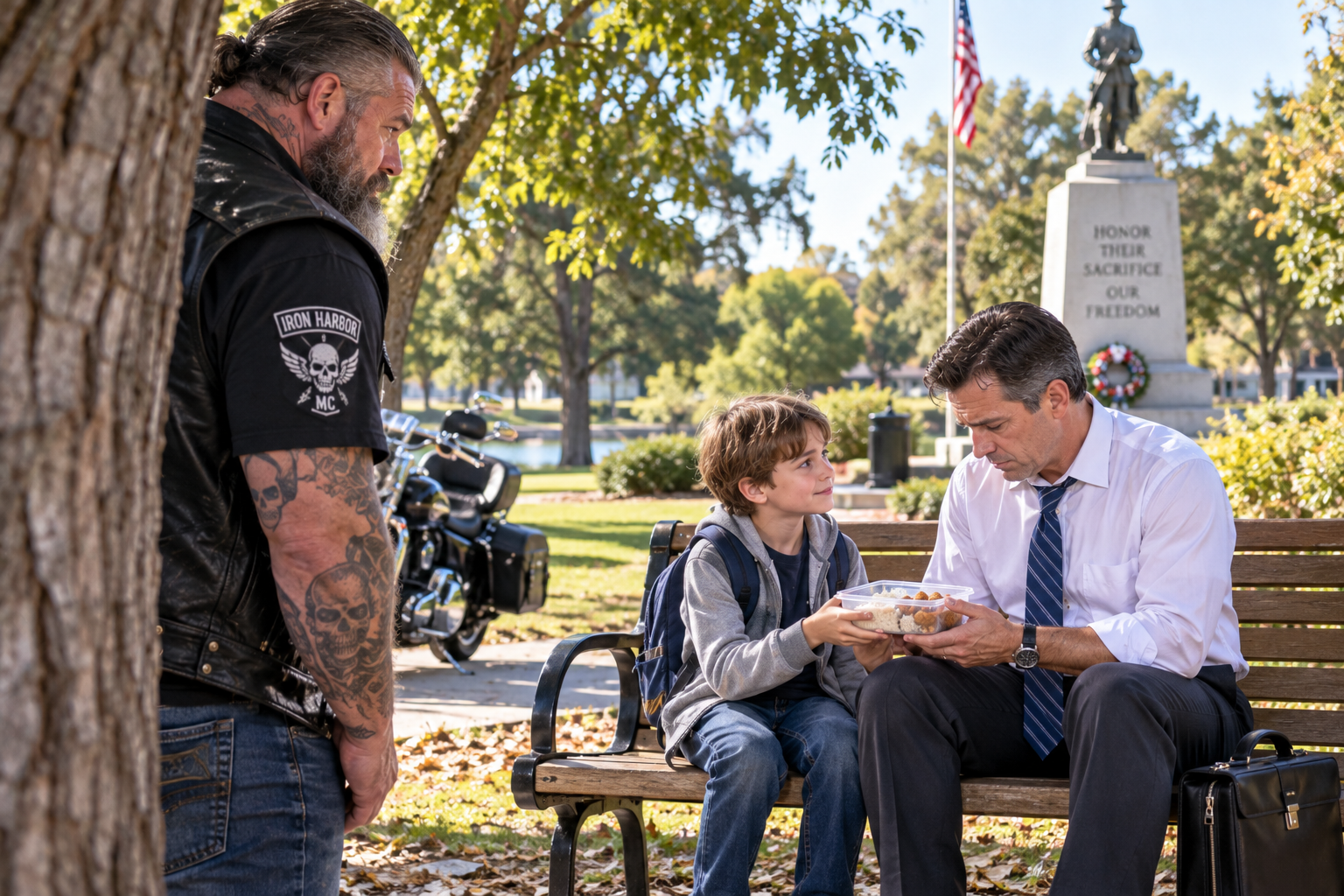
Part 2: The Debt We Never Knew About
Part 2: The Debt We Never Knew About
Dean Mercer pulled the old loan file from Iron Harbor Garage’s cabinet.
Eleven bikers stood around the workbench while I turned the yellowed pages.
Then Dean stopped me.
“Grizzly. Go back.”
Attached behind the original approval was a document none of us remembered seeing.
Daniel Bennett’s signature was at the bottom.
Six years earlier, our numbers had been terrible. The garage had contracts and skilled mechanics, but the bank’s lending committee considered us too risky.
Daniel had argued otherwise.
When the committee still refused, he had agreed to place part of his annual performance compensation into a restricted reserve tied to the loan.
Not enough to cover our debt.
But enough to show his own bank that he believed in the business he was recommending.
Dean stared at the page.
“He risked his own money?”
“He risked more than that.”
Daniel had also signed an internal recommendation taking professional responsibility for the loan analysis.
If Iron Harbor collapsed immediately, Daniel’s judgment—and possibly his career—would have taken the hit.
We had repaid every dollar years ago.
Nobody had ever told us what he’d done.
The next afternoon, eleven Harleys rolled into Riverside Park.
Daniel stood when he saw us.
Noah immediately moved closer to his father.
I raised my hands.
“Easy. We’re here to talk.”
Daniel recognized me.
“Mr. Maddox?”
“Grizzly.”
He looked embarrassed.
“If this is about yesterday—”
“It isn’t.”
Dean handed him a folder.
Inside was an offer from Iron Harbor Garage.
Not charity.
A job.
Our operation had grown. We needed someone to handle vendor financing, commercial accounts, payroll coordination, and the financial paperwork mechanics like us hated.
Daniel read the salary twice.
“I can’t accept this because of what happened six years ago.”
“Good,” Dean said. “Because that’s not why we’re offering it.”
Daniel looked up.
Dean placed another folder beside it.
Applications from three other candidates.
“You’re qualified. We checked.”
I added, “What happened six years ago is why we remembered to look.”
Daniel glanced toward Noah.
The boy was pretending not to listen.
“What if I say no?”
“Then we’ll shake your hand and leave.”
No pressure.
No debt.
Daniel asked for two days.
We gave him four.
On Monday morning, he walked into Iron Harbor wearing the same conservative tie he’d worn in the park.
Noah came with him.
The kid was carrying his blue coin pouch.
He placed $5.25 on my desk.
“For lunch.”
I pushed it back.
“No.”
His face tightened.
“I don’t want free food.”
“Neither do I.”
I pointed toward the shop floor.
“Your dad works here now. Employees’ families eat at Friday cookouts. Club rule.”
Noah considered that.
“That’s a real rule?”
“It became one about thirty seconds ago.”
For the first time, I saw him laugh.
Daniel didn’t hide the truth from his wife anymore.
That evening, he told her about losing the bank job, the applications, the park lunches, and the termination letter Noah had discovered.
There were tears.
There was anger.
There were difficult conversations.
But there were no more imaginary meetings.
Three months later, I walked into Miller’s Diner.
Noah was sitting in his usual booth.
A chicken strip remained on his plate.
I watched carefully.
He picked it up.
And ate it.
The whole thing.
Daniel entered a minute later wearing an Iron Harbor work shirt instead of a banker’s tie.
Noah waved.
“Dad!”
Daniel sat beside him.
Jenny brought another plate.
Nobody divided anything.
Before leaving, Daniel stopped at my table.
“You didn’t owe me this.”
I shook my head.
“No.”
Then I told him something I’d been thinking about since finding that old loan file.
“Six years ago, you looked at eleven men wearing leather and saw workers worth betting on when everyone else saw risk.”
I nodded toward Noah.
“Your kid did the same thing for you.”
Daniel looked across the diner.
Noah was counting his coins again.
But this time, he wasn’t calculating how much food he could afford to give away.
He was saving for a used bicycle.
Daniel smiled.
And that was when I finally understood what had bothered me most.
It wasn’t that we’d forgotten the banker who saved our garage.
It was that his ten-year-old son remembered something eleven grown men had forgotten:
When someone you care about is struggling, you don’t wait until they ask before you start paying attention.