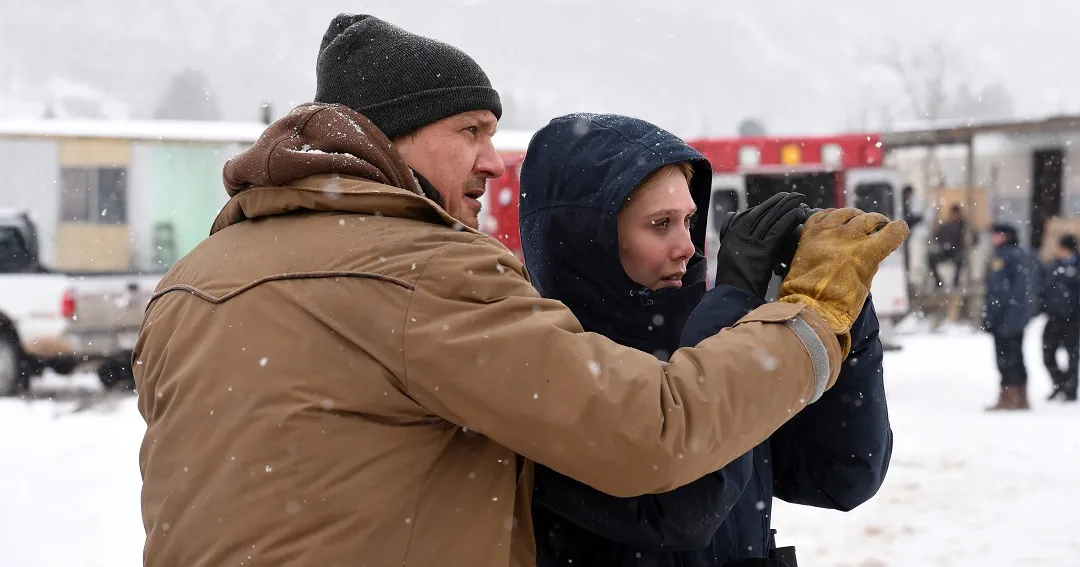
THE HIGH-STAKES NEO-WESTERN THRILLER ON NETFLIX EXPOSING A CHILLING MURDER IN THE FROZEN WILDERNESS
THE HIGH-STAKES NEO-WESTERN THRILLER ON NETFLIX EXPOSING A CHILLING MURDER IN THE FROZEN WILDERNESS
Tense gazes through blinding snow. A local tracker guiding a rookie agent. A horrific crime buried beneath the ice. On Netflix, Jeremy Renner and Elizabeth Olsen deliver an electrifying, critically acclaimed pairing in a haunting investigation into the death of a young woman on a remote reservation. In Wind River, their sharp focus is not cop-show swagger. It is survival. Behind it lies an unforgiving landscape, a jurisdictional maze, and a violence that the official world has learned not to count. The freezing, heart-pounding tension of that moment on the white plain is the film’s entire climate. If the cold does not kill you, the silence might.
Written and directed by Taylor Sheridan, the 2017 neo-Western completes an unofficial trilogy of modern frontier stories after Sicario and Hell or High Water. This time the frontier is the Wind River Indian Reservation in Wyoming, a place of mountains, oil, snow, and laws that stop at the wrong fences. U.S. Fish and Wildlife Service tracker Cory Lambert, played by Renner, finds the frozen body of eighteen-year-old Natalie Hanson while working the land he knows better than any incoming badge. Natalie, played by Kelsey Asbille, is Northern Arapaho. She ran barefoot through subzero night until her lungs gave out. The snow kept her. It also kept the story the people who hurt her hoped nobody would bother to read.
FBI special agent Jane Banner, played by Olsen, arrives from Las Vegas underdressed for the weather and overdressed for the politics. She is competent, green in this terrain, and quickly educated in a fact that still shocks outsiders: a death like this can struggle even to be classified in a way that brings full federal force. Tribal police, local knowledge, and a thin roster of officers have to carry what a richer county would call a major crime. Graham Greene’s Ben Shoyo, the tribal police chief, has the weary authority of a man who has been asking for resources for years. Gil Birmingham, as Natalie’s father Martin, gives the film its broken heart. Grief here is not a speech. It is a man sitting in the snow because standing up would mean accepting the world that took his child.
Wind River is a murder investigation and a portrait of a crisis that did not begin with this one body. Sheridan has said the story was shaped by the epidemic of missing and murdered Indigenous women, a catastrophe long undercounted in official statistics. The film’s closing text underlines that failure of record-keeping. The point is not that one thriller can fix a national shame. The point is that the shame has a landscape, a climate, and families who already know the ending before the outsiders arrive.
Renner plays Cory as a man who tracks animals for a living and cannot stop tracking the thing that happened to his own daughter years earlier. Emily’s death rhymes with Natalie’s in ways the script makes painfully clear without turning grief into a puzzle box. Cory is not a cowboy savior. He is a white wildlife officer with deep ties to the reservation through marriage, work, and loss. The film lets that position be useful and uncomfortable at once. He can read prints in powder. He cannot restore the girls. Olsen’s Jane is the audience’s surrogate only at first. Then she becomes something better: a professional who learns to shut up and follow the person who understands the ground.
Sheridan writes violence as weather. The set pieces, when they come, are sudden and ugly, the opposite of balletic action. What stays longer is the hunt across white distance, two figures leaning into wind, the knowledge that whoever ran this way was already dying. Nature in Wind River is not scenery. It is an accomplice and a judge. The same cold that preserves evidence erases amateurs. The same isolation that looks like peace hides an oil camp, a trailer, men who brought the mainland’s worst habits to a place they treated as empty.
Jon Bernthal appears in the shadow of Natalie’s last relationship, another life the snow has already claimed. The investigation tightens toward work crews and security culture, toward men who thought a reservation night had no witnesses. Without turning the plot into a tour of brutality, the film is explicit that Natalie’s final hours were an assault and a flight. The cause of death is the land itself used as a weapon: frozen air pulled into ruined lungs. That detail is Sheridan at his most pitiless. The wilderness does not need a second shot.
Cinematography by Ben Richardson makes the beauty hostile. Mountains gleam. Trails vanish. Interiors are dim and overcrowded with history. Nick Cave and Warren Ellis’s score sounds like weather moving over a grave. Wind River has been called True Detective in the snow, Bosch with a conscience, a cousin to Sheridan’s later television empires. It is leaner than those comparisons suggest. At 107 minutes it does not explain the West. It walks you into a case and dares you to look away from the family sitting with an empty chair.
Critics and audiences met the film with strong approval, even as conversations continued about who gets to tell reservation stories. Sheridan, a white writer-director, was both praised for attention and questioned for framing. The Native performances—Birmingham above all, Asbille in limited but indelible time, Greene’s bone-tired command—are the movie’s moral ballast. A sequel has since moved forward with a different principal cast, proof that the setting was never only a backdrop for two stars. The original remains the wound that made the map visible.
Streaming on Netflix, Wind River still works as a thriller because the stakes are not clever. A girl ran. Someone has to reconstruct why. A father has to decide whether justice, if it comes, will look like a court or like the mountain. A rookie agent has to admit that her training did not include this kind of cold. Renner and Olsen do not play a flirtation. They play a partnership forged by necessity, two people trying not to become another story the snow will close over.
That is the tension in the still image: eyes narrowed against glare, bodies angled into a storm, the knowledge that the crime is not only under the ice but inside a country that did not build a system equal to finding these girls. Wind River is a neo-Western in the oldest sense. The frontier was never empty. It was already inhabited, already grieving, already owed a count. Sheridan’s film does not offer warmth. It offers witness. In this weather, that may be the only fire that lasts.