ROBERT DE NIRO IN THE HIGH-STAKES DRAMA EXPOSING A MAFIA ENFORCER’S LOYALTY AND SECRETS FAR CLOSER TO HOME THAN EXPECTED!
ROBERT DE NIRO IN THE HIGH-STAKES DRAMA EXPOSING A MAFIA ENFORCER’S LOYALTY AND SECRETS FAR CLOSER TO HOME THAN EXPECTED!

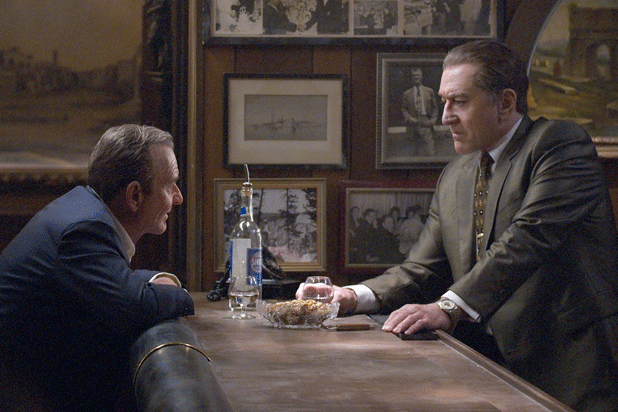
Two men sit closely across a quiet bar counter, their hushed dialogue thick with tension and unspoken threats. That is the temperature of The Irishman. Streaming with the patience of cinema rather than the rush of a conventional gangster picture, Robert De Niro delivers an unforgettable, masterclass performance in a deeply gripping crime drama. Forced to navigate the ruthless hierarchy of organized crime while protecting his own family, every brief conversation brings him closer to a dark decision that changes everything. Behind his hardened, contemplative expression lies a man carrying the overwhelming weight of blood loyalty and quiet regret. The tense, secretive atmosphere captured in that frame is Martin Scorsese’s late style in miniature: violence spoken softly, friendship indistinguishable from obligation, and a life that looks, from the outside, like power, and from the inside, like a long walk toward an empty room.
Released in 2019, The Irishman is Scorsese’s epic account of Frank Sheeran, the World War II veteran and Philadelphia truck driver who became a trusted enforcer for Pennsylvania mob boss Russell Bufalino and a close companion of Teamsters leader Jimmy Hoffa. The film follows decades of union politics, mob diplomacy, and alleged murder, including the still-contested claim that Sheeran killed Hoffa. De Niro, digitally de-aged across the years and then allowed to become old in earnest, plays Frank as a man whose greatest skill is doing what he is told and whose greatest punishment is living long enough to remember it.
The bar-counter hush the caption describes is the film’s true action sequence. Scorsese and screenwriter Steven Zaillian, working from Charles Brandt’s book I Heard You Paint Houses, understand that in this world the lethal moment is often a conversation that sounds like courtesy. Joe Pesci’s Bufalino is a masterpiece of quiet authority — a man who barely raises his voice because he does not need to. Al Pacino’s Hoffa is the opposite current: loud, wounded, convinced that loyalty is a two-way street. De Niro sits between them as the instrument both men believe they own. Every brief conversation is a negotiation about who will be sacrificed so the hierarchy can continue. The dark decision the film moves toward is not a surprise twist. It is the logical end of a life spent making himself useful to people who collect debts in blood.
What The Irishman adds to the Scorsese crime canon is time — too much time. At 209 minutes the film is deliberately long, because regret is long. Frank’s family, especially his daughter Peggy (played as an adult by Anna Paquin in a performance built from silence), becomes the secret closer to home than the hits and the union halls. Peggy sees what Frank does. She does not need a confession. The “protection” of family in the caption is the film’s bitter joke. Frank thinks he is providing. What he provides is a house in which his child learns not to look at him. Blood loyalty to the mob and blood loyalty to his own name cannot occupy the same life forever. The contemplative hardness on De Niro’s face is the look of a man who chose the first and is only later able to count the cost of the second.
The supporting bench is a reunion and a reckoning: Harvey Keitel, Ray Romano, Bobby Cannavale, Stephen Graham, and a deep roster of faces that make the mid-century underworld feel populated rather than mythic. Rodrigo Prieto’s cinematography and Thelma Schoonmaker’s cutting give the decades a funeral rhythm. The much-discussed de-aging technology is imperfect and, in a way, appropriate. Frank’s youth looks slightly unreal because the story is already being told from the far side of it, from a nursing-home present tense in which the enforcer has outlived almost everyone he served and almost everyone he hurt.
Critics treated The Irishman as a major late work. It earned ten Academy Award nominations, including Best Picture, Best Director, and Best Supporting Actor for Pesci and Pacino. Some viewers found the length and the digital faces a barrier. Others recognized the point: this is what happens when the gangster film stops celebrating velocity and starts measuring aftermath. De Niro’s masterclass is not a single explosive scene. It is the accumulation of yeses — the small acceptances that turn a truck driver into a man who paints houses, until the last assignment is the friend who thought he was safe.
The Irishman was financed and released by Netflix after a limited theatrical run in November 2019, a release strategy that sparked argument at the time and now looks like simple fact. The film remains a Netflix title. It streams on Netflix and on Netflix Standard with Ads in the United States, the United Kingdom, and most international territories. Physical discs are still sold. There is no current wide theatrical booking and no competing-streamer exclusive. “Streaming on Cinema” in the caption names the film’s scale and its bar-room hush — images composed for a dark room — while the actual home of the picture is the platform that paid for its runtime.
What that secretive frame proves is that the mafia enforcer’s loyalty was never only about the organization. It was about a man who needed to belong to something that would tell him who to be, and who discovered too late that the something would not sit with him at the end. The unspoken threats across the bar are the plot. The quiet regret in De Niro’s eyes is the meaning. The Irishman does not ask you to admire Frank Sheeran. It asks you to watch a life become a confession that nobody in the next room wants to hear.
The film is streaming now on Netflix. Give it the hours it demands. The conversation at the counter is still going. The decision has already been made. The family is still waiting at home for a man who learned how to disappear people and never learned how to come back.