The Weight of a Golden Promise
The night my father stopped answering my calls was the night I finally understood hunger.
Not the poetic kind people talk about—the hunger for success or meaning—but the real one that gnaws at your stomach and makes time stretch into something cruel. I was twenty-six, sleeping in the back of my hatchback with a duffel bag of clothes, a dead phone charger, and exactly seven dollars in my wallet. I kept telling myself it was temporary. Everything had always been temporary. Until it wasn’t.
I had run out of chances long before I ran out of excuses.
For years, I floated. I had a diploma framed on my wall but no job worth mentioning. I talked about “finding my path” while borrowing gas money. When life pushed back, I leaned on my parents—especially my dad. He never said no. Not until the day he finally did.
I’d called him from a parking lot, voice casual, asking for help with rent. He paused longer than usual.
“I can’t,” he said. “Not anymore.”
Then he hung up.
I stared at my phone like it had betrayed me. What he didn’t know—what I hadn’t told him—was that I’d already been evicted that morning. I was already homeless.
Someone else knew, though.
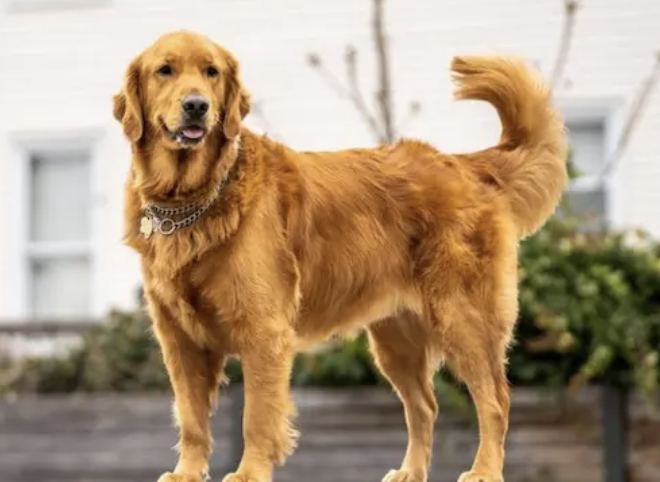
Sunny sat in the passenger seat, her golden fur glowing softly in the dim light of the streetlamp. She was a Golden Retriever with the calm eyes of an old soul and a habit of resting her chin on my knee when I got quiet. She trusted me completely. That trust felt heavier than anything I’d ever carried.
Sunny wasn’t cheap to take care of. She had sensitive digestion, joint supplements, and food I could barely pronounce. That first night in the car, I promised her I’d figure it out.
By the third day, I broke that promise.
I bought the cheapest dog food I could find. Bright packaging. Artificial smell. I told myself it would be fine—for a little while.
It wasn’t.
By morning, Sunny wouldn’t stand. Her stomach cramped, her breathing shallow. She whimpered in a way I’d never heard before—small, confused, accusing. I pressed my forehead to the steering wheel and cried harder than I had since I was a kid.
I drove to my parents’ house on fumes, rehearsing apologies I didn’t deserve to make. My father didn’t answer the door. I sat on the front steps until my legs went numb.
When I finally stood up, I noticed a cardboard box tucked beside the porch.
Inside was Sunny’s food. Her supplements. A receipt from the veterinary clinic across town, prepaid. On top sat a folded note.
“This is for her,” it read. “You are not the emergency. She is. If you want to keep her, you have to become someone who can.”
The car ran out of gas two blocks later.
The clinic was three miles away.
I looked at Sunny. She tried to stand, failed, then wagged her tail at me anyway.
“Okay,” I whispered. “I’ve got you.”
I lifted her into my arms. She was heavier than I expected—nearly seventy pounds of warmth and trust. My arms shook within minutes. Sweat soaked my shirt. People stared. Some slowed their cars. No one stopped.
Halfway there, my legs started to cramp. Sunny shifted in my arms and licked my chin, as if apologizing for the weight.
“I know,” I said through clenched teeth. “This is on me.”
I reached the clinic just before collapsing onto the curb. A pickup truck rolled to a stop nearby. A woman stepped out—mid-forties, steel-toed boots, sawdust on her jeans. She’d been driving behind me for the last block.
“That dog okay?” she asked.
“She will be,” I said, though I wasn’t sure.
She studied me for a long second. Then she nodded once and handed me a business card.
“I run a warehouse,” she said. “Loading docks. Early mornings. Hard work. Not glamorous.”
I looked at the card like it might disappear.
“Why?” I asked.
“Because people don’t carry what they don’t care about,” she replied. “And you carried her.”
I started the next morning.
The work wrecked me. My hands split open. My back screamed. Every night, I slept in the car beside Sunny, exhausted beyond thought. But every week, I got paid. I bought her food first. Everything else came second.
Two months later, we had a room. Four months later, an apartment. The first thing I bought wasn’t furniture—it was a thick bed for Sunny, placed right beside mine.
The night she slept through without waking in pain, I lay awake smiling at the ceiling.
A year later, I stood in my father’s driveway. Sunny sat at my side, healthy and shining. He opened the door and froze.
“I didn’t come to ask,” I said quietly. “I just wanted you to see her.”
He knelt and buried his hands in her fur. When he stood, his eyes were wet.
“You figured it out,” he said.
“Yeah,” I replied. “I had to.”
Sometimes love doesn’t show up as rescue. Sometimes it shows up as distance, forcing you to carry the weight you’ve been avoiding.
Sunny taught me that responsibility isn’t a burden—it’s an anchor.
And once you learn how to hold it, it can save your life.