The Sound of the Air Brakes
I lied to my daughter ten minutes ago. I told her I was fine, that the silence didn’t bother me. But the truth is, my dog just tried to greet a ghost, and it broke my heart.
My name is Thomas. I live in a four-bedroom colonial in the suburbs that used to vibrate. Literally vibrate.
Thirty years ago, the hardwood floors in this hallway didn’t shine. They were scuffed by hockey sticks, muddy cleats, and tap shoes. The air didn’t smell like “Fresh Linen” plug-in air fresheners; it smelled of damp wool, burning pine logs, and whatever science experiment my son David was blowing up in the basement.
Back then, I used to complain about the noise. I used to fantasize about a quiet Sunday morning where I could drink my coffee without stepping on a plastic building block or breaking up a fight over the TV remote.
Be careful what you wish for. You just might get it.
Now, the floors are immaculate. I polished them myself yesterday. The house is perfectly staged, like something out of a real estate catalog. But it’s cold. Not temperature cold—the furnace works fine. It’s a spiritual cold.
It’s just me, Willow—a stray cat who judges me from the mantle—and Barnaby.
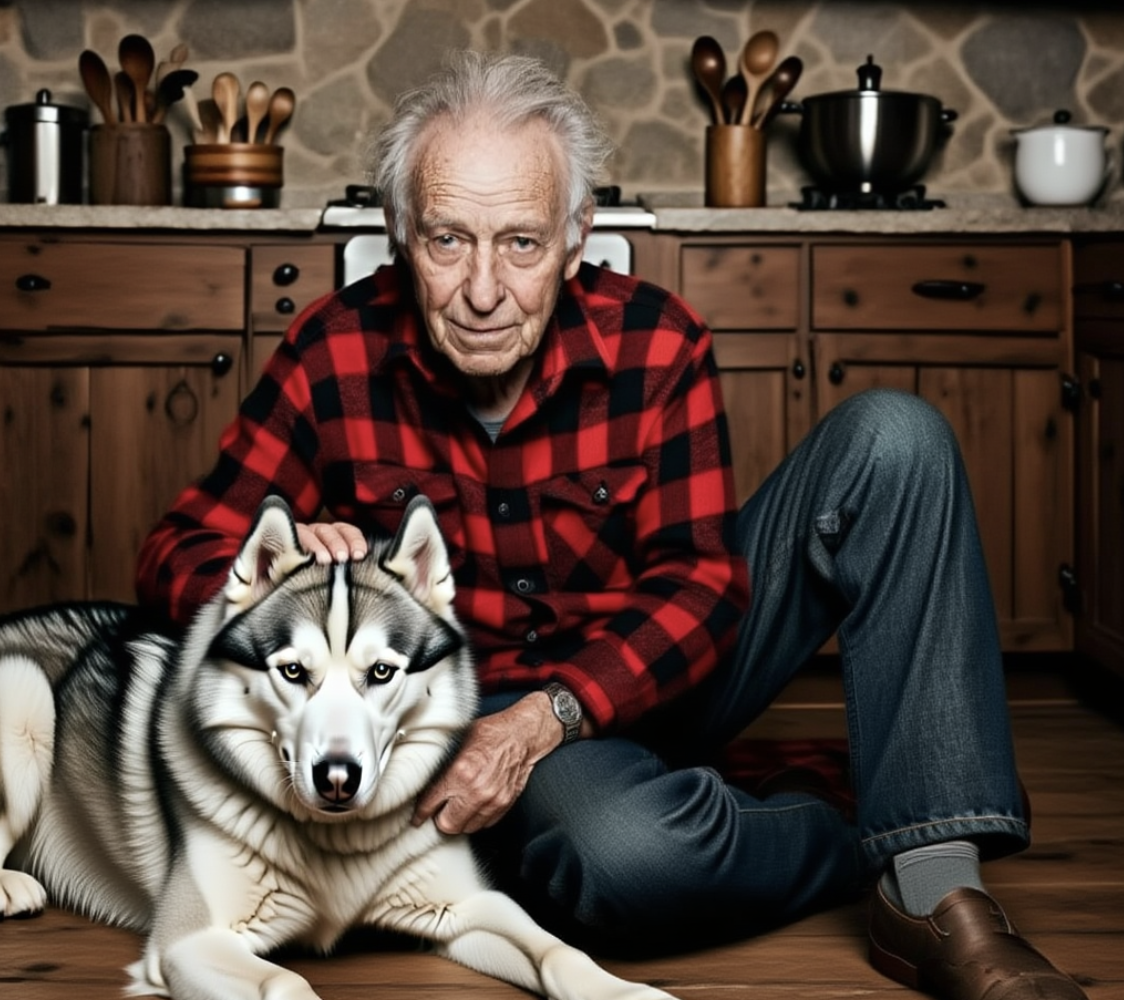
Barnaby is a Husky who has outlived his working years. He’s fifteen. His muzzle is entirely white, his eyes are cloudy with cataracts, and his hips are so bad that getting up requires a three-point turn and a groan of effort. He spends twenty-three hours a day sleeping on the rug by the front door, dreaming of rabbits he can no longer catch.
Today is Thanksgiving. Or maybe it’s Christmas Eve. Honestly, when you’re seventy-eight, the holidays sort of blur into “The Days People Are Supposed to Be Here.”
I had the ham in the oven. The honey glaze recipe was Martha’s—my late wife. She died four years ago, and since then, I’ve become the curator of our museum. I keep the traditions alive, assuming the kids will come back to inhabit them.
Then the video call came.
It was my daughter, Sarah. The connection was pixelated, and the background noise was deafening—airport announcements, angry travelers.
“Dad,” she shouted over the din. “I’m so sorry. The storm in Denver grounded everything. We’re stuck. We’re not going to make it for dinner.”
I felt the disappointment hit me physically, like a punch to the gut. But I’m a dad. We don’t show that. We absorb the blow so our kids don’t have to feel the recoil.
“It’s okay, sweetheart,” I said, forcing a smile that didn’t reach my eyes. “Safety is priority number one. Don’t worry about me. I’ve got the A-Team here with me.” I pointed the camera at the sleeping dog and the indifferent cat.
“We sent gifts though!” she said, guilt written all over her pixelated face. “I tracked the package. The delivery truck should be there any minute. It’s something really cool for the house. Love you, Dad!”
The screen went black. The silence rushed back in, heavier than before.
I went to the kitchen and turned the oven off. A ten-pound ham for one old man and two pets seemed ridiculous, but I took it out anyway.
That’s when we heard it.
The rumble.
A heavy diesel engine slowed down and stopped right in front of the driveway. The air brakes hissed—a sound distinctively similar to the old station wagon David used to drive in college.
Barnaby, who is stone-deaf to my voice, felt the vibration through the floorboards.
I watched a miracle happen. Or a tragedy.
Barnaby’s head snapped up. His cloudy eyes widened. His tail, usually a dormant rope, started to thump against the floor. Thump. Thump. Thump.
He thought it was them.
He thought the pack was returning.
With a grunt of exertion that made me wince, the old dog scrambled to his feet. His back legs slid on the polished wood, but he didn’t care. He found traction. He let out a sharp, happy bark—a sound I hadn’t heard in months—and limped as fast as he could toward the heavy oak door.
He pressed his nose against the crack, whining, his whole body shaking with anticipation. He was ready to be tackled by grandkids. He was ready for the ear scratches. He was ready for the noise.
I walked to the door, my own heart hammering a little. Infection, I guess. Hope is contagious.
I unlocked the deadbolt and swung the door open.
Barnaby lunged forward… and then stopped.
There was no station wagon. There were no grandkids tumbling out of a backseat.
There was just a brown delivery truck idling at the curb. A young man in a uniform jogged up the walkway, dropped two cardboard boxes on the porch, tapped something on his handheld device, and gave a polite wave.
“Happy Holidays, sir,” he called out, already turning back to his truck.
I looked down at Barnaby.
The dog stood frozen on the porch. He sniffed the cold winter air, moving his head left and right, searching for a scent that wasn’t there. He waited. He looked at the driver, then at the empty street, then up at me.
The realization hit him.
The tail stopped wagging. The light in his cloudy eyes flickered out.
He didn’t bark. He didn’t whine. He just let out a long, shuddering sigh—the kind of sound that comes from the bottom of a soul—and collapsed right there on the cold concrete of the porch. He put his chin on his paws and closed his eyes.
He wasn’t tired. He was heartbroken.
I carried the boxes inside, then I had to go back out and help Barnaby up. I had to lift his hips to get him over the threshold. He felt heavier than usual. Grief has weight, I suppose.
I opened the boxes in the kitchen.
From my son: A state-of-the-art robot vacuum cleaner. From my daughter: A digital photo frame that connects to the cloud.
I laughed. It was a dry, cracking sound.
A robot to clean the floors that are already too clean because no one walks on them. A screen to show me pictures of the people who aren’t here.
I set the frame on the counter. Within minutes, it started cycling through photos. There was Sarah at a pumpkin patch. David at a beach. My grandkids smiling with Santa at a mall.
They looked happy. They looked busy. Their lives were a roaring bonfire of activity, blazing bright and hot.
And here I was, guarding the embers.
I plated a slice of ham. I cut a few pieces for Barnaby and put some in a bowl for Willow.
I sat on the floor. Not at the dining table—it felt too big. I sat on the rug next to the old dog. Willow, sensing the shift in the atmosphere, jumped down from the mantle and curled up against my knee, purring softly.
Barnaby ate the ham slowly, then rested his head on my thigh. I stroked his soft, velvet ears.
“I know, buddy,” I whispered. “I miss the noise too.”
We sat there for a long time as the digital frame flickered in the background, a slideshow of ghosts.
And I realized something that I want you to know.
We spend our youth trying to build a comfortable life. We work for the big house, the nice furniture, the quiet neighborhood. We think that success looks like a pristine living room and expensive gifts.
But the most expensive thing in the world isn’t a robot vacuum or a plane ticket. It’s presence.
My kids love me. I know they do. The weather isn’t their fault. But the distance… the distance is a slow-motion tragedy that we accepted as normal.
So, here is my warning to you, from a man sitting on the floor with a ham sandwich and a heartbroken dog:
Technology is a brilliant tool, but it is a terrible substitute for a heartbeat. A text message is not a hug. A video call is not a hand on a shoulder. A digital photo frame cannot sit with you in the dark when the silence gets too loud.
If you can drive to them, drive. If you can sit with them, sit. Don’t send the gift. Be the gift.
Because one day, the house will be perfectly clean. The floors will never be scuffed. The phone will be a sleek piece of glass that never rings.
And you will give anything—absolutely anything—for just one more chaotic, messy, noisy day.