The Last Stop: The Sound of Silence
They say you die twice: once when your heart stops, and again when the last person who knew your name forgets it. I’m not scared of the first part anymore.
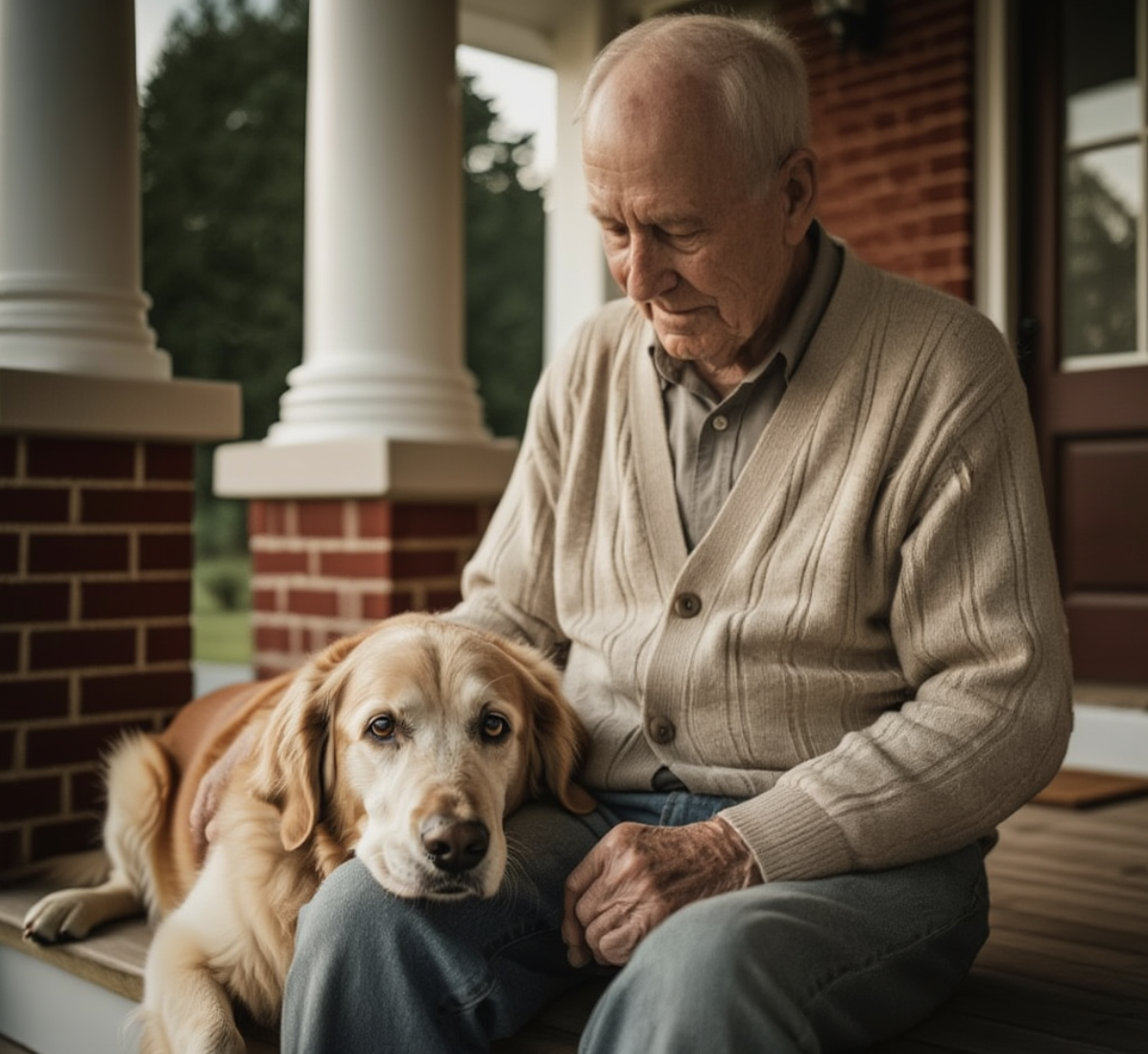
I’m sitting on my front porch, the wood of the swing groaning under my weight—a rhythmic creak-thump, creak-thump that has been the soundtrack of my life for fifty years. Beside me is Buster. He’s a Golden Retriever who’s long past his golden years. His face is white, his eyes are cloudy with cataracts, and it takes him three tries to stand up on the hardwood. But he’s here. He’s always here.
My grandmother used to tell me that life is like a train ride. I never really got it when I was a kid, bouncing off the walls with skinned knees and a mouth full of bubblegum. But looking out at the street now, lined with Maple trees dropping leaves like burning embers, I finally understand.
The porch is my seat on the train. And Lord, have I seen some passengers come and go.
I close my eyes and I can still hear the noise. That’s the thing about the “good old days” that nobody tells you—they were loud. Beautifully, chaotically loud.
In the seventies, this porch wasn’t a place for quiet reflection. It was a grandstand for the circus. I can see my wife, Sarah, standing by the screen door, wiping her hands on a floral apron, yelling at our three boys to stop wrestling in the fresh mulch. I can smell the charcoal from the Weber grill in the backyard—hamburgers burning just a little on the edges, exactly how I liked them.
The train was full then.
We had neighbors who didn’t just wave from cars; they walked up the driveway with tuna casseroles and gossip. We had Fourth of July parties where the cooler was always full of ice-cold soda and cheap beer, and the laughter drowned out the crickets. My boys were small, sticky-handed passengers who climbed all over me, convinced I was the strongest man in the world.
But trains move. That’s their job. They rattle forward, mile after mile.
First, the boys grew up. They found their own seats in different cars—one in Chicago, one in Seattle, one in the Navy. They wave from the windows now, through FaceTime screens and rushed Christmas cards, but they don’t sit here anymore.
Then, the neighbors started changing. The Johnsons moved to Florida. The Millers passed away. The new folks drove electric cars and had high fences. They were polite, but they were strangers. The cabin got quieter.
Then came the tunnel.
Ten years ago, the train went into the pitch black. Sarah got sick. It was fast, and then it was over. When she stepped off the train, she took all the color in the world with her.
I remember sitting on this exact swing the day after the funeral. The house was full of flowers I didn’t want and casseroles I couldn’t eat. The silence was deafening. It felt like the air had been sucked out of the universe. I stared at the empty space on the swing beside me—her space—and I honestly didn’t know if I wanted to keep riding. What was the point of the view if she wasn’t there to see it?
That’s when I felt a wet nose nudge my hand.
It was Buster. He was just a pup then, full of boundless, annoying energy. He’d been pacing the house looking for her, confused, whining at the closet door where her coats still hung. But seeing me broken, he stopped.
He didn’t bark. He didn’t try to play. He climbed up onto the swing—something he was strictly forbidden to do—and laid his heavy head on my thigh. He let out a long, heavy sigh, as if he was carrying the weight of my grief so I didn’t have to hold it all alone.
We sat there for hours as the sun went down. He licked the tears off my knuckles.
That dog saved me. He taught me the most important lesson of the journey: When you can’t see the light at the end of the tunnel, you don’t need a map. You just need someone to sit with you in the dark.
Creak-thump. Creak-thump.
The wind picks up, blowing a few dry leaves onto the porch. Buster lifts his head, sniffing the air. His hearing is gone, but his nose still remembers the smell of autumn. I reach down and scratch him behind the ears. His tail gives a weak, rhythmic thump-thump against the floorboards.
“We’re a couple of old relics, aren’t we, buddy?” I whisper.
Just then, I see movement on the sidewalk.
It’s a young woman. She looks frazzled. She’s pushing a stroller with one hand and trying to balance a grocery bag in the other. Her hair is messy, and even from here, I can see the red-rimmed exhaustion in her eyes.
Suddenly, the front wheel of the stroller catches a crack in the pavement. The stroller jerks. The grocery bag slips.
Smash.
A glass jar of pasta sauce shatters on the concrete. Red sauce splatters everywhere—on her jeans, on the white sneakers, on the sidewalk.
The young woman freezes. She doesn’t scream. She just drops her head, her shoulders shaking. I know that shake. That’s the shake of someone who has been holding it together for too long, and that jar of sauce was the final straw.
Buster senses it, too. He lifts his head and gives a low, soft “woof.” Not a warning—a greeting.
I try to stand up, my knees popping like firecrackers. It takes a moment, but I grab my cane. I shuffle down the steps.
“Miss?” I call out. My voice is raspier than it used to be.
She looks up, startled, wiping her eyes quickly. “I’m so sorry, sir. I’ll clean it up. I just… I don’t have any napkins.”
“Forget the sauce,” I say, waving a hand. “The ants need to eat, too.”
She forces a smile, but it cracks. “It’s been a long day.”
“I know,” I say gently. “I remember those days. Days where the baby won’t sleep, the bills are piled up, and gravity seems to have a personal vendetta against you.”
I reach into the pocket of my cardigan. I pull out a clean, wrapped peppermint candy—an old man habit I picked up somewhere along the line.
“My Sarah… she used to say that spilled sauce is just the universe telling you to order a pizza,” I tell her.
The woman laughs. It’s a wet, choked sound, but it’s a laugh.
“Come here a second,” I say, motioning to the porch.
She hesitates, then walks over. The baby in the stroller is asleep, clutching a stuffed bear.
“You see that dog?” I point to Buster.
“He’s beautiful,” she says.
“He’s old,” I correct her. “He can’t run anymore. He can hardly chew hard food. But you know what? He’s the happiest soul I know. Because he doesn’t worry about the jar he broke yesterday, and he doesn’t worry about the hill he has to climb tomorrow. He’s just happy the sun is hitting his face right now.”
I look at her, really look at her. “You’re in the tunnel right now, darlin’. The loud, chaotic, messy tunnel of raising a family. You’re tired. You feel like you’re failing. But let me tell you something from someone who is nearing the last stop…”
I lean in closer.
“You’re going to miss this. You’re going to miss the noise. You’re going to miss the mess. Because one day, the house gets clean, and it stays clean. And the silence… well, the silence is heavy.”
She looks at the broken sauce, then at her sleeping baby, and finally at me. Her shoulders drop about two inches. The tension bleeds out.
“Thank you,” she whispers. “I think I really needed to hear that.”
“Go on now,” I smile. “And don’t worry about the sidewalk. rain washes everything away eventually.”
She walks away, looking a little lighter. I watch her until she turns the corner.
I sit back down next to Buster. The effort has winded me. My chest feels tight, a familiar pressure that’s been visiting me more often lately.
The sun is dipping below the horizon, painting the sky in purples and oranges. It’s the golden hour. The time of day when everything looks better than it really is.
I look at Buster. He’s asleep, dreaming of chasing squirrels he can no longer catch.
I realize something profound as the light fades. We spend our whole lives worrying about the destination. We worry about where the train is going, how much money we have for the ticket, and who has a better seat than us.
But the destination is the same for everyone. The train stops. You get off.
The only thing that matters—the only thing that separates a good ride from a bad one—is how you treated the people in the cabin with you. Did you share your sandwich? Did you offer your seat? Did you tell the scared girl that the broken sauce doesn’t matter?
I rest my hand on Buster’s fur. He’s warm.
My ticket is expiring soon. I can feel it. But I’m not sad. I look at the empty spot where Sarah used to sit, and I feel a warmth in my chest. I look at the dog who stayed when everyone else left.
I realize I haven’t been riding alone. Not really.
The love follows you. It’s the only luggage you get to keep.
I close my eyes, listening to the wind in the maples and the steady breathing of my best friend.
Creak-thump. Creak-thump.
It’s been a good ride.