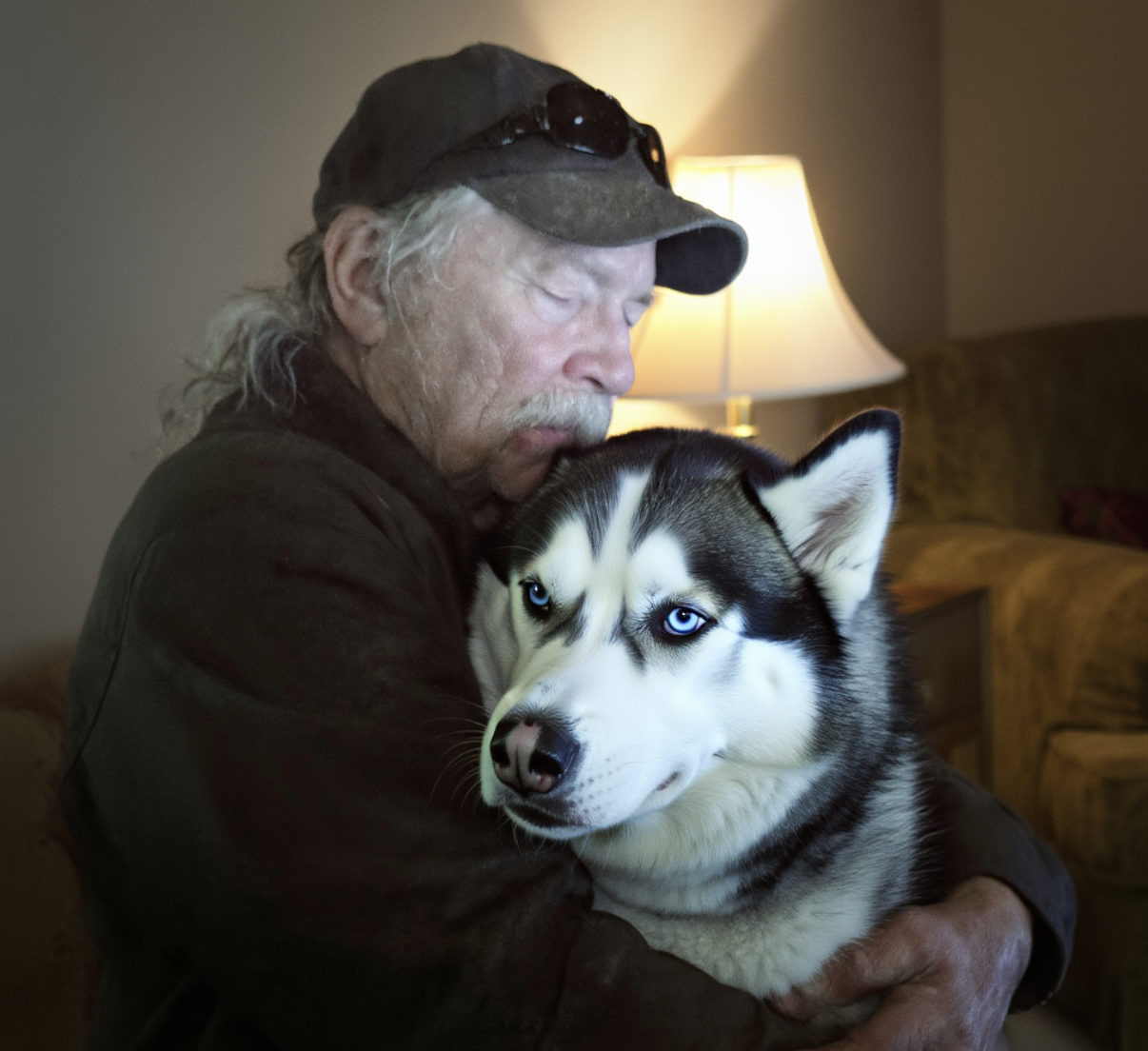
The Last Track: The Heart of the Old Husky
They said my dog was a liability, a washed-up relic with bad hips and blind eyes. But yesterday, that relic walked straight into hell to do what their million-dollar machines couldn’t.
I stood at the edge of the police cordon, the rain drumming against the brim of my cap. It was a cold, miserable October night in the Appalachians—the kind that soaks into your bones and stays there.
Next to my leg, Shadow shivered. He’s a fourteen-year-old Husky, his face a roadmap of gray fur and noble, sagging skin. His famous piercing blue eyes are clouded with cataracts, and he walks with a hitch in his giddy-up that makes people look away in pity.
“Go home, Elias,” the incident commander said. He was a young guy, sharp jawline, holding a tablet like it was the Ten Commandments. “We’ve got thermal imaging drones up. We’ve got a grid. We don’t need… whatever this is.” He gestured vaguely at Shadow, who was currently leaning against my shin to keep his balance.
“It’s six hours, son,” I said, my voice gravelly. “That little girl is six years old. And these woods? They don’t care about your batteries.”
He ignored me. They always do now. We live in a world that worships the new and discards the old. They trust algorithms over instincts. They trust silicon over a beating heart.
Ten years ago, Shadow was a legend in this county. He could pull a sled through a whiteout and find a track buried under six inches of snow. We pulled hikers off ridges and kids out of storm drains. But time is a thief. It took his sight, it took his speed, and it took his status. Now, we’re just two old things taking up space on a porch.
Then the storm broke. The wind howled through the valley, whipping the trees into a frenzy.
“Ground the drones!” someone shouted. “Thermal is blind in this rain!”
Panic set in. You could smell it—acrid and sharp, cutting through the scent of wet pine. The high-tech gear was useless. The screens went black. The fancy ATVs were spinning tires in the mud.
But down at my feet, Shadow lifted his head.
His cloudy eyes couldn’t see a thing, but his nose—that magnificent, ancient instrument—twitched. once. Twice. He let out a low, mournful howl. It wasn’t a bark; it was a statement.
He had her.
I looked at the chaos around us, then I looked at my boy. He was in pain; I knew it. Every step in this cold was agony for his joints.
“One last ride, partner?” I whispered.
Shadow wagged his tail. Just once.
We slipped past the yellow tape while the officers argued over maps. We entered the dark.
It was a brutal climb. The mud sucked at my boots. Shadow stumbled, his back legs giving out on a slick rock. I fell to my knees, wrapping my arms around his chest, hoisting him up. I carried half his weight, him carrying all my hope.
“Find her, Shadow. Find her.”
He dragged me through thorn bushes that tore at my jacket. He led me away from the grid, away from the logic, deep into a ravine where the GPS signal died.
And there she was.
Huddled under the overhang of a fallen oak, a tiny patch of pink in a world of gray. She was freezing, barely conscious. Shadow didn’t bark. He just collapsed next to her, curling his large, thick, warm body around her small, shivering frame. He licked her face, cleaning away the tears and the dirt.
By the time the rescue team followed my flare gun, the girl was warm. She was holding onto Shadow’s thick fur like a lifeline.
They loaded her onto the stretcher. Cheers erupted. The young commander clapped me on the back, grinning. “A miracle! A damn miracle!”
They rushed her to the ambulance, lights flashing, cameras rolling for the morning news.
But they didn’t see the rest.
They didn’t see me sitting in the mud, cradling a heavy, silent head in my lap.
Shadow didn’t get up. His heart, big as it was, had fired its last beat keeping that little girl warm. He had spent every last ounce of life he had left to finish the job.
I buried his collar this morning. The house is quiet. Too quiet.
I’m writing this because I saw the news report today. They talked about the “successful operation.” They showed the drones. They showed the smiling officers. They didn’t mention the dog.
And it made me realize something terrifying about us.
We are so obsessed with being faster, smarter, and newer, that we’ve forgotten the value of being faithful. We treat people like we treat iPhones—useful until they slow down, then replaceable.
But technology doesn’t have a soul. A drone cannot hold a scared child’s hand. An algorithm cannot love you enough to die for you.
Shadow wasn’t perfect. He was broken, old, and slow. But he was there.
So please, tonight, look at the “old dogs” in your life—the elderly neighbor, the grandparent, the worker forced into early retirement. They might move a little slower. They might not understand your apps.
But they built the ground you stand on. And when the storm comes and the screens go dark, they are the ones who will carry you home.
Don’t wait until they’re gone to realize that “new” isn’t always “better.” Sometimes, the best things are the ones we’ve already forgotten.