The Last Steak on Route 66
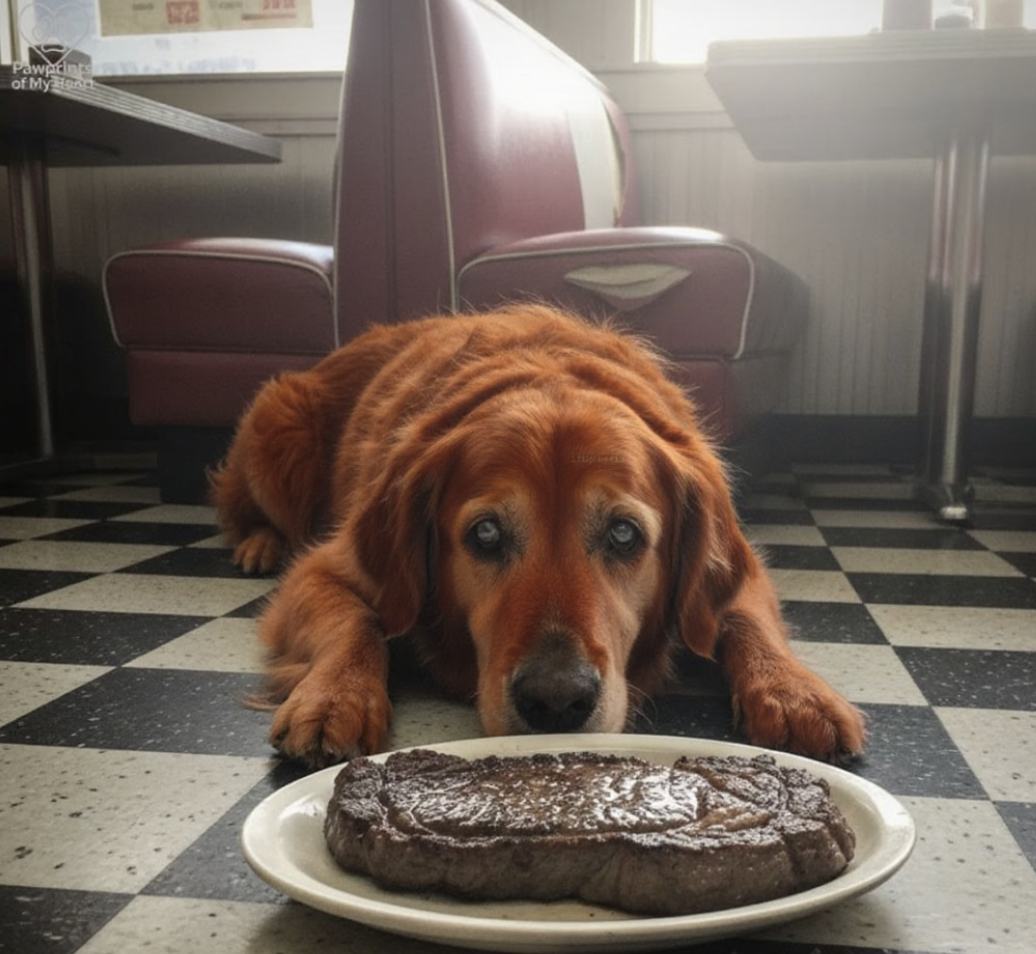
I ordered the sixteen-ounce ribeye, rare, with absolutely no seasoning. It wasn’t for me. It was the last meal for the fifteen-year-old soul resting heavily at my feet.
The diner was one of those roadside relics on the edge of the Arizona desert, the kind with chrome-edged counters and red vinyl booths that have been cracked by decades of dry heat. It was 3:00 PM on a Tuesday. The place was empty, save for the hum of a refrigerator and the dust motes dancing in the slanted sunlight.
I sat in the corner booth. Under the table, Rusty let out a long, rattling sigh.
He was a Golden Retriever, though you wouldn’t know it from the color of his face anymore. His muzzle was entirely white, matching the cloudiness in his eyes. His hips had given out two days ago. I had carried him in from the truck, his eighty pounds feeling both heavy and impossibly fragile in my arms.
The waitress walked over with a notepad. She was older, maybe late sixties, with gray hair pulled back in a tight bun and a name tag that simply read “Helen.” She looked tired in the way that people who have worked on their feet for forty years look tired—bone deep.
She glanced at the menu I hadn’t opened, then down at the floor where Rusty was trying to get comfortable on the linoleum.
“Steak’s not for you, is it?” she asked. Her voice was scratchy, like gravel on a highway.
“No, ma’am,” I said, my throat tight. “And a bowl of ice water, please.”
She didn’t coo. She didn’t do the high-pitched baby voice people usually do when they see a dog. She just nodded, a somber understanding passing behind her spectacles. “I’ll make sure the cook picks a tender cut.”
When she walked away, I reached down and stroked Rusty’s velvet ears.
“Almost there, buddy,” I whispered.
We were doing the tour. Route 66. The Grand Canyon. The places I promised him we’d see back when we were living out of a Ford F-150 in 2009. I was twenty-two then, angry at the world, and he was a clumsy puppy who chewed through my only pair of work boots.
The financial crash had taken my dad’s job, then his house, then his pride. I had dropped out of college to work construction, but the jobs dried up. We ended up on the road. For six months, “home” was the cab of that truck. It was a dark, humiliating time in American history that people don’t like to talk about much anymore. But Rusty? He didn’t care that we were poor. He didn’t care that we showered at truck stops. He just cared that we were together.
Helen returned with a ceramic plate. The steak was perfect. She placed it on the floor with surprising gentleness.
Rusty lifted his head. His nose twitched. The smell of seared beef cut through the fog of his age. He ate slowly, savoring every bite, his tail giving a weak thump-thump against the booth.
“He’s a handsome boy,” Helen said, refilling my coffee. She lingered, leaning her hip against the counter. “Had a Golden myself, once. A lifetime ago.”
“He’s the best,” I said, watching him eat. “He saved my life. Literally. Kept me warm when the heater broke in Flagstaff. Barked when someone tried to break into the truck in Albuquerque.”
Helen squinted, looking closer at Rusty. She leaned down, bracing her hands on her knees. “Can I?” she asked.
“Sure. He loves people.”
She reached out and traced a finger over Rusty’s snout. There was a small, jagged scar there, shaped like a lightning bolt—a souvenir from getting caught in a chain-link fence when he was a pup.
Helen froze.
Her hand stopped moving. She stayed crouched there for a long time, the silence in the diner growing heavy. When she looked up at me, her eyes were wide, the tiredness replaced by a sharp, piercing recognition.
“You got him at the county shelter,” she said. “Maricopa. December 24th, 2008.”
I stopped with my coffee cup halfway to my mouth. “How could you possibly know that?”
“It was Christmas Eve,” she whispered, standing up slowly. Her hands were trembling. “It was freezing. The shelter was at maximum capacity. They were going to euthanize the overflow the next morning.”
She looked at me, really looked at me, searching for the boy I used to be.
“You were the kid in the oversized flannel jacket,” she said. “You came in crying. You said you needed a friend because your dad wouldn’t talk anymore. But the manager told you no.”
The memory hit me like a physical blow.
I remembered the smell of bleach and wet fur. I remembered the stern man behind the desk telling me that because I didn’t have a physical address—because I was “transient”—I couldn’t adopt. It was policy. No home, no dog.
I remembered walking away, devastated, sitting on the curb outside. And then…
“You,” I breathed.
I looked at Helen. The uniform was different, the hair was gray, but the eyes—
“You’re the lady at the back door,” I said.
On that night in 2008, a woman had slipped out the service entrance. She had whistled to me. She had a puppy in her arms—the one with the lightning-bolt scar. She had shoved a clipboard at me and said, “Sign here. Don’t make me regret this.”
“I falsified the records,” Helen said softly. “I put my own address on the paperwork. I marked him as ‘claimed by owner.’ If they’d found out, I would have been fired and blacklisted.”
“Why?” I asked. “You didn’t know me.”
“I knew a boy who needed saving,” she said, wiping her eye. “And I knew that dog needed a job. I worried about you two for years.”
I slid out of the booth.
“He did more than make it, Helen,” I said. “He got me through the recession. He was the ring bearer at my wedding. He sat by the crib when my daughter was born. He… he’s been my whole life.”
Rusty had finished the steak. He was licking his chops.
“Rusty,” I said softly.
He looked up. Then he looked at Helen.
Even old dogs know hearts. They know scents.
Rusty let out a low ‘wuff.’ He struggled to stand. I moved to help, but he shook me off. With a groan, he stood and took two wobbly steps toward the woman who had opened the cage door fifteen years ago.
He pressed his head into her legs and exhaled.
Helen broke.
She fell to her knees, wrapping her arms around him, sobbing into his white fur. Fifteen years of wondering, answered in one moment.
“I knew you’d be a good boy,” she wept. “I knew you’d take care of him.”
Rusty licked the tears from her cheek. Thump. Thump. Thump.
We stayed like that for a long time.
When it was time to go, I tried to pay. Helen pushed my hand away.
“It’s on the house,” she said. “It was paid for fifteen years ago.”
I carried Rusty out to the car. The vet was an hour away. The appointment was at 5:00 PM.
Helen stood in the doorway as I rolled down the window.
“Thank you,” I said.
“You gave him a good life,” she called back. “That’s all the thanks I need.”
As I drove away, Rusty rested his head on the center console, his paw touching my arm. He was calm. He was ready.
I drove down Route 66 through the gold and purple of the desert twilight. I realized I wasn’t just losing a dog. I was closing a chapter.
And I realized something else:
Sometimes your entire life is built on the quiet, rebellious kindness of a stranger who broke the rules just to give you a chance.
Rusty didn’t just belong to me. He belonged to Helen, too. He belonged to hope.
Goodbye, Rusty.
You were a good boy.
The very best.