The House We Carried With Us
They say you can’t mourn a building, but watching my twelve-year-old Golden Retriever wander through the empty rooms, searching for a ghost that wasn’t there, broke something inside me.
My name is Ethan, and it was 4:00 PM on a Tuesday. The moving truck had already rumbled down the cul-de-sac, taking with it the sofas, the oak dining table, and the boxes marked “Fragile.” What remained was a shell. A hollowed-out carcass of drywall and hardwood that echoed with a strange, sterile silence.
I stood in the foyer, my car keys digging into my palm. Beside me stood Cooper.
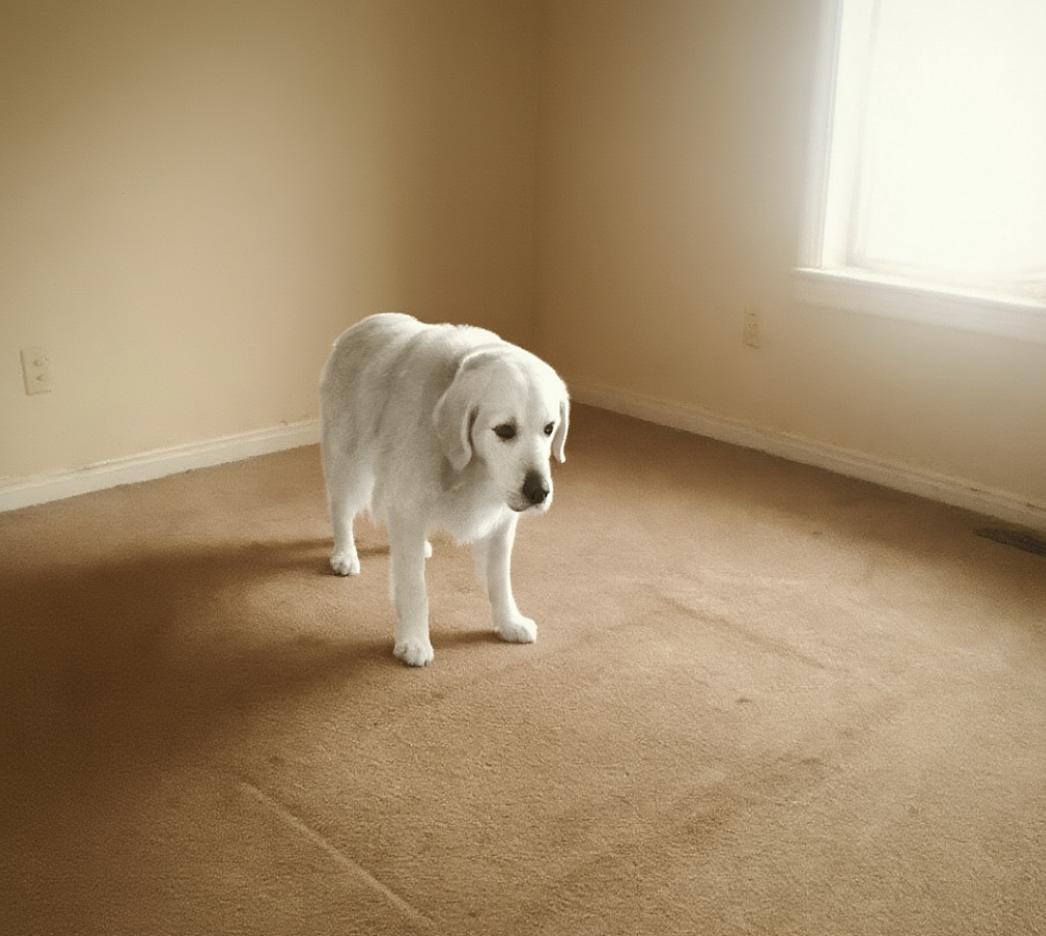
Cooper is old now. His muzzle, once a deep, rich gold, is painted with the white frost of age. His hips are stiff, and his eyes, once sharp enough to spot a squirrel from three backyards away, are cloudy with cataracts. He panted softly, the sound rhythmic and wet in the quiet house.
He didn’t understand.
To me, this was a transaction. A life transition. We were downsizing. Mom and Dad were moving to a condo in Florida; I was heading back to the city for a promotion. It was the logical next step.
But to Cooper, we were dismantling the world.
He let out a low whine and clicked his claws against the floorboards, pacing in a tight circle. Then, he started his patrol. I didn’t stop him. I followed him, a ghost haunting my own history.
He went to the kitchen first.
The room looked remarkably small without the island counter and the mismatched barstools. Cooper walked to the spot near the oven—a specific three-foot radius of scuffed linoleum. He sniffed the ground intently, his tail giving a slow, uncertain wag.
I closed my eyes, and suddenly, the silence vanished.
I could hear the chaos of Thanksgiving, 2012. The air was thick with the smell of sage stuffing and roasted turkey. My mom was laughing, trying to shoo my dad out of the prep area. And there, under the noise, was a younger Cooper—sleek, fast, and driven by an insatiable hunger. I saw the moment Dad “accidentally” dropped a piece of glazed ham. I saw the blur of gold fur, the snap of jaws, and the conspiracy of silence between a man and his dog.
Cooper sniffed the spot again. The ham was gone. The smell of sage was replaced by the harsh, chemical sting of industrial lemon cleaner. He looked up at me, his brow furrowed. Where is the magic? his eyes asked. Where is the warmth?
“It’s okay, buddy,” I whispered, my voice cracking in the empty room. “Come on.”
He didn’t listen. He moved to the living room.
This was the hardest part. The rectangular pale spot on the carpet showed where the TV console had stood for fifteen years. But Cooper wasn’t interested in the TV. He walked to the sliding glass door leading to the backyard.
He sat down and stared at the glass. He let out a sharp, demanding bark. Woof.
It was the bark he used when he wanted to go out. But the door was locked, the curtains were gone, and the backyard was just a patch of overgrown grass waiting for the new owners.
I stared at the glass, and the reflection shifted.
I saw a ten-year-old boy—me—bursting through that door. I heard the distinctive sound that defined my childhood summers: the metallic thwack-hiss-slam of the screen door. It slammed a hundred times a day. In and out. In and out. I saw myself running into the green explosion of July, a baseball glove on my left hand, screaming for Cooper. And he was there, a golden rocket, ears pinned back, tongue lolling, chasing me until we both collapsed in the clover, smelling of sun and dirt.
The screen door didn’t slam today. It was just glass. Cold, unmoving glass.
Cooper waited. He waited for the boy to run out. He waited for the door to open. When it didn’t, he let out a heavy sigh—a sound so human it made my chest tighten—and lowered his head.
We walked up the stairs. The wood creaked. It was the same C-sharp creak on the third step that used to warn me when Dad was coming up to check if I was actually sleeping or playing Game Boy.
Cooper navigated the stairs slowly, one paw at a time, favoring his bad hip. He bypassed my parents’ room and went straight to the end of the hall.
My room.
It was shocking how small it actually was. How did I fit a universe in here? The posters were down, leaving behind tiny holes in the plaster. The desk where I struggled through algebra and wrote my first love letter was gone.
Cooper walked to the center of the room and circled three times before collapsing onto the bare floor where my bed used to be. He rested his chin on his paws, his eyes tracking dust motes dancing in the shaft of afternoon light.
This was his sanctuary too.
I remembered the thunderstorms. The ones that shook the gutters and turned the sky purple. I was terrified of thunder. I used to hide under the covers, shaking. And every single time, without fail, I would feel a weight jump onto the mattress. Cooper. He wasn’t allowed on the furniture, but during storms, the rules didn’t apply. He would curl up against my back, a solid, warm anchor in a scary world. His steady heartbeat against my spine was the only thing that allowed me to sleep.
I sat down on the floor next to him. The hardwood was cold, but his fur was warm. I stroked the soft spot behind his ears, the velvet fur that never changed, even as he got gray.
“We have to go, Cooper,” I said softly. “Mom and Dad are waiting at the new place. It has a pool. You’ll like the pool.”
He didn’t move. He just stared at the empty corner. It felt like he was staging a protest. He was the keeper of the memories, and he refused to abandon his post.
I checked my watch. We really had to go. I stood up and jiggled the keys. “Treat? You want a treat?”
Usually, that word would trigger a frenzy. Today, he just slowly hoisted himself up. He looked at me, then looked back at the empty room. He trotted out into the hallway, but instead of heading for the stairs, he ducked into the open closet in the hallway—the one we had emptied hours ago.
“Cooper, no. Nothing’s in there,” I called out.
He ignored me. I heard him scuffling around in the dark back corner, his claws scratching against the wood.
“Cooper, come!”
He emerged a moment later. In his mouth, he held something.
It was unrecognizable at first. A gray, fraying, slobber-soaked sphere. The leather was torn, revealing the string underneath. The red stitching was practically gone.
It was The Ball.
We had lost this baseball five, maybe six years ago. It had been the Holy Grail of our backyard games. We thought it had gone over the fence or been eaten by the lawnmower. But somehow, it had been kicked into the dark abyss of the hallway closet, sitting there in the shadows, waiting.
Cooper walked up to me. He didn’t drop it. He just held it there, his tail giving a low, steady thump-thump-thump against the wall.
He looked at the ball, then he looked at me.
And in that moment, the crushing weight of the empty house lifted.
I realized what he was doing. He wasn’t mourning. He was scavenging. He was making sure we didn’t leave the important stuff behind.
The house was just wood and nails. The kitchen island didn’t matter. The carpet stains didn’t matter. The screen door didn’t matter.
What mattered was the game. What mattered was the feeling of safety during a storm. What mattered was the “accidentally” dropped ham.
Cooper wasn’t confused. He was smarter than I was. He knew that the magic wasn’t in the floorboards; it was in the connection between us. He had found the symbol of that connection, and he was ready to transport it.
I knelt down, tears finally spilling over, and took the gross, ancient baseball from his mouth. I put it in my jacket pocket, right next to my heart.
“Good boy,” I choked out. “Good boy, Cooper.”
He licked the tear off my cheek, gave a short sneeze of satisfaction, and then turned toward the stairs. This time, he didn’t look back. He moved with a new energy, a little bounce in his stiff step.
We walked out the front door together. I locked it. I didn’t look back at the window. I didn’t need to.
I helped Cooper into the backseat of my SUV. He curled up immediately, resting his chin on the center console so he could be close to me. As I put the car in drive, I looked in the rearview mirror.
The house stood there, stoic and empty. The “For Sale” sign had a “Sold” sticker slapped across it diagonally.
I thought about the young couple moving in next week. They would paint the walls a different color. They would replace the carpets. They would make new scratches in the floor and burn their own dinners in the kitchen.
And that was okay.
Because as I merged onto the highway, hearing the soft, rhythmic snoring of my best friend from the backseat and feeling the weight of that old baseball in my pocket, I understood the truth.
You don’t outgrow a home. You absorb it.
You fold it into your character. You carry it in the way you laugh, the way you forgive, and the way you love. We weren’t leaving the memories behind in that zip code. We were packing them up, wrapped in fur and old leather, and taking them with us.
Some places don’t leave you. Some places become you.
“Let’s go home, buddy,” I whispered.
Cooper thumped his tail once in his sleep. He was already there.