The Golden Thread: A Life Measured in Moments and Mud
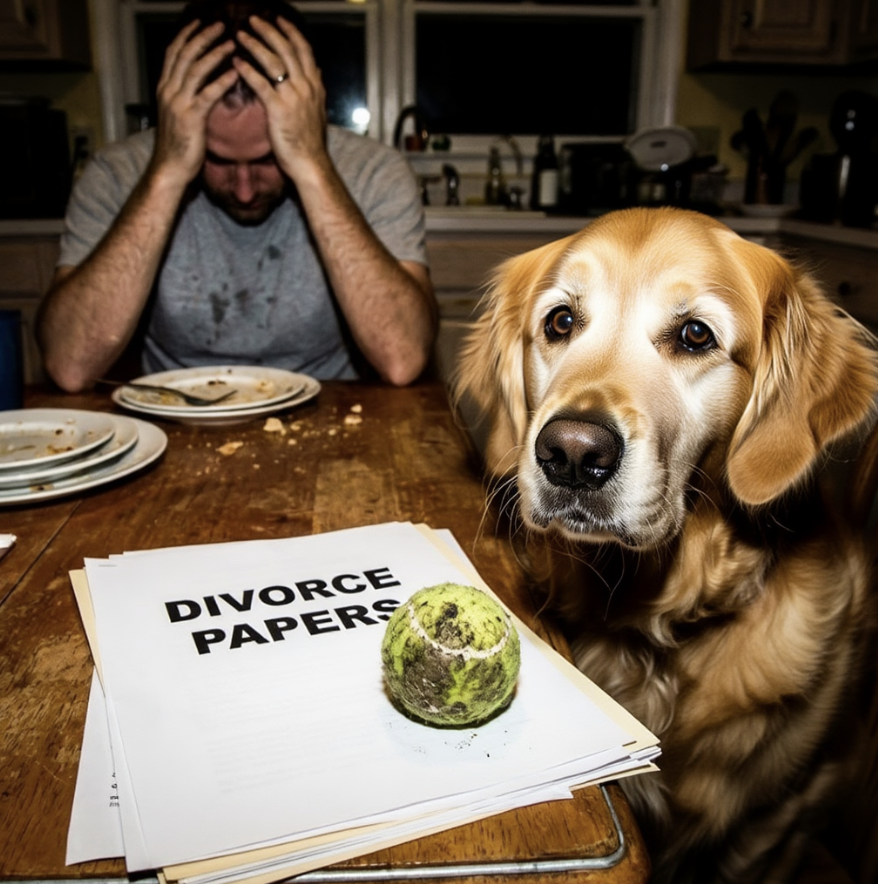
I was staring at the divorce papers on the kitchen table when a beautiful, slightly clumsy Golden Retriever walked in, dropped a dirty tennis ball on the legal documents, and looked up at me like I was a complete idiot.
That was twenty years ago. The papers never got signed. They ended up in the recycling bin, stained with slobber—the most accurate metaphor for our marriage I could have ever asked for.
Now, sitting on the back porch with Sarah, I realize nobody tells you the truth about the long haul. Marriage isn’t a solid object; it’s a living thing that sheds its skin and is reborn, over and over, usually when you’re too tired to notice.
Barnaby is sleeping at our feet. He’s ancient now. His muzzle, once the color of honey, is entirely snow-white. He’s been the witness to every version of us.
I remember the Learning Stage. We were twenty-four and broke. We adopted Barnaby, a chaotic ball of golden puppy energy, because the house felt too big. One Saturday, he skidded on a drop cloth and knocked a gallon of “Sky Blue” paint onto the floor. Blue paint exploded everywhere. We didn’t yell. We just looked at this blue-dipped dog wagging his tail and collapsed laughing. That was love then: loud, messy, and easily forgiven.
Then came the Building Stage. The “Blur.” The blue paw prints faded under the scuff marks of two kids. My career took off, Sarah was exhausted, and the laughter got quieter. I remember coming home late one Tuesday, feeling like a bill-paying machine rather than a husband. Then I felt a weight on my foot. Barnaby. He just pressed his warm, sturdy side against my shin and stayed there until I stopped shaking. Sarah walked in, handed me a mug of tea, and we sat in silence. Love wasn’t a grand declaration anymore; it was the company of someone who knew I was tired and didn’t ask for an explanation.
But the Testing Stage hit when the kids left for college. The house went echoing quiet. We had forgotten how to talk without a buffer. Resentments crawled out. I was stubborn; Sarah was critical.
That was the night of the papers. The night Barnaby dropped the ball on the “Asset Division” section. He sensed the tension and tried to break it. Play? he seemed to ask. Are we still a pack?
I looked at Sarah. Her jaw was set tight, but her eyes moved to the dog. “He needs a bath,” she whispered, her voice cracking.
“Yeah,” I said, the anger draining away. We didn’t solve everything that night, but we took the dog for a walk. We realized leaving was easy—staying was the work.
Now, we are in the Companion Stage. The sun is setting. Sarah’s hand, familiar and warm, takes mine. Barnaby stirs, his back legs wobbling as he tries to stand. I help him up, my own back creaking in symphony with his.
He taught us that loyalty isn’t a feeling; it’s a habit. He taught us that when someone is hurting, you don’t give advice; you just sit with them. He taught us that every morning is a chance to wag your tail and start over.
Marriage isn’t the shiny beginning. It’s the mud on the floor. It’s the moment you choose to put down the papers and pick up the leash. It’s looking at the person beside you and thinking, I’m glad I walked this road with you.
Barnaby lets out a long, contented sigh and rests his chin on my sneaker. The sun dips below the horizon. We are home.
The Cliffhanger
As the last light of the sun vanished, Barnaby did something he hadn’t done in years. He didn’t settle back into sleep. Instead, he stood up with a sudden, strange fluidity, his ears pricked toward the dark line of the woods at the edge of our property.
He let out a single, clear bark—not the raspy cough of an old dog, but the bright, ringing call of the puppy who once knocked over the blue paint.
Sarah frowned, squinting into the shadows. “What is it, Barnaby? A deer?”
But Barnaby didn’t look at the woods. He turned back to us, nudged a hidden floorboard on the porch with his nose, and began to dig with a frantic energy we thought he’d lost a decade ago.
“Wait,” Sarah whispered, standing up. “I forgot about that. The ‘Time Capsule’ we buried under the boards the day we moved in.”
I reached down and pried up the loose wood. Inside was a small metal box, rusted shut. As I forced it open, a single photograph fell out—one we didn’t remember taking—and a handwritten note from my father, dated the day of our wedding.
“Read it,” Sarah said, her voice trembling.
I unfolded the paper. My father had written only one sentence, but as I read it, I realized Barnaby hadn’t just been our dog. He had been a sentry for a secret that was never supposed to be revealed until this exact moment.