The Golden Anchor: Why the World Still Needs the Quiet Places
I had a straight razor pressed against a man’s throat when the screaming started, proving once again that in this country, silence is the most expensive luxury left to buy.
My barbershop, “The Iron Shear,” is a twenty-by-twenty box of fading history. For thirty years, the rules here have been simple, taped to the mirror in my handwriting: No Politics. No Religion. If you need to complain, tell the dog.
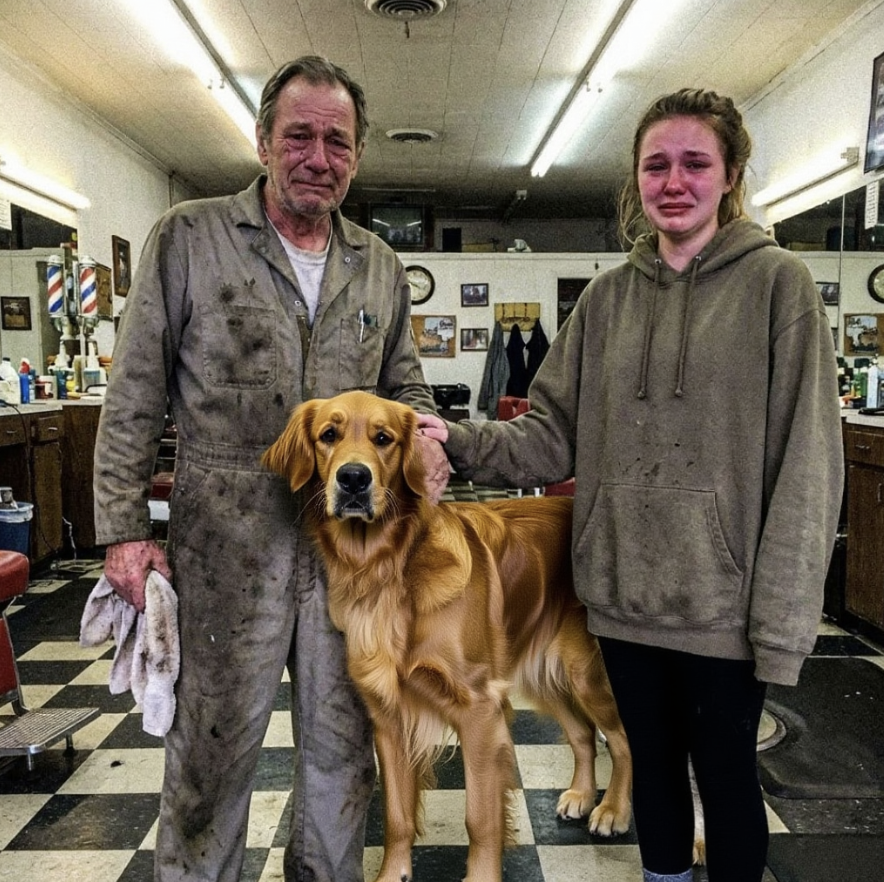
The dog is Goldie. She’s a Golden Retriever, a seventy-pound sunbeam of honey-colored fur and unshakeable optimism. She spends her days draped over the waiting chairs, looking like a discarded silk rug. She smells faintly of toasted oats and sunshine.
But that Tuesday, the noise was loud enough to wake the dead.
In the chair was Rick, a mechanic whose knuckles are permanently stained with grease. Leaning against the doorframe was Maya, a twenty-year-old student carrying a crushing amount of student debt.
“I can’t afford to care about the polar ice caps when I can’t keep the heat on in my living room!” Rick’s voice cracked with fear-driven anger.
Maya’s face was flushed. “And I’ll never be able to afford a living room to heat! You guys pulled the ladder up behind you!”
I pulled the razor away from Rick’s neck. This wasn’t just an argument. This was the sound of America tearing itself apart—two people drowning in the same ocean, fighting over who was swallowing more water.
“Hey,” I said. “Read the sign.”
They ignored me. Rick started to stand; Maya stepped forward. Then, a soft, rhythmic thump-thump-thump sounded against the wooden floor.
Goldie had lifted her head. She didn’t growl. Golden Retrievers don’t do “threats.” She simply slid off the chair and walked to the center of the room, directly between them. She looked at Rick with those deep, liquid-amber eyes that seem to hold only kindness. Then she looked at Maya.
She let out a heavy huff of breath and did the thing she’s famous for: The Golden Lean.
She pressed her entire body weight against Maya’s legs. Then, she shifted, stretching her neck to rest her chin firmly on Rick’s calloused knee, looking up at him with a wag so slow it moved her whole tail-base.
“She likes you,” I lied.
The truth is, Goldie doesn’t care about your ideology. She doesn’t smell opinions. She smells cortisol and fear. Rick wasn’t angry; he was terrified of being obsolete. Maya wasn’t arrogant; she was terrified of having no future.
Rick’s shaking hand landed on Goldie’s soft head. Maya reached down to stroke her ears. The circuit was broken. The anger grounded by seventy pounds of neutral warmth.
“Sorry, Frank,” Rick muttered. “Yeah,” Maya whispered. “Sorry.”
But that night, after I swept the hair, the silence felt heavy. The rent for the shop had gone up again. I was three months behind. I was seventy-two years old, standing on a ship that had already sunk.
I looked at Goldie. “We’re done, girl. I can’t hold the line anymore.”
For years, people thought Goldie was the magic. They didn’t know the other part. When Rick couldn’t buy his granddaughter a coat, I’d slipped a hundred bucks into his pocket. When Maya’s laptop broke, I “found” an old one in the back. I used the dog as the distraction so they could accept “luck” instead of “charity.” But I was empty now.
The next morning, I taped a sign to the glass: CLOSED FOR GOOD. THANK YOU FOR THE MEMORIES.
I walked Goldie to the park all day, delaying the inevitable. When we finally walked back at 4:00 PM to get my tools, Goldie stopped. She let out a happy bark and pulled on the leash.
There were people in front of the shop. Rick, Maya, the baker, the local cop.
The “Closed” sign was gone. In its place was a massive corkboard covered in paper.
“Frank!” Rick shouted, holding a hammer. “I’m replacing this sticky lock for you. On the house.”
“What is this?” I asked.
Maya stepped forward. “We saw the sign, Frank. We made some calls.”
I looked at the board. “I’ll do your taxes for free this year.” — Sarah. “I’ll drop off a box of produce every Tuesday. You won’t starve.” — Mr. Henderson. “For the Rent. We’re at $4,000 and climbing. The internet loves a Golden Retriever, Frank.” — The GoFundMe note.
I stood there, clutching Goldie’s leash. “Why?” I choked out. “I’m just a barber.”
Rick looked at the dog, then at me. “You ain’t just a barber, Frank. Out there? It’s a mess. In here? It’s quiet.”
Maya smiled. “You gave us a place to put the heavy stuff down. You think we didn’t know?”
Goldie sat down and looked at the crowd—Republicans, Democrats, Boomers, Gen Z. She didn’t smell fear anymore. She let out a joyful bark and did a lap around the group, her tail hitting everyone’s knees like a blessing.
I unlocked the door. “Alright,” I said, wiping my eyes. “Get inside. Maya, turn on the coffee pot.”
We didn’t fix the economy. But inside, the air smelled like talc and coffee. In a world that profits from our division, the most radical thing you can do is sit in a room with someone you disagree with, pet the same dog, and realize you are both just trying to survive the winter.