The Golden Anchor
The staircase of the old Victorian house on Pine Street had thirty-two steps. For most of my life, I took them two at a time, usually with a hammer in one hand and a tool belt jingling at my waist. But lately, those stairs had become a vertical mountain range, a wooden monument to my own expiration date.
I’m Elias. I spent forty years as a master carpenter, building homes for people who eventually moved away or grew old. Now, I was the one growing old in a house that felt too large, filled with the echo of a wife who had been gone for three winters and a son who lived three time zones away. My son, David, called every Sunday. His voice was always laced with that thin, vibrating layer of pity.
“Dad, the stairs are dangerous,” he’d say. “There’s a lovely place in Arizona. Single story. Medical staff on site. No more worrying.”
“I’m not a used car, David,” I’d snap. “I don’t need a showroom.”
But the truth was biting. Last Tuesday, I had reached for a jar of peaches on the top shelf, my balance wavered, and I spent twenty minutes sitting on the cold linoleum, waiting for the world to stop spinning. I didn’t tell David. If I told him, the “For Sale” sign would be in the yard by Monday.
I decided I needed a distraction. Or maybe just a reason to keep the lights on.
I went to the local rescue. I expected to find a young, energetic dog that would force me to walk, but instead, I found Oliver.
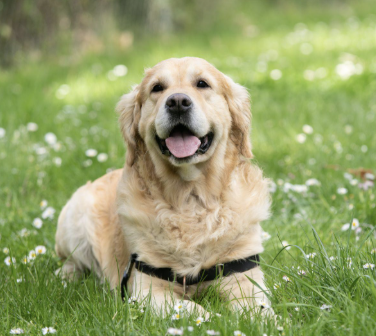
Oliver was a Golden Retriever who looked like he had been dipped in honey and then left out in the rain for a decade. His coat was matted, his muzzle was a ghostly white, and he walked with a heavy, rhythmic limp in his rear left leg. He didn’t jump against the kennel gate. He just rested his chin on the bars and looked at me with eyes that seemed to say, “I’m tired of being a burden, too.”
The shelter volunteer sighed. “Oliver was a therapy dog for children with disabilities. But his hips gave out, and his owners couldn’t afford the surgery or the care. He’s been here four months. He’s… well, he’s a hospice candidate, really.”
“He’s perfect,” I said. “He’s a man of my own vintage.”
The first few weeks at the house were a symphony of groans. I’d groan when I got out of bed; Oliver would groan when he stood up from the rug. We were two sinking ships tethered together. I spent my afternoons in my workshop—a place I hadn’t touched since the funeral—trying to figure out how to make life easier for him.
I looked at the three steep concrete steps leading from the back porch to the garden. Oliver would stand at the top, his tail giving a pathetic little wag, but he wouldn’t descend. He was terrified of the drop.
“I hear you, buddy,” I whispered, rubbing his ears. “It’s a long way down.”
I started building. It felt good to have sawdust in my lungs again. I designed a long, sweeping ramp with a gentle incline, using high-grip outdoor carpeting and sturdy railings. My hands cramped and my back screamed, but for the first time in years, I wasn’t building for a paycheck. I was building a bridge for a friend.
When I finished, I led Oliver to it. He sniffed the wood, looked at me, and then walked down with a grace I hadn’t seen him possess. He reached the grass, did a clumsy little lap around the oak tree, and looked back at me.
The realization hit me like a hammer: I hadn’t just built a ramp for a dog. I had built a way for me to get to my garden without using the stairs. I used the ramp myself that evening, and for the first time in a year, my knees didn’t throb.
But the “mountain” remained—the thirty-two steps to the bedroom.
One night, a massive summer storm rolled through. The power cut out, plunging the house into a thick, suffocating darkness. I was in the kitchen, and Oliver was upstairs in the bedroom—he had managed the climb earlier in the day when he was feeling brave.
A deafening crack of thunder shook the foundation. I heard a frantic scrambling from above, followed by a sickening thudand a sharp, pained yelp.
“Oliver!” I shouted.
I tried to rush to the stairs, but in the dark, I tripped over the edge of the rug. I went down hard. A white-hot bolt of pain shot through my shoulder. I tried to push myself up, but my arm wouldn’t hold my weight. I was pinned by the dark and my own frailty.
Upstairs, Oliver was whimpering, a sound of pure terror.
I reached for my phone in my pocket. I could call the paramedics. They’d break down the door. They’d see me on the floor. David would get the call. The Arizona brochures would become a reality.
“I can’t,” I wheezed. “Not yet.”
I looked toward the stairs. I couldn’t walk, but I could crawl. I dragged myself across the floor, my breath coming in ragged sobs. It took me eternity to reach the first step.
“Oliver! Stay!” I called out.
I felt a wet nose against my cheek. Oliver hadn’t fallen down the stairs—he had slid down them in his panic to find me. He was shivering, his bad hip clearly hurt, but he was licking the salt from my face.
We stayed there on the bottom landing for an hour, huddled together in the dark. The carpenter and the therapy dog.
The next morning, I didn’t call David. I called Sarah, the teenager from down the street who mowed the lawn.
“Sarah,” I said. “I’m going to pay you to help me install a chairlift on these stairs. And I need you to help me finish the modifications on the truck so I can fit a dog ramp in the back.”
She came over that afternoon. She didn’t look at me like I was dying. She looked at me like I was a foreman giving orders.
“You’re staying, then?” she asked, hoisting a box of parts.
“We’re staying,” I said, nodding toward Oliver, who was snoozing on his new orthopedic bed.
I realized then that David was wrong. Independence isn’t about never falling; it’s about having the tools and the heart to get back up. I wasn’t a used car. I was a classic. And with a few new parts and a co-pilot with a golden heart, I still had a lot of miles left on the map.
We don’t leave the house because the stairs are hard. We stay because the memories are worth the climb—and because sometimes, the best way to save yourself is to find someone else who needs saving just as much.