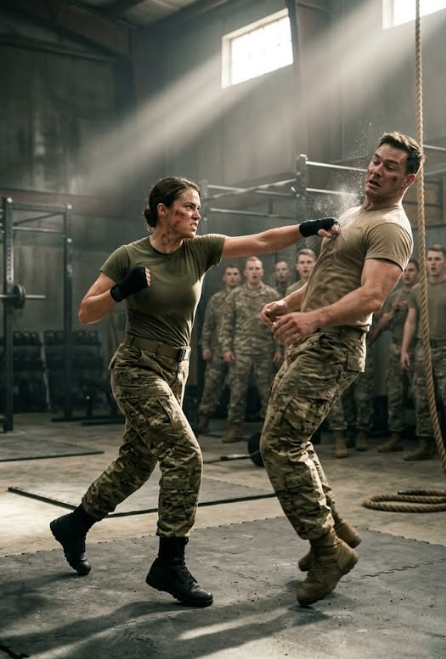
🔥 “Remember, I’m a Navy SEAL!” — He Hit Her Once, She Knocked Him Out Before 1,040 Troops
PART 2:
At the family table, Rachel felt her stomach drop for reasons she couldn’t name. Emma had gone silent. Elena had that rosary-tight look in her face again.
Marcus tapped two fingers on the table. “So, Sarah Whitaker, what kind of business brings a civilian into a restricted dining facility this early?”
“The kind that doesn’t require your approval.”
That got the room quieter.
Marcus had spent years reading hesitation in other people, and she offered him none. It was like throwing a punch into cold water.
“You always this friendly?” he asked.
“Only when strangers sit down at my table and start measuring me like inventory.”
A young corporal two rows back stared so hard into his eggs he might as well have buried his face in them.
Marcus became acutely aware that his daughter was somewhere in the room. He had glimpsed Rachel and Emma when he came in, had planned to greet them after making his usual pass through the hall, after reminding everyone who he was. It would take ten minutes. Fifteen at most. Rachel would read annoyance into it because that was what Rachel did now. Emma would forget once he hugged her.
Still, there was an audience here, and an audience changed the laws of pride.
“This installation,” Marcus said, lowering his voice, “runs on chain of command. If you’re here on official business, you shouldn’t have any problem identifying your office.”
Sarah folded her hands on the table.
“The kind of official business I’m here for,” she said, “is above your clearance level.”
The words landed like a slap.
Marcus laughed once, but there was no humor in it. “Above my clearance level?”
“That’s what I said.”
He had been praised, promoted, feared, and deferred to for so long that the sentence almost didn’t parse. Around him, the hall had thinned into concentric circles of silence.
“Lady,” he said, “I’ve worked missions most people on this base couldn’t imagine.”
“I’m sure you have.”
“I’ve seen things—”
“I’m sure you’ve seen many things.”
There it was again: that faint suggestion that his war stories were a costume she could see through.
Marcus leaned in. “Then maybe you also know that respect matters in places like this.”
Sarah tilted her head. “Respect is not the same thing as deference.”
He could hear Rachel’s voice in his memory all of a sudden, from a fight years earlier in their kitchen: You don’t know the difference either.
Marcus ignored the echo.
“Look around,” he said. “You’re in my house.”
Sarah’s expression changed for the first time. Not fear. Not surprise.
Disappointment.
“Your house,” she repeated.
“My troops. My base. My table if I want it to be.” He spread a hand. “And I don’t appreciate people acting above everybody else before they’ve earned the right.”
At her table across the room, Emma whispered, “Mom, why is he talking to her like that?”
Rachel answered without taking her eyes off Marcus. “Because he thinks he’s performing.”
Sarah closed her notebook completely and stood.
She was taller than Marcus had first guessed, maybe five-eight, but more than that, she carried herself like height wasn’t something she ever needed to borrow from shoes or posture. Every movement was efficient, no wasted motion, no uncertainty.
She slid the notebook into her bag. “Senior Chief Rodriguez, I’m here legally, I’m here officially, and I have no interest in getting into a public contest of ego before 7:15 in the morning.”
A few people coughed to hide laughter.
Marcus rose too.
The old machinery inside him had begun turning now—the one fueled by humiliation, by the need to reclaim space, by the inability to let a room watch him lose ground.
“You know,” he said, “most people are smarter than this. They hear what I’ve done, and they understand how to talk to me.”
Sarah looked up at him. “That may be the most revealing thing you’ve said.”
He smiled tightly. “Three deployments. Multiple commendations. Combat citations you’ll never sniff. I’ve buried friends in flag-draped boxes and still came back to do the job. So if I’m asking who you are, you answer.”
Sarah’s voice stayed even. “Your service can be honorable and your behavior can still be unacceptable.”
That sentence struck with a precision Marcus would only understand later.
He looked around the room and saw faces he knew: junior operators, Marines in training rotations, support staff, officers. Some looked stunned. Some entertained. Some hungry for blood because men with reputations always create that in other men.
And then, beyond them, he saw Emma.
She was sitting rigidly beside Rachel, staring at him with that open, wounded attention children don’t yet know how to disguise.
For one split second Marcus could have ended it.
He could have walked away, crossed the room, sat with his daughter, pretended he had somewhere else to be. Maybe salvaged the morning. Maybe.
But pride has a way of sounding like necessity inside your own head.
He stepped closer.
Sarah’s gaze dropped briefly to the distance between them, calculating. “Move back,” she said.
“Excuse me?”
“Move back.”
Marcus laughed softly. “Or what?”
Sarah slung her bag over one shoulder. “I’m leaving. You are crowding me. Move back.”
He could smell coffee and starch and the faint, metallic scent of industrial air conditioning. He could hear the scrape of forks stopping on plates all around them.
“I’m not done here,” he said.
“I am.”
She stepped to the side.
Marcus moved with her.
“What office?” he asked. “What agency? Because unless you’re wearing stars on your collar, you don’t get to talk down to me on my own base.”
“I’m going to say this once more,” Sarah said. “Step away.”
The room had gone so still that Rachel could hear the hum of the beverage coolers. Elena had one hand at her throat now. Emma’s fingers were crushing Rachel’s.
Marcus saw none of it clearly.
He saw only a woman in plain clothes refusing to grant him the reaction he wanted. Refusing to be impressed. Refusing to bend.
That was when he said the thing men like Marcus always say when they are most insecure: “You have any idea who you’re talking to?”
Sarah stared at him for two long seconds.
“Yes,” she said. “That’s the problem.”
Something sharp passed over his face.
Then Sarah added, almost gently, “Your file is thicker than your judgment.”
Marcus went cold.
“How do you know anything about my file?”
She did not answer.
His mind lurched. A civilian shouldn’t know that. A stranger shouldn’t know that. The reprimands, the counseling statements, the sealed complaints—those belonged to the internal channels that had always, somehow, failed to catch up with him in any meaningful way.
“What did you just say?”
Sarah adjusted her grip on the bag. “I said this conversation is over.”
She started to walk around him.
And then Marcus Rodriguez made the choice that would break his life open in front of 1,040 witnesses.
He grabbed her arm.
Not hard enough, in his mind, to count as violence. Just enough to stop her. Just enough to reassert control. Just enough to say, Nobody leaves a conversation with me until I’m done.
It was the same logic men use when they insist their handprints are just pressure, not force.
Sarah stopped instantly.
She looked down at his hand on her sleeve.
Then she looked up at him.
The room seemed to lose temperature.
“Senior Chief Rodriguez,” she said, her voice quiet and perfectly clear, “you have three seconds to let go of me.”
Marcus tightened his grip a fraction. The eyes on him felt electric now.
“Or what?”
“Three.”
Something old and bad in Rachel stood up inside her. She had heard that tone before, not from Sarah, but from trauma nurses, MPs, women who had learned exactly where the point of no return lived.
Marcus should have let go then.
He didn’t.
“Two.”
Emma whispered, “Mom…”
Rachel was already half-rising from her chair.
Elena said his name under her breath like prayer might travel faster than consequences.
Marcus leaned closer, anger and embarrassment boiling into stupidity. “Remember,” he said loudly enough for the whole hall to hear, “I’m a Navy SEAL.”
He would later remember the sentence in fragments. The taste of it. The arrogance. The way the room inhaled afterward.
What happened next took less than four seconds and lasted in memory forever.
Sarah rotated her trapped wrist inward with brutal efficiency, using the exact weakness in his thumb and grip. Marcus’s hand peeled away before his brain registered the loss. In the same motion, she drove the heel of her palm straight up under his jaw—not wild, not theatrical, but sharp and exact, snapping his head back and disrupting his balance.
Before his body could recover, her foot hooked behind his lead leg.
It was almost graceful.
Marcus, all 220 pounds of reputation and muscle, crashed backward into the hard cafeteria floor with a sound that made people flinch.
A collective gasp tore through the hall.
Marcus tried to surge up on instinct, years of combat training firing in his limbs. Sarah didn’t give him the chance. She stepped in and delivered a controlled strike with the edge of her boot to his solar plexus—hard enough to empty his lungs, precise enough to stop short of real injury.
The air left him in one helpless burst.
He hit the floor again, gasping.
Trays rattled. A spoon clattered somewhere and spun in widening circles.
No one moved.
For the first time in longer than Marcus could remember, there was no room left in his body for pride. Only shock. Pain. The awful animal panic of not being able to breathe while a thousand people watched.
Sarah stepped back immediately.
Hands open. Posture calm. Eyes alert.
Not gloating.
Not rushed.
Just ready.
Marcus rolled partly onto his side, coughing against the polished linoleum.
And from across the hall came the sound Rachel would hear in dreams later: her daughter’s broken whisper.
“Oh my God.”
If humiliation has a shape, Marcus thought later, it was the ceiling of that mess hall.
White tile. Fluorescent panels. Industrial vents. All of it hovering above him while his chest spasmed and his body fought to drag air back in. He had been blown off his feet in training, slammed into walls during breaching drills, thrown by men bigger than him in mats and kill houses. But never like this.
Never in front of people who used his name as shorthand for toughness.
Never in front of his daughter.
Sarah stood three feet away, breathing normally.
“Senior Chief Rodriguez,” she said, “when a woman tells you to take your hand off her, you do it.”
Her voice carried without effort.
Major Jennifer Walsh was the first officer to break from the freeze. She strode forward from the officer section, one hand lifted, command snapping back into her body like a switch thrown.
“That’s enough,” she called. “Everyone stay seated. Maintain order.”
Nobody had been moving anyway.
Rachel had, though.
By the time Walsh reached Sarah and Marcus, Rachel was already across the aisle with Emma close behind her. Elena followed, slower, pale, stunned, one hand still at her throat.
Marcus pushed himself up to one knee. His face was flushed dark red. His jaw throbbed. His sternum felt like a mule had kicked him.
And all around him were faces.
Young men who had once looked at him like he was carved out of war movies. Staff officers. Enlisted Marines. Support specialists. A chaplain. Civilians. Kitchen staff. His ex-wife. His daughter.
He couldn’t find one face that looked impressed anymore.
Walsh stopped in front of Sarah. “Ma’am, I need identification. Now.”
Sarah reached into her jacket and withdrew a slim leather credential wallet.
Walsh took one look and the color changed in her face.
Not fear.
Recognition.
A more dangerous thing.
“Yes, ma’am,” Walsh said, suddenly formal. She handed the wallet back with both hands. “I wasn’t informed you were on site.”
“You weren’t meant to be,” Sarah said.
The whispering started then, low and contagious, moving through the hall in invisible currents.
Rachel felt Emma move behind her. She turned just enough to see her daughter staring, not at Sarah, but at Marcus.
There was no hero in Emma’s face now. Only confusion and grief and the first hard outline of disillusionment.
“Emma,” Rachel said quietly. “Stay with Grandma.”
But Emma shook her head. “No.”
Marcus got one foot under him and shoved upward. His body still wanted to fold over itself, but the worse pain was elsewhere. In the part of him built on control.
“What the hell are you?” he managed.
Sarah looked at him the way a good doctor looks at a patient refusing treatment.
“I’m not the person you should be angry at.”
Major Walsh turned sharply. “Senior Chief, stop talking.”
He ignored her. “You assaulted me.”
Rachel almost laughed at the insanity of it, but it came out as a dry, stunned breath.
Sarah said, “You put your hands on me after being warned multiple times not to.”
“You—”
“Every person in this room saw it.”
Walsh straightened. “Senior Chief Rodriguez, report to command after medical clearance. Immediately.”
Still he could not stop. That was Marcus’s fatal flaw. He could survive bullets, cold water, pain, and hunger. He could not survive being challenged without trying to win the argument long after he’d already lost the field.
“I want to know who authorized you to be here,” he said.
Sarah’s gaze held steady. “Authority is not your problem this morning.”
Then she turned, not to him, but to the hall.
A thousand eyes met hers.
“What you witnessed,” she said, “was not a fight. It was not a challenge. It was not entertainment. It was a man refusing to respect a clear boundary and being stopped.”
Her voice never rose. It didn’t need to.
“Military achievement does not excuse misconduct. Decorations do not replace character. And status does not give anyone the right to put hands on another person.”
Nobody whispered now.
Nobody coughed.
Even the kitchen had gone still.
Rachel watched faces change around the room. Not all at once, but enough. Some people looked embarrassed, as if they were reviewing old moments in their heads. Others looked relieved. A few older enlisted men looked grim, unsurprised.
Marcus opened his mouth.
Walsh cut him off with a command voice sharp enough to split concrete. “That is enough, Rodriguez.”
It was the first time Rachel had ever heard anyone use his name like a weapon.
Sarah shifted her bag higher on her shoulder. “Major, I apologize for the disruption to your facility.”
“You don’t need to apologize, ma’am.”
Marcus heard that. Everyone did.
Rachel stepped forward then, not because she planned to speak, but because Emma had moved.
Before Rachel could catch her, her daughter took two uncertain steps toward her father.
“Dad?”
Marcus turned.
If she had slapped him, the effect might have been smaller.
His face changed. For a second the operator, the performer, the legend all fell away, and Rachel saw the man she had once married—the one who sometimes looked lost enough to drown on dry land.
Emma’s eyes shone, but her voice was steady in a way that broke Rachel’s heart.
“You were supposed to sit with us.”
Nobody in the hall moved.
Marcus swallowed. “Emma, honey, I—”
“You didn’t even come over.”
Rachel crossed the last steps and put a hand on Emma’s shoulder, but her daughter kept looking at Marcus.
“You always say family comes first when other people are watching,” Emma said. “But it never does.”
Marcus stared at her as if the sentence had struck harder than the floor.
Elena made a soft sound like protest, but it died in her chest.
Rachel didn’t rescue him.
For years she had been the translator between Marcus and the damage he caused. She had softened, explained, delayed, covered, redirected. She was done.
Marcus tried again. “Em, that’s not what happened.”
Emma’s voice cracked. “Then what did happen?”
He looked past her, maybe for help, maybe for language. There was none.
Sarah watched the exchange without expression, though Rachel thought she saw something like sadness pass over her face.
Major Walsh stepped in before the silence got any more terrible. “Mrs. Rodriguez, please take your daughter and leave the immediate area.”
Rachel nodded once. Emma resisted for half a second, then let herself be guided away.
As they turned, Sarah spoke again, this time only to Marcus.
“Remember this part,” she said. “Not the fall. The moment right before it, when you still had a choice.”
Then she walked out of the hall.
And people moved aside for her not because she demanded it, but because something in them understood she had just said aloud a truth too many had been forced to live around quietly.
By 9:30 that morning, Colonel James Harrison had received two calls from the Pentagon, one from regional command, and one from a voice so calm and senior he knew better than to ask twice what kind of office it belonged to.
By ten, Marcus’s security access had been suspended.
By eleven, the first rumor had already left the base.
By noon, everyone who mattered knew the woman in the gray sweater had not been a civilian.
She was Special Investigator Sarah Whitaker, Defense Intelligence Agency, Internal Affairs Division.
And she had been on base because of Marcus.
Not only because of him, as Harrison later explained, but enough because of him that the distinction barely mattered.
When First Sergeant Hayes escorted Marcus into the colonel’s office, Marcus still had a split lip, a sore jaw, and the fading delusion that this might somehow be managed if he asserted the right combination of rank, service history, and outrage.
Colonel Harrison did not invite him to speak first.
“Sit down.”
Marcus sat.
On the desk lay a folder thicker than any standard disciplinary packet.
Harrison folded his hands. “You are being placed on immediate administrative leave pending a formal investigation.”
Marcus blinked. “For defending—”
“Stop.”
The word cracked like rifle fire.
Marcus stopped.
Harrison’s face was gray with contained fury. “The woman you put your hands on this morning is a DIA investigator assigned to an internal misconduct inquiry involving personnel attached to this installation.”
The room seemed to tilt slightly.
Marcus stared. “What inquiry?”
Harrison opened the folder. “Over the last eighteen months, multiple complaints have been logged, some formal, some protected, concerning abuse of authority, harassment, intimidation of junior personnel, and retaliatory behavior among certain special operations and support staff.”
Marcus heard the words but kept waiting for them to shift away from him.
“They sent a DIA investigator for that?”
“They sent a DIA investigator because the pattern suggested local reporting channels had failed.”
Marcus’s mouth went dry.
Harrison flipped a page. “And because your name appears repeatedly.”
The silence that followed was the worst Marcus had ever sat in.
He had always imagined accountability as dramatic—yelling, punishments, a storm. Instead it arrived bureaucratically, in paper and signatures and cleanly spoken facts.
“That’s impossible,” he said finally.
“No, Rodriguez. It’s documented.”
“They’re twisting things.”
“Are they?”
Marcus looked at the folder as if it were alive.
He knew pieces of what might be inside. The counseling statement from two years ago after he verbally shredded a lieutenant in front of her team. The warning from a command master chief after a “misunderstanding” with a civilian analyst. The evaluation note about “interpersonal abrasiveness under stress.” The informal complaint a medic had made after he called her useless in the middle of a training scenario and later stood too close, too angry, while she tried to explain herself.
Individually, each incident had been survivable. He had outrun consequences before.
But paper has a way of learning to stand together.
“What exactly is she saying?” he asked.
Harrison’s eyes hardened. “That is not your concern right now. Your concern is that you physically accosted a federal investigator in a public facility after repeated instructions to disengage.”
Marcus leaned forward. “I didn’t accost her. I stopped her.”
The colonel stared at him for a long beat, then said, “That sentence is the problem.”
Marcus felt his pulse in his temples.
“I’ve served this country for eighteen years.”
“And this country still expects you to keep your hands off people.”
Marcus flinched.
Harrison pushed back from the desk. “You will surrender base access outside assigned quarters and authorized meetings. You will not contact potential witnesses. You will not discuss this investigation with subordinates. You will not attempt to identify or approach Investigator Whitaker.”
Marcus almost laughed at the absurdity of the last one. As if he could approach her again and survive the attempt, professionally or physically.
“This is because she embarrassed command,” he said. “That’s what this is. Everyone saw it. Now you need a scapegoat.”
Harrison stood.
“When you walk into a room believing your reputation is stronger than rules, this is what happens,” he said. “You are not being scapegoated, Rodriguez. You are being revealed.”
For the first time, Marcus had no answer at all.
Rachel left the base with Emma in the passenger seat and Elena in the back, rosary wrapped around her hand so tightly the beads left marks.
No one spoke until they were halfway to Jacksonville.
Then Elena said, “He has given his whole life to this country.”
Rachel kept her eyes on the road. “That doesn’t give him the right to do whatever he wants.”
“You don’t understand military pressure.”
Rachel laughed once, exhausted. “Elena, please. I spent eleven years making casseroles for command families and pretending not to notice when women went quiet around certain men. Don’t tell me I don’t understand the pressure. I understand exactly how much silence gets demanded from the people who aren’t wearing medals.”
Emma stared out the window.
Elena leaned forward. “Your daughter just watched her father be humiliated.”
Rachel’s hands tightened on the wheel. “No. She watched her father humiliate himself.”
That shut the car down.
Later that afternoon, after Elena had gone home and Emma had locked herself in her room, Rachel stood at the kitchen sink staring at a mug she’d washed three times without meaning to.
Her phone buzzed.
Unknown number.
She almost ignored it. Then answered.
“Mrs. Rodriguez?”
The voice was female, calm.
“Yes?”
“This is Special Investigator Sarah Whitaker. I’m sorry to contact you directly. Your number was provided through family liaison records. I wanted to inform you that your daughter may be asked for a brief witness statement regarding this morning’s incident, though given her age, we’ll keep any contact limited and appropriate.”
Rachel closed her eyes.
“Okay.”
There was a pause.
Then Sarah said, “I also wanted to tell you that she handled herself with remarkable composure.”
Rachel swallowed. “She shouldn’t have had to.”
“No,” Sarah said. “She shouldn’t have.”
Rachel looked toward the hallway, where Emma’s door remained closed.
Then she asked the question that had been crawling under her skin since breakfast.
“Were you there because of him?”
Another pause.
“I can’t discuss the full scope of an active investigation,” Sarah said. “But I can tell you that what happened this morning was not an isolated concern.”
Rachel gripped the counter. Something hot and furious moved through her, though she couldn’t tell whether it was rage at Marcus, at the military, at herself, or at all the times she had almost said more and then decided not to.
“I should have reported things years ago,” she said before she could stop herself.
Sarah’s voice softened a fraction. “Many people think that after the fact.”
“He never—” Rachel stopped. She hated the way even now she wanted to qualify his behavior, to defend the boundary he hadn’t technically crossed while ignoring all the damage on this side of it. “He never did the worst things people imagine,” she said carefully. “But he made people small. He knew how to do that. At home too.”
“I understand.”
Rachel let out a breath that shook. “Do you?”
“Yes,” Sarah said. “More than you know.”
Rachel looked again at Emma’s door.
“What happens now?”
“That depends on how honest people are willing to be.”
When the call ended, Rachel stood still for a long time.
Then she dried her hands, walked down the hallway, and knocked gently on Emma’s bedroom door.
“Can I come in?”
No answer for a moment.
Then: “Okay.”
Emma was sitting on the bed with her knees tucked up, still wearing the same sweater from the morning. Her eyes were dry now. That worried Rachel more than tears.
Rachel sat beside her.
After a while Emma asked, “Did you know?”
“Know what?”
“That he’d do something like that.”
Rachel chose the truth, finally.
“I knew he cared too much about being respected,” she said. “I knew that when people didn’t give him what he thought he deserved, he sometimes made bad choices.”
Emma twisted a loose thread on her blanket. “Is he a bad person?”
Rachel had been asked versions of that question for years by friends who only knew parts of the story, by herself in mirrors, by the God she was no longer sure she believed in.
“He’s a man who has done good things,” she said. “And he’s also hurt people. Both can be true.”
Emma absorbed that.
Then, after a silence that seemed older than twelve years, she said, “I think he likes being important more than he likes being kind.”
Rachel felt tears rise so fast she had to look away.
Children, she thought, are always the first honest witnesses.
For the next three days, Camp Lejeune turned into a machine built of interviews.
Service members were called in one by one. Statements were taken. Surveillance footage from the mess hall was reviewed frame by frame. Access logs were pulled. Emails surfaced. Performance evaluations were reread with new eyes. Informal complaints that had once gone nowhere were suddenly stitched into chronology.
Sarah Whitaker moved through it all with the same unnerving calm Marcus had seen at breakfast.
She did not grandstand. She did not leak. She did not humiliate him publicly beyond what he had already done to himself. In some ways that made her worse, because Marcus could have fought spectacle. He could not fight precision.
He spent those days in temporary quarters under restriction, alternately furious and hollow.
His old friend Chief Jenny Martinez was the first person he trusted enough to answer his calls, mostly because she called him instead.
“I’m coming by,” she said.
“You shouldn’t.”
“I didn’t ask.”
Jenny had known Marcus since BUD/S prep, back when both of them were younger, meaner, and convinced suffering was a personality. She had once loved the man’s discipline, his loyalty in the field, his ability to carry more than his share when things got ugly. She had also watched something rot in him slowly after his second deployment—the way he began mistaking fear for respect, volume for authority, intimidation for leadership.
She walked into his room in utilities, shut the door, and took one long look at him.
“You look terrible,” she said.
“Thanks.”
“Good.”
Marcus sat on the edge of the bed, forearms on his knees. “You here to tell me I deserve it?”
Jenny crossed her arms. “Do you want me to lie?”
He looked up sharply. “So you’re on their side.”
Jenny’s laugh was flat. “That’s exactly what I mean. You still think there are sides. That woman didn’t ambush you. She told you to back off, like, four different ways.”
Marcus’s jaw flexed. It still hurt. “She baited me.”
“No. She didn’t bow.”
He looked away.
Jenny stepped closer. “You want the truth? The room didn’t look shocked because you got dropped. It looked shocked because half the people there had been waiting years for someone to stop you.”
Marcus stared at her.
“Bullshit.”
“Is it?”
He said nothing.
Jenny sat in the chair opposite him. “Remember the intel lieutenant at Coronado? You dressed her down in front of twenty people because her slide deck had one timing error.”
“She compromised—”
“She corrected it before the brief even started.”
Marcus’s silence widened.
Jenny kept going. “Remember the corpsman in Virginia Beach? You made her cry because she told you protocol required a second signature. Remember that young boatswain you called dead weight because he missed a benchmark after a family emergency? Remember Rachel showing up to a command picnic with sunglasses on when it was cloudy?”
Marcus looked up so hard it was almost a flinch.
“You don’t know what you’re talking about.”
Jenny held his gaze. “Then tell me I’m wrong.”
He couldn’t.
Not exactly.
Rachel had worn sunglasses once after an argument that ended with his hand, his temper, and her dresser too close together in the dark. He had told himself afterward that he had not meant to shove her. She had told the mirror a different story while covering the bruise.
Jenny saw it on his face and exhaled.
“God, Marcus.”
He stood abruptly and paced toward the window. Outside, a maintenance truck rolled past under a sky too bright for the mood of the room.
“She made me look weak,” he said.
Jenny’s voice went quiet. “No. She made you look exactly like what you did.”
He turned on her. “Do you know what it’s like to spend your life becoming a weapon and then be told the only thing that matters is whether you smile correctly in meetings?”
“Yes,” Jenny snapped. “Because I did the same damn training and somehow managed not to turn into a bully.”
The room shook with the force of what neither of them had said aloud before.
Marcus ran a hand over his face. “I never meant for any of this.”
“No one ever does,” Jenny said. “That’s why accountability exists.”
He sank back onto the bed, suddenly old.
“What happens if they pull the Trident?” he asked.
Jenny didn’t answer right away.
Finally she said, “Then you learn who you are without it.”
It was the cruelest question of all because Marcus wasn’t sure there was much left.
Sarah interviewed Rachel on the fourth day.
The room was plain and administrative, with a metal table, two chairs, a recorder, and a box of tissues no one acknowledged. Rachel almost laughed at the tissues. Military rooms always wanted emotions managed tidily, as if grief and anger could be boxed like office supplies.
Sarah entered in a navy blazer this time, hair pinned back, legal pad in hand.
No sweater. No casual anonymity.
Official, then.
Rachel expected menace and found professionalism. She expected judgment and found attention.
“Thank you for coming,” Sarah said.
Rachel sat. “I almost didn’t.”
“That would have been your right.”
Rachel studied her. “Do you ever get tired of talking like that?”
“Like what?”
“Like a person who never says more than she means.”
Sarah’s mouth twitched, almost a smile. “Occupational hazard.”
The interview began with the mess hall incident—where Rachel was sitting, what she saw, what Marcus said, whether she saw him place his hand on Sarah’s arm. Rachel answered cleanly. There was relief in clean facts. They didn’t ask anything from her except honesty.
Then Sarah closed that line of questioning and said, “Mrs. Rodriguez, I want to be clear. You are under no obligation to discuss your marriage unless you choose to. But if there were patterns of intimidation, physical control, retaliation, or threats that may help establish broader behavior, this is the time to say so.”
Rachel looked at the blank wall behind Sarah’s shoulder.
For years she had edited her marriage into something socially survivable. Marcus could be difficult. Marcus was intense. Marcus was under strain. Marcus was not himself. Marcus had never really hurt her, not in the way that counted.
But what if the counting had always been rigged?
“He wanted every room tilted toward him,” Rachel said at last. “That’s the simplest way I can explain it. If a conversation wasn’t admiring him, agreeing with him, orbiting him, he took it as disrespect.”
Sarah wrote something down.
“He’d grab my arm sometimes when he wanted me to stop walking away. Not every fight. Just enough that I started tracking where doors were. He never hit me in the face.” Rachel hated that she said it again, the same old minimizing reflex. She forced herself to continue. “Once he shoved me into a dresser. Once he punched a pantry door six inches from my head. Mostly it was his size, his voice, the sense that he needed you to feel what he felt.”
Sarah’s pen paused.
“Did he ever apologize?”
“Every time.”
“Did it change anything?”
Rachel laughed softly, bitterly. “For a weekend.”
She told the story then. Not every terrible detail, but enough. The night Marcus came home from training furious because a superior had questioned his judgment and he spent two hours turning his own humiliation into her fault. The command Christmas party where he drank too much and mocked a female officer as “sensitive” for disagreeing with him, then blamed Rachel when she said he’d gone too far. The way Emma learned by age eight to listen for cabinet doors.
When she finished, the room was very still.
Sarah set her pen down.
“I’m sorry,” she said.
Rachel looked at her sharply. “Don’t be.”
“Why not?”
“Because if you’re sorry, it sounds like something that happened to me. Some of it did. Some of it, I kept helping survive.”
Sarah considered that. “Staying is not consent to mistreatment.”
“No. But silence is fertilizer.”
They held each other’s gaze for a long moment.
Then Rachel asked the question she had not meant to ask.
“Why do you do this?”
Sarah leaned back slightly.
“My father was Army,” she said. “Decorated. Respected. Charismatic. He taught people how to salute before he taught them how to listen. My mother spent twenty years making excuses for him that sounded a lot like the ones you just told me.” She paused. “I joined because I believed institutions could be honorable. Then I learned they are only as honorable as the people willing to tell the truth inside them.”
For the first time, Rachel saw the human underneath the investigator.
“Did your mother ever leave?” she asked.
“Yes.”
“Did he change?”
Sarah’s face went unreadable again, but not cold.
“He got old,” she said. “That’s not the same thing.”
Emma gave her statement with Rachel beside her and a child advocate in the room. She said little. Only what she had seen. Her father saw them. He chose the other table. He sounded angry. The woman warned him. He grabbed her. The woman knocked him down.
When the advocate asked if she wanted to add anything else, Emma looked at Rachel, then at Sarah.
“Yes,” she said. “My dad always acts different when people are watching.”
Sarah asked, “Different how?”
Emma thought carefully. “Bigger. Like he has to win the room.”
That line made it into the notes.
Months later, one of the attorneys would call it the clearest behavioral summary in the entire file.
The hearing did not happen in a dramatic courtroom with TV cameras and gasping spectators. It happened the way military reckonings usually do—in conference rooms, legal review boards, restricted findings, testimonies under oath, and decisions that altered lives without ever becoming public enough to satisfy gossip.
Marcus sat through all of it in dress uniform stripped of some of the invisible power it once carried. He looked heavier somehow, not in body but in bearing. Men are often surprised by how much of posture is borrowed from other people’s admiration.
The charges relating to the mess hall incident were the simplest to prove. There was footage. There were 1,040 witnesses, not all individually called, but more than enough who corroborated the sequence exactly. Marcus approached. Marcus escalated. Marcus blocked. Marcus grabbed. Sarah defended herself.
Harder, in some ways, were the patterns.
Junior personnel testified about public humiliation, retaliatory assignments, off-record threats disguised as advice. One analyst described Marcus stepping too close in a hallway and telling her she should be “careful who she embarrassed” after she corrected him in a planning session. A corpsman testified that after she filed a concern through proper channels, Marcus made sure everyone on a two-week training cycle knew she was “not built for this world.”
None of it on its own would have destroyed him.
Together, it painted a man who had come to confuse elite service with personal exemption.
Rachel testified too.
She did not cry.
She did not dramatize.
She answered questions in the same voice she used to explain triage priorities in an emergency room. Facts. Dates. Incidents. Patterns.
When she stepped out, Marcus was waiting in the corridor with legal escort twenty feet away.
For a moment neither spoke.
Then Marcus said, “You really wanted to do this in public.”
Rachel stared at him.
“That’s still the story you’re telling yourself?” she asked.
He looked tired enough to collapse where he stood. “You could’ve handled this differently.”
“I did,” Rachel said. “For years.”
He opened his mouth, shut it, then said something so small she almost missed it.
“I didn’t know it looked like that from the outside.”
Rachel felt a strange flash of pity. Not forgiveness. Not softness. Just pity for how little he seemed to know himself after so much effort spent building an image.
“It looked worse from the inside,” she said.
Then she walked away.
Sarah testified last among the major witnesses.
She described the mess hall incident clinically, then contextualized the broader investigation: repeated complaints, corroborating patterns, command-level blind spots, the culture around elite personnel that too often treated charisma and combat achievement as shields against scrutiny.
One board member, a brigadier general with three decades in, asked, “Investigator Whitaker, do you believe Senior Chief Rodriguez’s conduct was aberrational or habitual?”
Sarah didn’t hesitate.
“Habitual,” she said. “But tolerated.”
That word mattered more than Marcus understood at first.
Not forgiven.
Not excused.
Tolerated.
Meaning people had seen enough for long enough that the institution itself had become part of the problem.
The findings were issued three weeks later.
Marcus would be removed from operational duty permanently.
His special warfare qualification would be under review with recommendation for revocation.
He would face reduction in rank, formal censure, mandatory counseling, and administrative separation proceedings short of retirement honors. The official language was dry. The effect was not.
To Marcus, it felt like erasure.
To Rachel, it felt like paperwork finally catching up to gravity.
To Emma, it felt confusing.
“Does that mean Dad was lying about being brave?” she asked one night at the dinner table.
Rachel put down her fork.
“No,” she said. “It means bravery in one part of life doesn’t cancel cruelty in another.”
Emma considered this. “So people can be both.”
“Yes.”
Emma nodded slowly. “I think that’s worse.”
Rachel had no answer better than the truth.
“It often is.”
News of the mess hall incident spread through military circles anyway, stripped of nuance and repackaged into legend.
Some versions made Sarah a CIA assassin. Some made Marcus drunk, though he hadn’t been. Some claimed she had broken his jaw; she had not. Some insisted he attacked her with a knife. Most exaggerated the number of witnesses upward, not downward.
But the core stayed intact everywhere the story traveled:
A legendary operator had put hands on the wrong woman in front of 1,040 troops.
She put him on the floor in four seconds.
And afterward, the investigation buried him.
Marcus heard versions of it in the commissary, online, in the clipped silence of men who used to clap him on the back and now found reasons to look past him. Humiliation became ambient, like weather you couldn’t close the windows against.
For a while he raged.
At Sarah. At command. At Rachel. At “the system.” At weak people who couldn’t handle strong leaders. At a culture that celebrated aggression until it suddenly needed a sacrifice.
Then, slowly, the rage lost fuel.
Because counseling forced him into rooms with people who did not care what he used to be. Because Jenny kept showing up and refusing self-pity. Because Emma stopped answering his calls for a month. Because his mother finally, shakily, said over coffee one afternoon, “I loved you so much I made excuses for you until I could not tell where you ended and my excuses began.”
That sentence broke something open.
Elena had never spoken to him like that. Not after school fights. Not after the divorce. Not after Rachel moved out. She had always reached first for context, then loyalty, then prayer.
Now she simply looked old.
“Mom—”
“No,” she said. “Listen. Your father scared me too sometimes. I told myself it was passion, pride, pressure. Then I watched your daughter watch you in that cafeteria.” Her eyes filled, though her voice did not. “I knew that look. It was the same one I used to see in the mirror.”
Marcus sat there with his coffee cooling in his hands and felt, perhaps for the first time in his adult life, that manhood was not a fortress but a long inheritance of damage unless somebody interrupted it.
He did not become good overnight.
He did not transform into humility because consequences arrived.
He sulked. He argued in therapy. He resented language like “power dynamics” and “coercive control.” He spent weeks insisting Sarah had used excessive force until a counselor made him watch the footage in slow motion and say out loud where her warnings began.
Three seconds.
Two.
One.
He wept afterward, not because the pain returned, but because he saw in his own face the certainty that she would not dare. That was the ugliest part. Not the grab. The certainty.
Six months later, on a cool Saturday in October, Marcus stood in plain clothes at the edge of a middle-school track field holding a bouquet of grocery-store flowers he felt ridiculous carrying.
He no longer wore a uniform.
The Trident was gone.
His separation had finalized two months earlier. No ceremony. No applause. No grand farewell. Just signatures, clearances, and a box of office items that fit in the trunk of a borrowed car.
Now he worked with a veterans’ construction nonprofit in Wilmington, mostly because a counselor had suggested manual labor with people who didn’t care about his old legend might be good for him. Some days it helped. Some days it only made him tired enough to sleep.
Rachel spotted him first from the bleachers.
Her body tensed automatically, then eased when she saw he had stayed exactly where he was—outside the crowd, outside the center, no swagger, no attempt to turn arrival into event.
Emma was tying her spikes with one knee in the grass. Rachel touched her shoulder and nodded toward the fence.
Emma looked up.
For a long moment she didn’t move.
Then she stood.
“Do you want him here?” Rachel asked quietly.
Emma took a breath. “I don’t know.”
“That means you can say no.”
Emma looked back at her father.
He lifted the flowers awkwardly, like proof of harmless intentions.
“No speeches?” Emma asked, trying for dry humor and almost getting there.
Rachel smiled despite herself. “I can’t promise that. I can promise I’ll tackle him.”
That got a small real grin out of Emma, and Rachel felt something unclench in her.
Emma walked toward the fence. Rachel stayed back but close enough to intervene if needed. Old instincts die with discipline, not with hope.
Marcus waited until Emma stopped a safe distance away.
“Hi,” he said.
“Hi.”
He looked thinner. Not dramatically. Just less inflated, as if life had finally let the air out of some private balloon.
“I brought these,” he said, then immediately grimaced. “Which I realize is weird for a track meet.”
Emma eyed the flowers. “A little.”
“Yeah.” He nodded. “Okay. Honest start.”
She crossed her arms. “Why are you here?”
Marcus glanced at the field, where girls in school colors were stretching in clusters, laughing, shoving shoulders, doing the ordinary bright things children do before competing.
“Because you invited me,” he said. “And because for a long time I treated invitations like guarantees.”
Emma said nothing.
He swallowed. “I’m trying not to do that anymore.”
Wind moved through the chain-link fence between them.
He did not ask for forgiveness. Rachel noticed that first. Good.
He did not say you know I love you. Good.
He did not list therapy appointments or recovery milestones like payment receipts. Better.
Instead he said, “I was wrong. About a lot of things. Including what strength looked like.”
Emma’s face remained cautious. “You always say that now.”
“I know.”
“How do I know you mean it?”
Marcus looked straight at her. “You don’t. Not yet.”
That, Rachel thought from the bleachers, was the first honest sentence he had given his daughter in years.
Emma stared at him for another long beat.
Then she said, “Mom said you’re not a Navy SEAL anymore.”
The words were not cruel. Just factual. Still, they landed.
“No,” Marcus said. “I’m not.”
“Does that make you sad?”
He considered lying. Didn’t.
“Yes.”
“Because you miss it? Or because people don’t think you’re special now?”
Marcus let out a breath that might once have become anger and now became reflection.
“Both,” he said. “But the second one is the part I should’ve been more ashamed of.”
Emma nodded slowly.
A whistle blew across the field. First call for the 800-meter.
Rachel watched her daughter glance back toward the start line, then to Marcus again.
“I have to go.”
“I know.”
She hesitated, then took the flowers through the fence.
“Thanks,” she said.
Marcus smiled, small and unsteady. “Run hard.”
Emma started to turn, then looked back one more time.
“Dad?”
“Yeah?”
“If you come next time, can you just come like this?”
He frowned slightly. “Like what?”
“Normal.”
For a second something like grief and gratitude crossed his face together.
“Yeah,” he said. “I can do that.”
Emma ran back to the line.
Marcus stayed by the fence.
Rachel walked down from the bleachers and stopped a few feet from him. They stood side by side without touching, watching their daughter settle into her lane.
“You look tired,” Rachel said.
“I am.”
“Good.”
He almost laughed. “You and Jenny should form a support group.”
“She already has one. It’s called women you scared for no reason.”
He winced. “Fair.”
They watched Emma stretch.
After a minute Marcus said, “I’m not asking for anything.”
“I know.”
“I used to think consequences were humiliation. Like that was the worst thing that could happen to a man.”
Rachel glanced at him. “And now?”
“Now I think the worst thing is seeing clearly and realizing how many chances you had not to become yourself.”
The starter raised the pistol.
Rachel folded her arms against the breeze.
“That sounds almost wise,” she said.
“I had an expensive teacher.”
She knew who he meant.
The gun cracked. The girls launched forward.
Emma settled into the pack, long-legged and determined, not the fastest at the start but calm, patient, disciplined. Marcus leaned toward the fence, not yelling, not performing, simply watching with the fierce, quiet attention of a man who had finally learned that love is not louder when it is real.
Rachel felt tears sting unexpectedly.
Not because everything was fixed.
It wasn’t.
Not because Marcus had earned redemption neatly inside a season.
He hadn’t.
But because this—this small, ordinary afternoon with cold wind and a school track and a girl finding her stride—was something truth had made possible. Not comfort. Not image. Truth.
Emma took the final curve in third place, then drove hard down the straightaway, arms pumping, face set, braid flying behind her. She crossed second and nearly stumbled laughing into her teammates’ arms.
Marcus clapped once, hard, then stopped himself from turning it into a show.
Rachel noticed. So did he.
When Emma jogged back toward them later, medal ribbon around her neck, cheeks bright with effort, she came first to Rachel, then after a pause to Marcus.
He looked at the medal.
“That’s incredible.”
Emma shrugged, trying and failing to play it cool. “Second.”
“In my experience,” Marcus said, “second can still teach you everything.”
Rachel gave him a look. He held up a hand. “Sorry. That one was a little too meaningful.”
Emma rolled her eyes—the first normal, preteen eye roll he’d ever been grateful to receive—and laughed.
There, in that laugh, was not absolution.
But there was room.
A beginning, maybe.
Not for legend. That was over.
For something harder and smaller and far more honest.
Later, as the sun dropped and families folded chairs and gathered sports bags, Marcus helped carry a cooler to Rachel’s car because she allowed it. He kept respectful distance because he had learned to. Emma talked about split times and a girl named Tasha who went out too fast in lane two. Elena, who had come near the end and stayed quiet in the stands, hugged Emma and did not make speeches about family healing. Even she had learned something.
Before they parted, Emma turned to her father.
“Are you coming next Saturday?”
“If you want me to.”
She considered. “Yeah. But no flowers.”
A faint smile touched his mouth. “Deal.”
“And no trying to coach me unless I ask.”
“Also deal.”
“And if you see someone sitting alone, maybe leave them alone.”
Marcus looked down, then back at her.
“Definitely deal.”
Emma nodded like a judge accepting terms.
As Rachel started the engine, she looked once in the mirror. Marcus stood in the parking lot with his hands in his pockets, no uniform, no crowd, no aura except what was left when a man could no longer hide behind symbols.
For the first time in years, he did not look large.
He looked human.
And maybe that was the point Sarah Whitaker had tried to force into the light from the beginning.
Navy SEALs were human.
War heroes were human.
Fathers were human.
Humans could be brave and broken, admired and dangerous, gifted and cruel.
But being human also meant this: no title, no medal, no whispered legend could exempt you from the consequences of placing your hands where they did not belong.
The story people told for years afterward began with the knockout because that was the part crowds loved.
But the true ending was quieter.
A man lost the identity he had used like a weapon.
A woman stopped apologizing for what she had survived.
A daughter learned that love without honesty turns rotten.
And on a bright field under an October sky, a fallen legend finally understood that respect was never something you could demand from fear.
It was what remained after ego was gone.
THE END.